Get Full Government Meeting Transcripts, Videos, & Alerts Forever!
Get email alerts on the King County Update topic
No spam. Unsubscribe anytime.
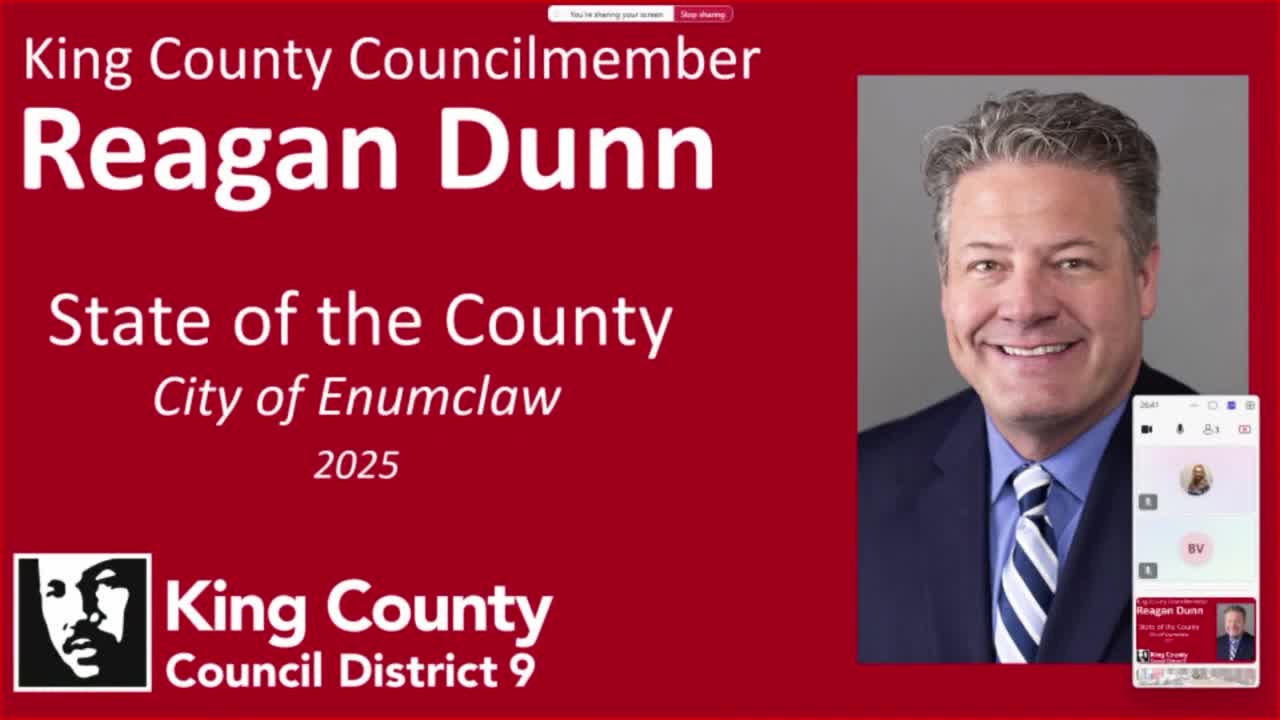
King County Council member Reagan Dunn updates Enumclaw on crime, homelessness and budget pressures
Summary
Reagan Dunn, King County Council vice chair for District 9, briefed the Enumclaw council on countywide trends including rising homelessness, juvenile crime, overdose deaths, court backlogs and a projected county budget shortfall driving proposed cuts to sheriff services.
King County Council member Reagan Dunn visited the Enumclaw City Council on April 14 to brief the council and community on issues affecting District 9, which includes Enumclaw, and on countywide policy topics.
Dunn, who serves as vice chair of the King County Council and chairs the King County Flood Control District, summarized recent actions and data. He said countywide homelessness rose from about 11,000 in 2019 to about 16,000 in 2024 and cited federal HUD data showing Washington among the worst states in chronic homelessness. He attributed part of the increase to addiction and mental-health drivers, saying “64 percent of homeless actively, report self report of actively being addicted to drugs or alcohol. 73 percent self report a serious mental health challenge.”
Dunn described shifts in crime trends: adult violent crime in 2024 showed signs of decreasing from a 2023 peak, but juvenile crime continued to rise sharply. He said juvenile violent felony filings rose 57% in 2023 compared with prior years and argued that closing the juvenile detention facility would be problematic. “I think it would be a catastrophic mistake in my my humble opinion to close the juvenile jail,” Dunn said, noting public polling and his motion that led council members to vote to keep the juvenile detention center open.
On substance use, Dunn said overdose deaths rose exponentially into early 2024, driven largely by fentanyl and polydrug use, and he described gaps in local treatment infrastructure compared with similarly sized counties. He listed county efforts including mobile crisis units, sobering centers and conferences on substance use disorders.
Dunn also outlined a roughly $150 million budget shortfall in the county proposal under review, pointing to proposed cuts that could include reductions to the sheriff’s office and court services. He called getting deputies back on the street a top priority and said he opposed some recent county taxes and fee proposals he viewed as excessive for the district.
Dunn closed by listing grant programs and district priorities—arts and historical grants, flood control funding and other discretionary pots—and encouraged local nonprofit and city staff to contact his office about funding opportunities. He said his office will continue to work on district-level issues and that he aims to visit the cities he represents each year.