Get Full Government Meeting Transcripts, Videos, & Alerts Forever!
Get email alerts on the Zoning topic
No spam. Unsubscribe anytime.
Planning staff proposes simpler Appendix B to clarify zoning uses
Summary
Planning staff presented a condensed version of the city—s zoning use table: reducing about 186 specific use listings to roughly 102 categorized uses with definitions, intended to improve clarity without broadly changing where uses are allowed.
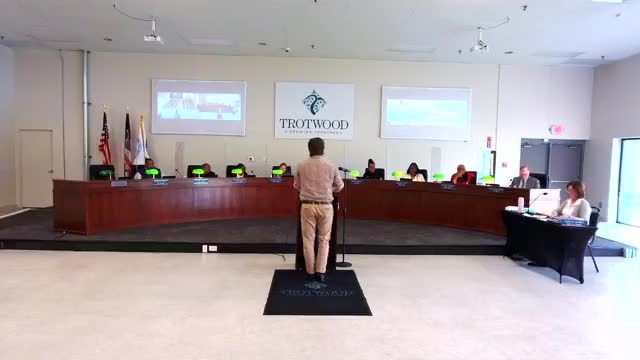
Planning staff presented proposed revisions to Trotwood—s zoning "Appendix B" at the special meeting, proposing to cut the number of listed uses from about 186 to 102, add clear definitions for every use, and group uses into broader categories such as residential, retail, agriculture/public and industrial.
Why it matters: Staff said the current appendix contains many overlapping, duplicated or hyper-specific use entries that make permitting decisions harder for staff, applicants and the public. The rewrite aims to make classification more consistent and to reduce administrative ambiguity when a business or developer applies for a permit.
Planning staff member Tyler (first name only in record) told council the proposed chart would not, in almost all cases, change the zoning districts where a use is permitted; rather, it would consolidate similar entries under common definitions and ensure every listed use has a definition. Tyler said the code would remain functionally equivalent in where uses are allowed, except for two noted exceptions: multifamily dwellings would be removed as a conditional use in Old Town Business, and "mini-warehouse/self-storage" would no longer be a permitted or conditional use in the industrial matrix as presented to council. Tyler and staff also said the city—s existing moratoria on cultivation and certain group-home topics remain separate and were not resolved in this package.
Council members asked use-specific questions during the presentation: how the new retail grouping would treat small electronics repair shops, whether self-storage would cover facilities such as the existing Target-area storage, and what a wastewater treatment or "waste disposal facility" designation would mean. Tyler answered that definitions would clarify those distinctions and that administrative decisions by the zoning administrator could be appealed to the planning commission if parties disagreed.
Staff said the proposal reduces the number of discrete use listings to make the code easier to read and to ensure each use has a definition; staff provided examples where nearly identical uses (for example, "personal electronics sales and service" versus "computer sales and service") created confusion in administration. Tyler—s presentation noted the planning commission reviewed the draft and removed one conditional allowance in Old Town Business for multifamily housing after public comments on the comprehensive plan.
Ending: Council members praised the clarity improvements and asked staff to move forward with next steps; staff said the condensed appendix would be part of a larger zoning rewrite later and that any substantive changes to where uses are allowed would be addressed in future code amendments.