Get Full Government Meeting Transcripts, Videos, & Alerts Forever!
Get email alerts on the Joint Rules topic
No spam. Unsubscribe anytime.
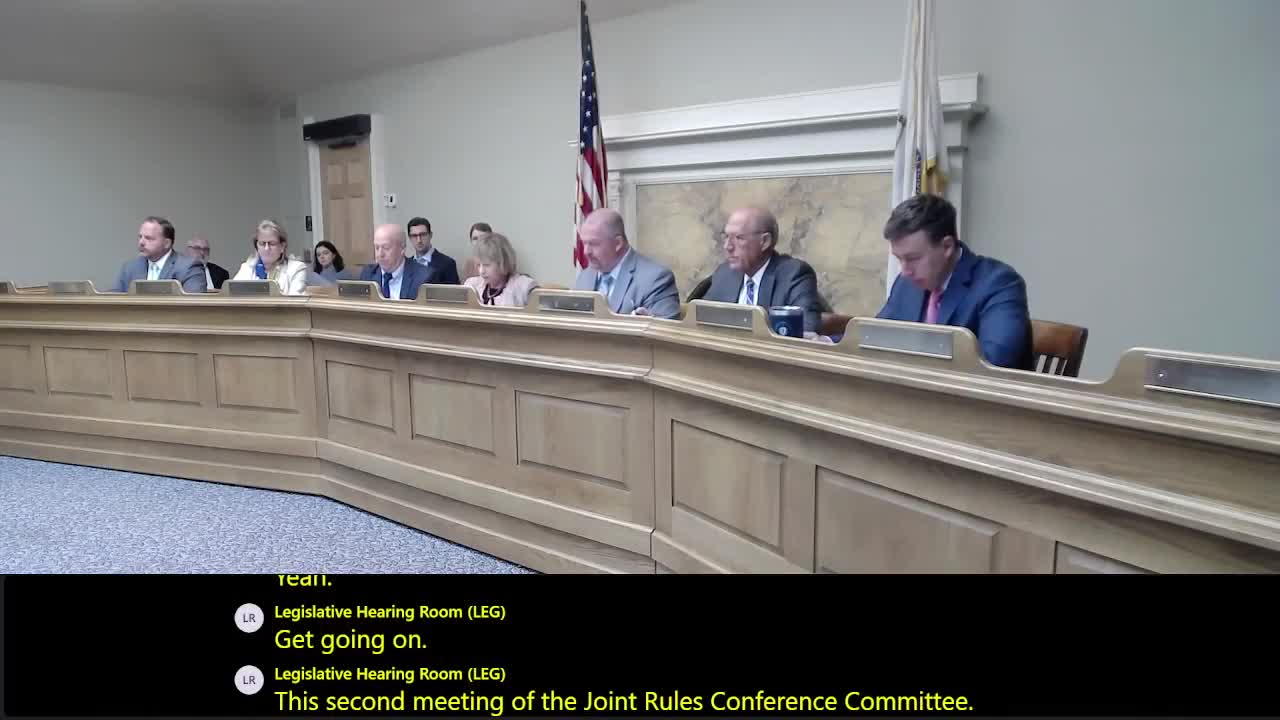
Mass. conference committee says it has narrowed 52-rule disputes to 24, tables several items for later
Summary
House and Senate conference committee on joint rules reported agreement on 24 of 52 disputed items, including committee name changes and some administrative procedures, while tabling others such as Mason’s Rules and several posting/notice provisions.
House Majority Leader Michael Moran, the lead on the conference committee, told a public meeting that the House and Senate began with 52 areas of disagreement on proposed joint rules and have reached agreement on 24 of them.
“You're gonna find out today that, in the first meeting, we agreed that there were 52 areas where the senate and house differed. You'll find out today that we agreed on, 24 of those,” Moran said, describing the items as grouped into seven categories such as committee reporting, deadlines and administrative functions.
The committee — chaired for the Senate by Senator Creem and for the House by Moran — reported agreement on several naming and administrative changes, including adding “fisheries” to the Committee on Agriculture and renaming “elder affairs” to “aging and independent” to better reflect the panel’s goals. “I'm pretty happy about adding fisheries because we would acknowledge the importance of the fishing industry to the state,” Senator Creem said.
The chairs said they also agreed to accept House language on several procedural points, including making committee reports electronically available to members and the public via the General Court website, and to remove certain subcommittee provisions so that subcommittees’ chairs and membership reflect the appointing branch’s proportional composition.
Several items were explicitly left unresolved or tabled for further negotiation. The committee tabled discussion of Mason’s Rules — a parliamentary procedure concern raised by the Senate because of the potential voting implications where the House would have greater membership on some committees — and agreed to revisit it later. The chairs also left open who should draft public-facing bill summaries (House staff or sponsors), how quickly committee votes and reports must be posted (the House sought 72 hours, the Senate sought five days, and a 48-hour window was discussed), remote attendance and testimony procedures, and shared human-resources language for joint temporary employees.
The committee said it reached compromise language on training that removes references to a handbook but left unresolved the shared-responsibility duties of human-resources officers for joint employees. On executive sessions the panel agreed that prior to entering an executive session the committee should state the purpose and take a public two-thirds vote to enter.
Committee members emphasized a push for greater transparency and faster movement of bills early in the session. One committee member said the periodic review in rule 35 — agreed to in principle — should include public hearings so stakeholders can participate. “I definitely appreciate that rule. I think having a much more open, transparent conversation that involves stakeholders as well is, paramount to the process,” the committee member said.
No formal roll-call votes on the rule package were recorded in the public portion of the meeting. At the end of the session, a motion to adjourn was moved and seconded; the transcript does not record a vote tally or formal outcome for that motion.
The committee said staff will continue to confer offline to resolve the remaining language issues and expected to meet again to finalize outstanding items.