Get Full Government Meeting Transcripts, Videos, & Alerts Forever!
Get email alerts on the Comprehensive Plan Update topic
No spam. Unsubscribe anytime.
Fife holds public hearing on 2024 comprehensive-plan update as residents press utility, rezoning concerns in Firwood
Summary
The Fife City Council held a public hearing April 15 on the city’s 2024 comprehensive-plan periodic update; staff presented required map and code changes and residents pressed for water, sewer and zoning clarity in the Firwood neighborhood.
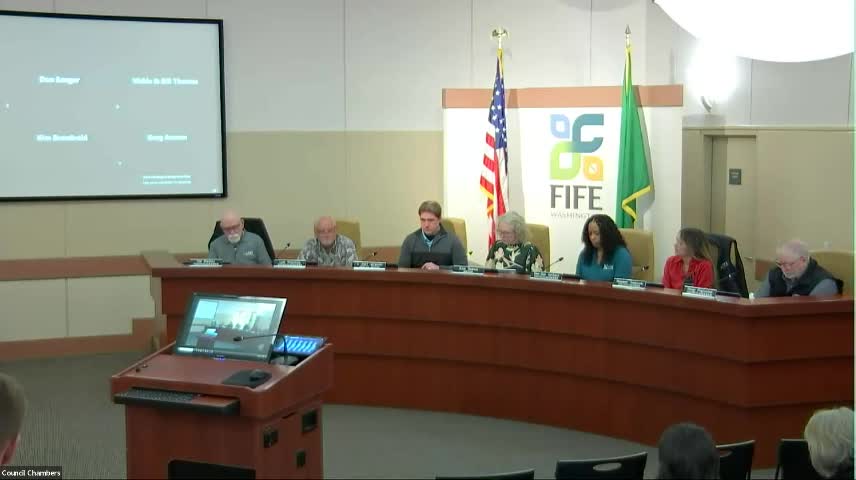
FIFE, Wash. — The Fife City Council held a public hearing April 15 on the city’s 2024 comprehensive plan periodic update, hearing a staff overview of outreach and proposed map and code changes and more than a dozen public comments focused on the Firwood neighborhood, utility access, and competing rezoning proposals.
City Planning Director Chris Larson told the council the update and related zoning-map changes are required by the Washington State Growth Management Act and to maintain consistency with regional policies including Vision 2050 and Pierce County countywide planning policies. "We are here to hold a public hearing on our 2024 periodic update," Larson said, summarizing two-plus years of engagement, planning commission review and state-agency comments.
The update package includes a new comprehensive plan, amendments to the Fife Municipal Code, changes to the city zoning map and a city center planned-action ordinance. Larson said the planning commission gave a unanimous recommendation on April 7 to forward the periodic update to council, and staff plan to return suggested revisions to respond to comments from state agencies and others at a May 20 study session. Ordinances are scheduled for first reading June 10 and adoption June 24; Larson noted that "a couple of regulations in here must be adopted by June 30 or the state's regulations will usurp our rules."
Why it matters: commenters said the study-area outcome could affect whether Firwood remains residential, the immediate safety and habitability of homes that lack reliable potable water and sewer, and how industrial expansion near freight routes will change daily life.
Public testimony was heavily concentrated on Firwood, a long-discussed area adjacent to industrial corridors. Residents described failing septic systems and poor drinking water, and several speakers urged the council to prioritize bringing permanent water and sewer to the neighborhood. "Bottled water isn't the solution. You can't shower with it, nor can you bathe with it," resident Stephanie Lynch told the council.
Developers and landowners presented competing land-use proposals. Quinn Clawson, director of real estate development for the Pape Group, described the Pape application to rezone a portion of land from community commercial to light industrial, saying the change would allow larger buildings and uses more consistent with adjacent industrial parcels and could support utility extensions and site improvements. "Our zone change application is from community commercial to industrial," Clawson said.
Vector Development Company representatives proposed a mixed approach that would combine light industrial and housing on the East Side of Freeman Road. Tyler Litzenberger of Vector said extending water and sewer is technically feasible but difficult because the site sits "at the end of the line" for both Fife and Puyallup utilities. "It just happens to be at the end of the line," Litzenberger said; he added that Vector is working with both cities and Pierce County on interconnections and on a process to address sewer-basin issues.
Council members and staff clarified technical details raised during testimony. Larson noted rules on nonconforming uses (commonly called "grandfathering") allow existing uses to continue until a property is abandoned for 12 months or changes use or owner in ways specified by code, and said medium-density residential zoning allows up to 10 dwelling units per acre (meaning a sixplex would need roughly 0.6 acre under the density formula). He also said the city has identified the potential to meet emergency housing capacity on paper but needs to document that analysis for the comprehensive-plan record.
State and regional agencies supplied written comments. Pierce Transit suggested strengthening transit-oriented development policies and removing physical barriers to transit; the Washington State Department of Transportation offered no changes but commended the city's efforts. The Washington Department of Fish and Wildlife flagged questions about best available science for buffer widths along watercourses (Wapato Creek, and potentially Fife Ditch and Bridal Ditch), and the Department of Commerce suggested staff document emergency housing capacity. The Port of Tacoma and Northwest Seaport Alliance sent a letter supporting industrial rezones and transportation projects that move freight to and from port facilities.
On utilities and remediation, Larson and staff described ongoing coordination with Tacoma-Pierce County Health Department. Staff said volunteer household well testing was scheduled for the 16th and 17th of the month with results expected in mid-May, and they identified a potential state funding source: a $10 million Connecting Housing to Infrastructure Program (CHIP) in the state budget that could help pay for water-line installation or waiving residential connection fees.
Council discussion and next steps: Deputy Mayor Murphy and others asked staff for clearer, side-by-side figures comparing current housing, Vector’s proposed units, and theoretical maximum units under alternate residential rezones; Larson agreed to present that comparison and additional technical data at the May 20 study session. Staff also agreed to return with parcel-level information about Puyallup Tribe property ownership in Firwood, whether parcels are in trust, and the 1988 land-claim settlement threshold (Larson said the 17% figure applies to acreage inside the city boundary at the time of the 1988 settlement).
The council closed the public hearing at 7:25 p.m.; council rules and staff advised no formal vote would be taken at the hearing, with first readings of the ordinances scheduled for June 10 and final action possible June 24.
What remains unresolved: the timing and routing of water and sewer extensions (staff and developers said some options remain under review and approvals from Pierce County and the City of Puyallup are still needed), the final zoning outcome for specific Firwood parcels, and any grant funding decisions required to engineer and build utility connections. Planning commission materials, state-agency letters and supplemental staff attachments were in the city packet and will be updated for the May study session.
The council intends to deliberate the periodic update at its May 20 study session and then consider ordinances in June; staff and council emphasized that the May meeting is for deliberation and that public comment opportunities will be available again once the ordinances reach the council docket for first and second readings.