Get Full Government Meeting Transcripts, Videos, & Alerts Forever!
Get email alerts on the Housing Production topic
No spam. Unsubscribe anytime.
State officials say Affordable Homes Act underway but far short of 222,000‑unit goal
Summary
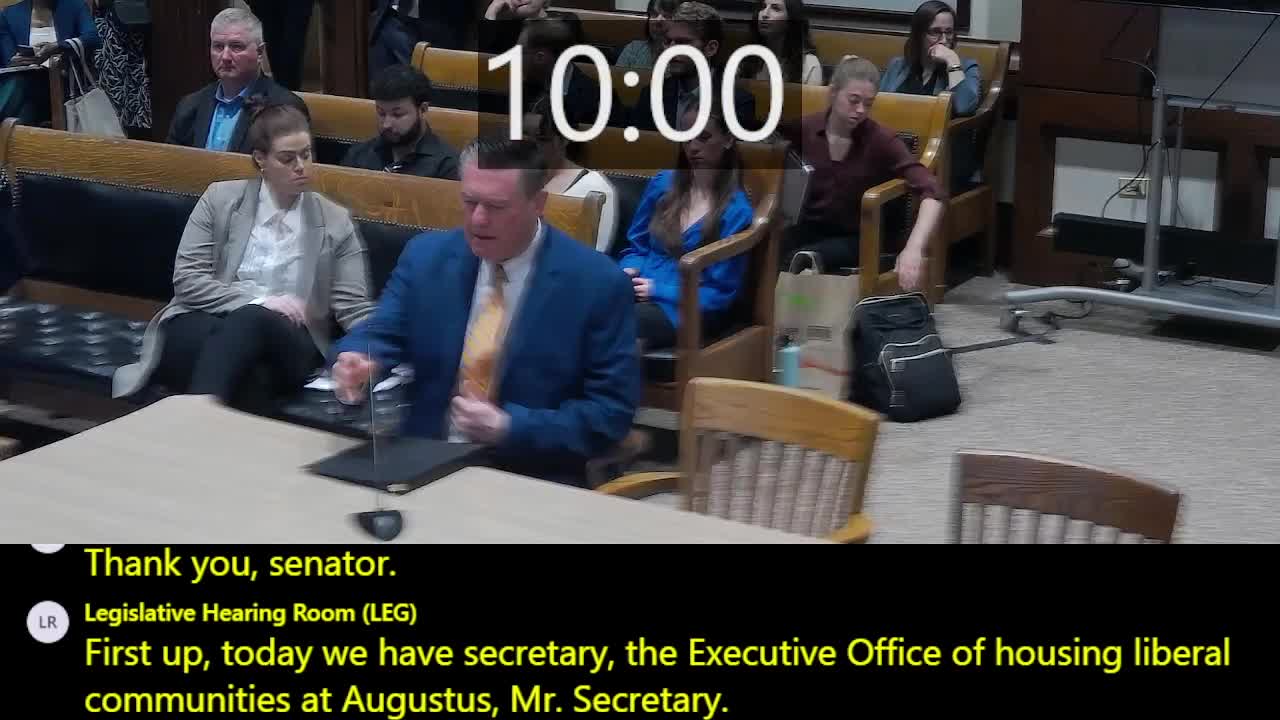
The secretary of the Executive Office of Housing and Livable Communities told the Joint Committee on Housing the Administration has begun distributing capital from the Affordable Homes Act and implementing policy changes such as ADUs by right and a Fair Housing Office, but the state still needs hundreds of thousands of homes to meet demand.
The Joint Committee on Housing heard Thursday that implementation of the Affordable Homes Act is underway but will not by itself reach the state’s housing-production target.
“ If there is any takeaway from the housing plan, it is that the state needs 222,000 new units over the next 10 years,” said the Secretary of the Executive Office of Housing and Livable Communities, summarizing the administration’s 10‑year production goal and the executive office’s planning work.
That 222,000 figure comes from the administration’s first comprehensive housing plan, which the secretary told the committee identifies an undersupply problem that includes a statewide vacancy rate of 1.6 percent and a projection that Massachusetts needs at least 73,000 new units over the next decade to absorb households formed by younger generations. The secretary testified the administration estimated the Affordable Homes Act would “create or preserve about 65,000 units of housing,” but cautioned that rising construction costs and market uncertainty have reduced that projection.
Committee members heard specific implementation items the administration has already moved to put in place: statewide allowance of accessory dwelling units (ADUs) by right; a newly created Fair Housing Office and the hiring of a fair housing director; capital awards and funds from the Affordable Homes Act including an administration announcement of roughly $158 million in awards to produce more than 1,100 affordable units and a Momentum Fund equity investment that recently injected $5 million to convert an underused commercial property into 92 mixed‑income rental units. The secretary said $157 million in capital improvements to public housing was budgeted for FY25, a 29% increase from FY24, and that 28 of the law’s roughly 50 policy initiatives have been fully implemented.
Committee members pressed the administration on near‑term production numbers and tools to accelerate building. The secretary said the administration originally projected 65,000 units from the law but that tariff‑driven cost increases and tighter equity markets mean “that number probably needs to be adjusted,” suggesting a reduced best‑case outcome of roughly 50,000 units over the coming decade unless other changes speed production.
On ADUs, the secretary said the administration is convening lenders and working with the Massachusetts Housing Partnership to make financing and model designs easier for homeowners, and is preparing technical assistance and model zoning bylaws to help municipalities adopt compliant local rules. The secretary described ADUs as a low‑cost production tool, estimating wide adoption “can create up to 10,000 new units over the next 5 years at no cost to the Commonwealth.”
Lawmakers and panelists also raised federal funding uncertainty. The secretary said the administration is watching potential federal cuts that could affect HUD programs the state leverages for housing, including concerns over reductions in block grant funding and staffing, and that the state is tracking realized federal cuts already reported to the governor.
The hearing included repeated calls from committee members and witnesses for additional policy changes at the state and local level—zoning, permitting reform, infrastructure funding—and for sustained capital and operating funding beyond what the Affordable Homes Act authorizes.
The committee did not take votes at the hearing; the session consisted of informational testimony and questions from members.