Get Full Government Meeting Transcripts, Videos, & Alerts Forever!
Get email alerts on the School Bus Safety topic
No spam. Unsubscribe anytime.
Committee hears testimony on bill clarifying amber bus lights and enforcement challenges
Summary
Lawmakers heard testimony on House Bill 4214 to define how motorists should respond to school bus amber warning lights and discussed enforcement difficulties, camera usage, and equipment limitations.
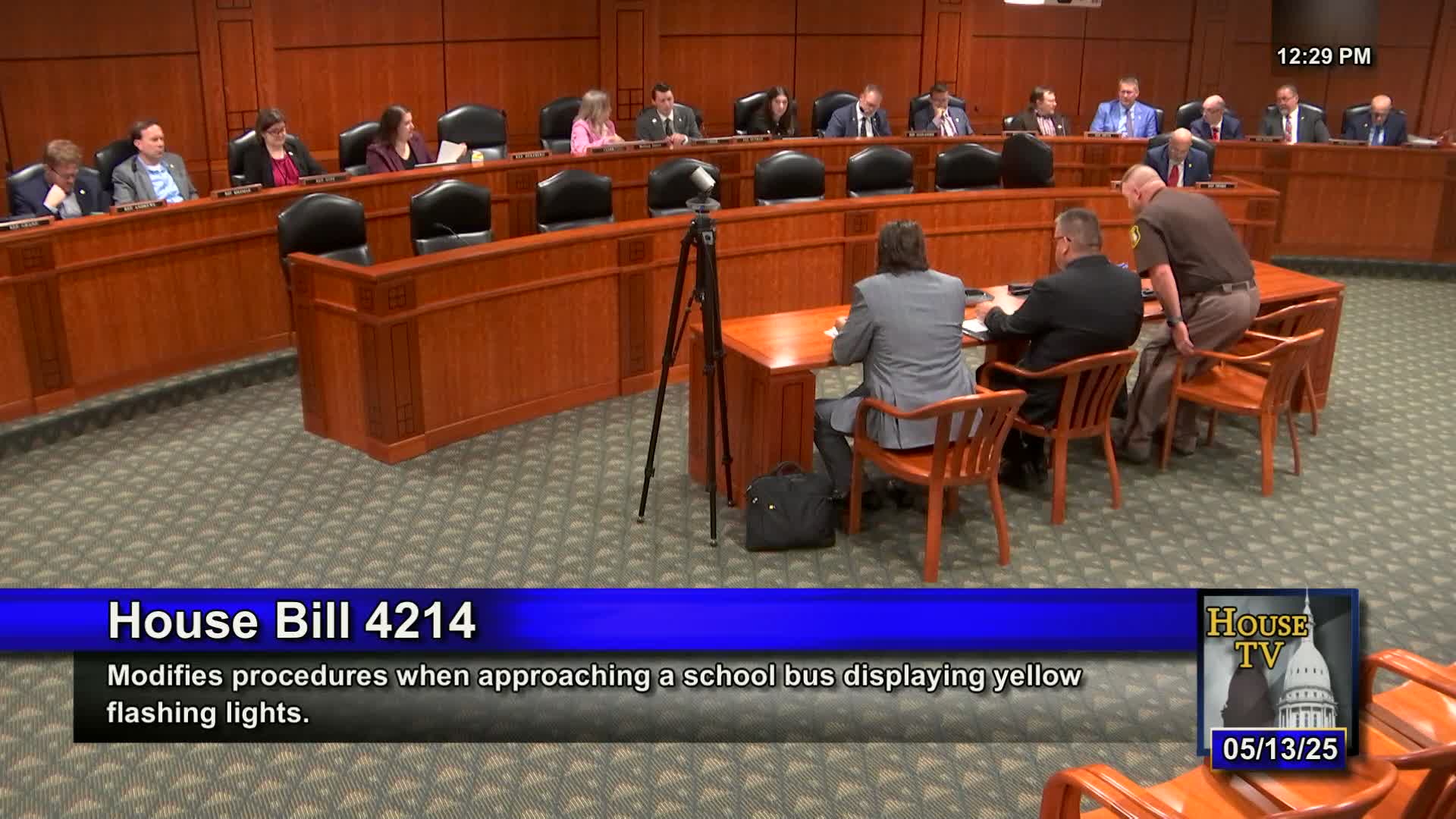
Representative Pau Cat introduced House Bill 4214 and called two witnesses from Berrien County to describe stop-arm violations and the risks posed by unclear legal treatment of amber bus lights.
John Lehi, who said he has worked in the school bus industry since 1996 and became a director in 2009, told the committee a one-day survey in May 2024 of about 2,000 bus drivers reported roughly 1,300 illegal passes in a single day, including 46 on the right side of buses. Lehi recounted a 2014 incident in which a child was struck near a bus as amber lights changed to red; after reviewing footage, he said law enforcement concluded the child’s movement occurred before the red lights were active.
Lehi said current Michigan law references amber warning lights only in the context that bus drivers must activate amber lights at least 200 feet in advance of a stop (Public Act 187). “Currently slowing down for these amber lights is only a suggestion and this is dangerous,” Lehi said, and he expressed support for House Bill 4214 to clarify motorist obligations.
Deputy Nathan of the Berrien County Sheriff’s Office, traffic unit, told the committee that enforcement is time-consuming and that the prosecutor’s office requires identifying and contacting the driver, confirming who was driving, and obtaining prosecutor sign-off before issuing a citation — a process he estimated can take about three hours per incident. He said two districts in the county, Berrien Springs and Buchanan, have cameras on some buses and that those cameras have improved the ability to identify vehicles in some cases.
Members asked technical and policy questions. Representative Brock asked when amber lights switch to red; John Lehi described a 17-step procedure that includes checking mirrors, shifting to neutral and opening the door — Lehi said the switch to red occurs when the door is opened. Representative Cara asked whether buses can be equipped so red lights activate earlier via a door-switch modification; witnesses said the capability exists in other states but that retrofitting buses would cost money because it requires a different door switch.
No committee vote or formal action on House Bill 4214 was recorded in the hearing transcript; the record shows testimony and committee questions.