Get Full Government Meeting Transcripts, Videos, & Alerts Forever!
Get email alerts on the Emergency Response Vehicles topic
No spam. Unsubscribe anytime.
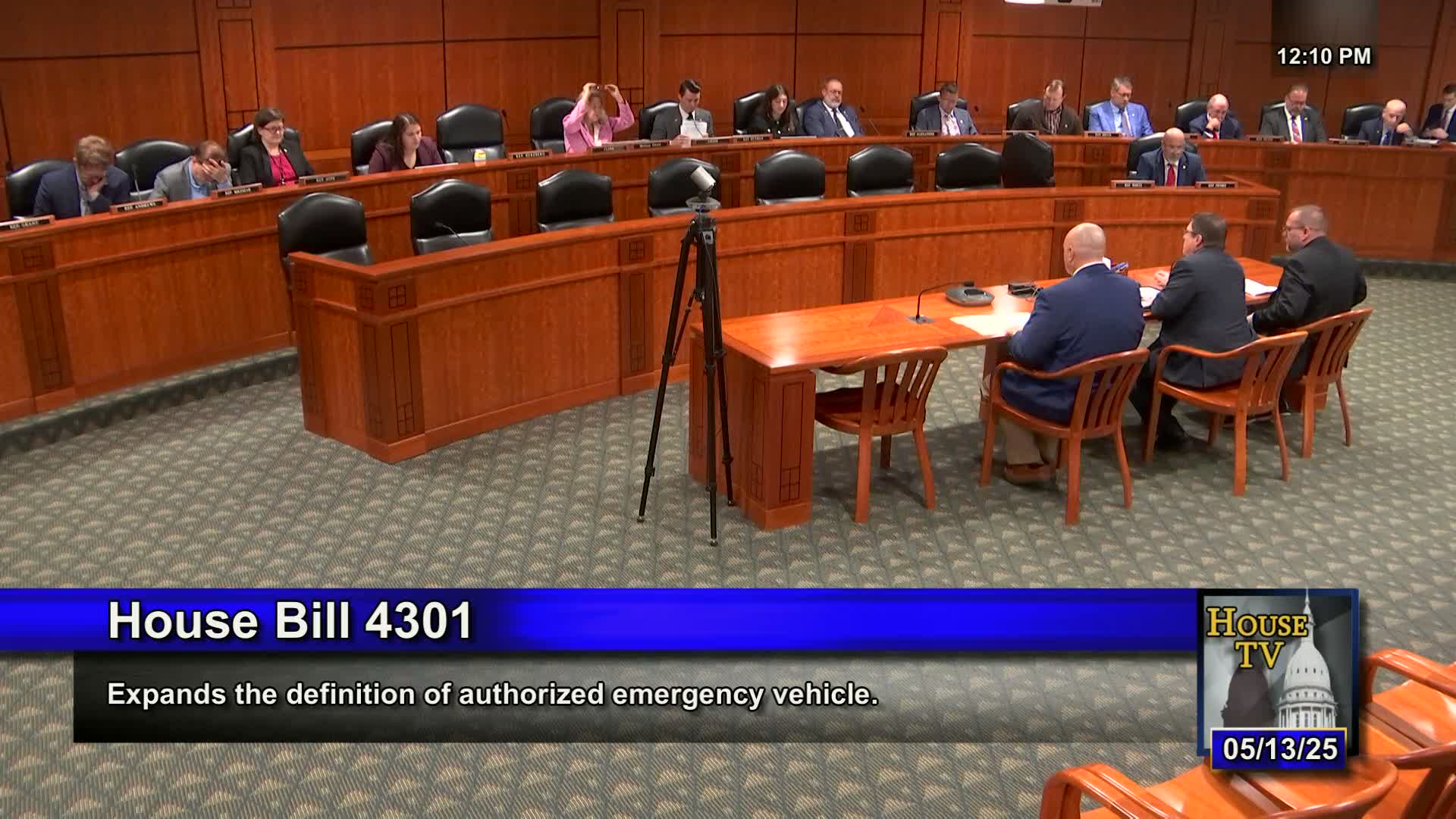
Committee hears testimony on bills to classify MABIS vehicles as emergency vehicles and align driver training
Summary
Lawmakers heard bipartisan testimony on House Bills 4301 and 4302 to change Michigan law so vehicles operating under the Michigan Mutual Aid Box Alarm System (MABIS) can display emergency lights and allow certain drivers to operate without a commercial driver’s license if they meet Firefighters Training Council standards.
Representative Begole introduced bipartisan House Bills 4301 and 4302 to the House Transportation and Infrastructure Committee, saying the measures would update the Michigan Motor Vehicle Code to support the Michigan Mutual Aid Box Alarm System, commonly called MABIS, and Michigan Task Force 1.
The bills would allow MABIS vehicles to use “red, white, yellow, and green oscillating lights while responding to or operating at emergencies,” and would permit members to operate emergency vehicles without a commercial driver’s license if they meet the driving standards under the Firefighters Training Council Act, Begole said.
Trent Adkins, former executive director of MABIS and Shiawassee County emergency management coordinator, told the committee MABIS is an opt-in mutual aid agreement that, he said, has been signed by “about 800 out of the 1,135” Michigan fire departments and that Michigan Task Force 1 is the state’s only Type 3 urban search-and-rescue team. “They cannot put emergency lights on it because by definition under the motor vehicle code, they're not considered an emergency vehicle, though they respond to emergencies,” Adkins said, arguing the current language leaves responders and the public less safe.
Adkins described Michigan Task Force 1 as a large, highly equipped team with “well over $10,000,000 worth of equipment” and the capacity to be self-sustaining in the field. He said inconsistent classification complicates vehicle registration and insurance and forces some drivers to obtain CDLs despite meeting the Firefighters Training Council’s emergency-vehicle standards.
Representative Koontz asked how the Firefighters Training Council training differs from Federal Motor Carrier Safety Administration CDL training and whether firefighter training programs could be accredited to confer CDL qualifications. Adkins said the council’s training is “very specific to emergency vehicles” and that some programs are accredited through the Firefighters Training Council, but he did not know the accreditation status of any specific program.
Representative Brock questioned whether adding multi-color lighting could cause confusion with other emergency or work vehicles. Adkins said Task Force 1 vehicles would likely be equipped with red and white lights typically used by fire-rescue equipment, and that MABIS and Task Force 1 already coordinate on radio channels within the State 800 system and have seats in the state emergency operations plan.
No vote or formal committee action on House Bills 4301 or 4302 was recorded in the hearing transcript; testimony was received and the committee moved on after questions.
Committee members asked several operational questions about training, accreditation, communications, and standard operating procedures for light use; Adkins said policies and procedures for light use are common in the fire service and would likely be adopted by Task Force 1 and MABIS.
The hearing record contains testimony and questions but no recorded motion or vote on the measures.