Get Full Government Meeting Transcripts, Videos, & Alerts Forever!
Get email alerts on the School Hunter Safety topic
No spam. Unsubscribe anytime.
Committee Hears Broad Support for Bill Letting Michigan Schools Offer Hunter-Safety Classes
Summary
House Bill 4,285, sponsored by Representative Vanderwall, would allow schools to offer hunter-safety instruction for credit or as extracurricular programming; testimony emphasized safety training, voluntary adoption, DNR coordination and economic ties to hunting.
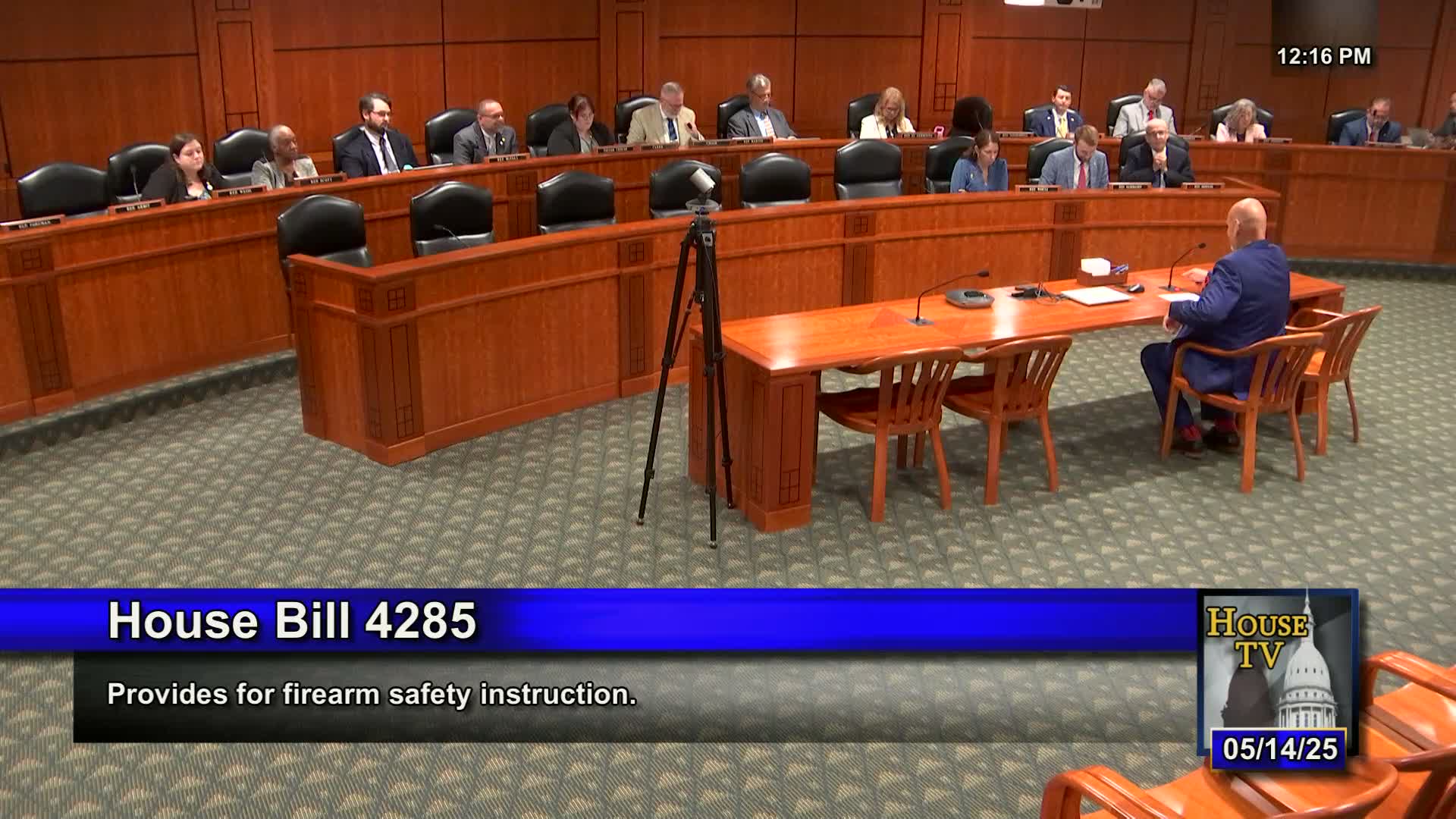
The House Committee on Natural Resources and Tourism heard testimony on House Bill 4,285, which would allow Michigan schools to offer hunter-safety instruction as an extracurricular program or as part of existing physical-education courses, sponsor Representative Vanderwall said.
Supporters from conservation and hunting groups told the committee the program would expand access to safety education, introduce more young people to hunting and support conservation funding. "Michigan United Conservation Clubs, our 40,000 members and 200 member clubs, want to speak today in support of House Bill 4,285," said Justin Tomei. He and other witnesses linked hunting participation to conservation funding and local economies.
Representative Vanderwall said the course would be optional for districts and parents could opt students out. "The course is created by this bill will only involve in class portion of the hunter safety. The firearms will not be allowed on school property," Vanderwall said, adding that the in-person field portion required for licensing is typically handled off-site by licensed instructors and sportsmen''s clubs.
Testimony addressed program details and concerns. Witnesses said curriculum materials are available through the Department of Natural Resources and that the DNR supports the concept while asking that statutory language align with existing DNR training rules. Committee members asked about cost, liability and age limits; supporters said the classroom instruction adds little to no cost because materials and space are already available, outside instructors handle live-fire field components, and DNR minimum training standards would guide curriculum. Testifiers and the sponsor stated the classroom component would generally be for students aged 10 and older; students younger than 10 would need parental accompaniment for field work.
Multiple organizations offered support, including the Michigan United Conservation Clubs, the Congressional Sportsman's Foundation, the NRA Institute for Legislative Action and the Michigan Coalition for Responsible Gun Owners. Several witnesses cited an economic case for hunting education: "Hunting, trapping, and angling in the state of Michigan is $11,200,000,000 economic impact," Justin Tomei said, citing a 2019 study.
No committee vote was taken during the hearing. Committee members and staff indicated they would continue work with the Department of Natural Resources and the Department of Education on language and potential amendments before any vote.
Why it matters: supporters framed the bill as an optional, safety-focused way to expand youth access to outdoor recreation and to sustain conservation funding streams; questions from lawmakers centered on curriculum scope, parental choice, liability and alignment with DNR rules.