Get Full Government Meeting Transcripts, Videos, & Alerts Forever!
Get email alerts on the Transportation System Plan topic
No spam. Unsubscribe anytime.
Vancouver moves forward on 'complete corridors,' Vision Zero and Safe Routes to Schools
Summary
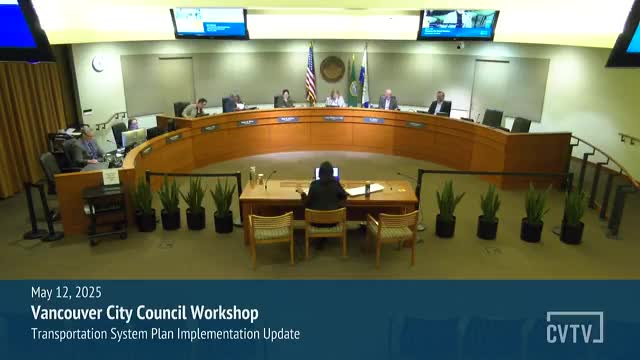
City staff presented a May 12 update on near-term implementation actions from the Transportation System Plan adopted last year, reporting progress on complete corridors, multimodal level-of-service standards, Vision Zero safety work, a Safe Routes to Schools pilot and an electric-vehicle strategy.
City staff presented a May 12 update on near-term implementation actions from the Transportation System Plan adopted last year, reporting progress on complete corridors, multimodal level-of-service standards, Vision Zero safety work, a Safe Routes to Schools pilot and an electric-vehicle strategy.
Kate Drennen, a staff member, said the city’s complete corridors program focuses on building accessible, low-stress multimodal streets on key corridors and listed about 17 projects that span planning, design and construction phases. Staff are also proposing new multimodal “level of service” metrics for pedestrians, bikes and small mobility devices tied to network quality; those standards will support updates to the city’s traffic impact fee program.
“Defining this level of service for these modes is also going to help us in our work to update our traffic impact fee program,” Drennen said, noting the city will contract professional services for that work in June. The staff presentation said National Association of City Transportation Officials (NACTO) standards will be used as reference points for bicycle and small mobility facilities on the primary network.
On safety, staff summarized the city’s local road safety plan, which analyzes five years of crash data to target intersections and roadway segments with the highest crash rates and to recommend countermeasures. Staff said they are designing projects funded by the federal Safe Streets and Roads for All program and pursuing additional regional safety funding. The presentation also noted city efforts to lower posted speeds as part of roadway improvements.
Transportation staff described a new municipal Safe Routes to Schools program that has begun coordinating with school districts, bike educators and partners; the city staged walk-and-bike-to-school events at two elementary schools that drew more than 100 participants at each location. Staff are preparing an action plan that will prioritize projects and schools for near-term investment.
Climate and equity work highlighted an EV-infrastructure strategy to expand publicly accessible chargers, a bike-parking program to place more racks at high-demand sites, the Get There Vancouver residential travel-options pilot and an update to the city’s commute-trip reduction plan. Staff said a cross-department ADA transition plan is underway (estimated completion end of 2026) and that a policy on public on-street ADA parking is being developed.
Council members asked about maintenance (repainting crosswalks), EV-charging options for smaller mobility devices, neighborhood-level charging pilots and how multimodal level-of-service metrics will be tied to traffic impact fees and project eligibility. Staff said they will provide additional details and follow-up information on maintenance procedures and pilot programs.