Get Full Government Meeting Transcripts, Videos, & Alerts Forever!
Get email alerts on the Comprehensive Plan topic
No spam. Unsubscribe anytime.
Vancouver staff pitch 'community feel,' equity goals as part of comprehensive-plan update
Summary
City staff briefed the Vancouver City Council on May 12 on draft comprehensive-plan goals that center “community feel” alongside equity and inclusion, outlining policy approaches that staff say will guide the city’s decisions and investments over the coming decades.
City staff briefed the Vancouver City Council on May 12 on draft comprehensive-plan goals that center “community feel” alongside equity and inclusion, outlining policy approaches that staff say will guide the city’s decisions and investments over the coming decades.
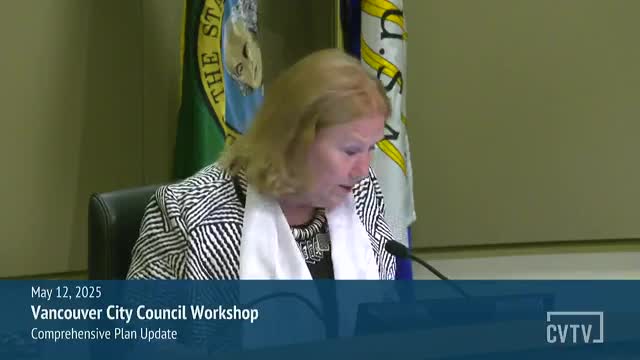
At a council workshop, Dominique Martinelli, a staff member, told council that the package groups policies under four themes — social infrastructure, inclusive and affirming environments, community preparedness and innovation — and that the community-driven “community feel” concept aims to address how public spaces and the built environment support belonging. “It’s how do you feel when you walk out your front door,” Martinelli said.
The presentation explained why the city added a distinct “community feel” chapter rather than subsuming the ideas under equity. Martinelli told council the intent is to foreground built-environment outcomes that are visible in public spaces, while equity and inclusion focus on how government acts and serves residents. The draft also includes policies on universal design, multilingual and culturally competent outreach, trauma-informed approaches, and the ethical use of technology.
Staff described specific policy touchpoints. The draft’s CF3 policy includes language embedding the concept of resiliency hubs — neighborhood locations intended to support residents during natural or man-made disasters. Martinelli said Department of Commerce funding for climate-vulnerability work has supported neighborhood conversations and informal networks tied to preparedness, and that partners such as CRESA are part of those efforts. The draft also proposes policy 109 to emphasize inclusive engagement, and staff said the city is already using an “equity index” to guide investment priorities.
Rebecca Kennedy of the Community Development Department noted community requests for more gathering places, artist hubs and culturally reflective public art, and said the draft emphasizes using data to target investments rather than only aspirational language. Council members asked staff to clarify language that relies on jargon (several suggested replacing or defining “accessible” and “community feel” for different audiences) and to provide more visual and descriptive examples in the chapter introductions so readers understand how the policies would look in practice.
Councilors also pressed staff on sequencing and implementation details. Staff said actions and metrics tied to the policy framework will be returned in future workshops and noted the environmental-impact document (DEIS) tied to the plan is delayed; staff said the DEIS is now expected in early July and a public-comment draft of the full plan, preferred alternatives and code updates would be released for review in the fall. The presentation emphasized the plan is aspirational and will be implemented over time through council budget priorities and capital programming.
What happens next: staff will continue drafting chapter introductions and action items, bring back implementation-level actions and metrics in future workshops, and release the DEIS and a public-comment draft later this year.