Get Full Government Meeting Transcripts, Videos, & Alerts Forever!
Get email alerts on the Gun Safety topic
No spam. Unsubscribe anytime.
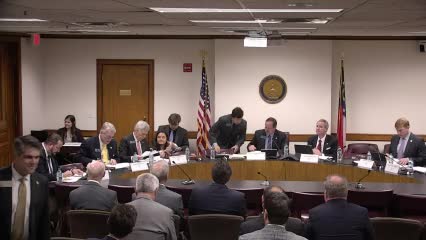
Finance Committee advances HB 79 Safe Storage Act with changes to tax incentives and record rules
Summary
Representative Newton told members the substitute to House Bill 79 keeps a $300 tax credit for firearms safe-handling instruction but removes a storage-related $300 credit, shortens a sales-tax holiday to four days and eliminates the measure's one-time-only restriction on the training credit after the committee adopted an amendment.
Representative Newton, the bill sponsor, told the Finance Committee that House Bill 79, the Safe Storage Act, would keep a $300 tax credit for a firearms safe-handling instruction course while removing a separate $300 tax credit tied to storage purchases in the original draft. "So HP 79, has been known as the Safe Storage Act," Newton said, describing the substitute (LC51238S) before the committee.
The substitute also includes a sales-tax holiday for ammunition, gun safes and related accessories that was shortened from 11 days to four as part of a compromise, and preserves a sunset already adopted by the committee. The substitute removes the storage-component tax credit but retains the training-course credit, Newton said.
Committee members debated whether the $300 training credit should remain a one-time lifetime credit or be available more than once. A motion was offered to strike the bill language that limited the credit to a single lifetime use (lines 47–50 and 55–56 of the substitute). Committee members raised administration and fraud-prevention questions for the Department of Revenue (DOR). Austin Gibbons, chief of staff at DOR, said preapproval and tax-administration steps mean "we do have to know who you are in order for you to receive a tax credit... There's still a list," explaining the agency's need to track preapprovals for cap compliance.
Supporters of removing the one‑time restriction argued striking that language would eliminate the statutory basis for DOR to maintain a persistent registry of prior claimants while still allowing verification against the program cap and receipts. Opponents said the change could let taxpayers claim the credit repeatedly in successive years; DOR staff replied audit tools and receipt dates would be available to detect improper multiple claims.
The committee adopted the amendment to strike the lifetime restriction; committee leadership recorded that the amendment passed with three members opposed. Senator Estavez registered vocal opposition to the bill's sales-tax holiday, saying it undercuts the bill's intent to promote responsible gun ownership. The committee then passed the substitute as amended; committee leadership reported two members opposed on the final vote.
No numerical vote-by-name roll call was recorded in the transcript. The committee's approving action advances the substitute to the next step in the legislative process.
The committee discussion focused on program design (which credits remain), tax-administration mechanics at DOR (preapproval and receipts), and policy tradeoffs of a sales-tax holiday tied to a gun-safety measure. The substitute retains the $300 training-course credit, removes the storage purchase credit, shortens the sales-tax holiday to four days and removes the single-lifetime-use restriction from the training credit language.
The committee did not specify an effective date in the floor discussion excerpted in the transcript; several references were made to line numbers and to the substitute's internal sunset provision but no exact calendar dates were stated.