Get Full Government Meeting Transcripts, Videos, & Alerts Forever!
Get email alerts on the Local Taxation topic
No spam. Unsubscribe anytime.
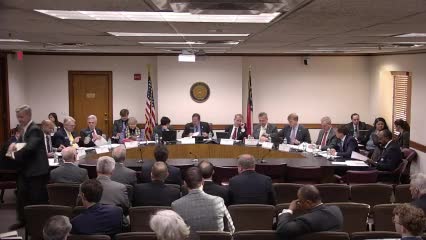
Committee approves alternative host tax language for Cherokee-area counties, includes 10-year sunset and capital-share provisions
Summary
The Finance committee approved substitute language to House Bill 66 to permit an alternative host tax in specified counties, pairing a homestead-exemption ballot question with a sales tax to pay for it and capping capital use at 25 percent, with a 10-year sunset.
The Finance committee approved substitute language to House Bill 66 that would create an alternative host (local option) tax available to counties without an existing local-option sales tax, identified in committee discussion as Cherokee, Cobb and Gwinnett counties. Sponsors said the substitute would allow up to 25% of the collections generated under the local sales tax to be used for capital projects; those capital funds would be distributed to municipalities within a county in the same proportion used for SPLOST distributions.
Under the substitute described in committee, voter approval would be required for two linked ballot questions: the alternative homestead exemption and the sales-and-use tax to pay for it. Sponsors said both parts must pass for either to take effect; if one fails, neither is implemented. Committee members emphasized that the substitute includes a 10-year sunset and that renewal would require another vote of the people, not automatic continuation.
Senator Albers and members of the Cherokee delegation presented details to the committee, saying the mechanism is intended to provide homeowner property-tax relief while allowing counties to retain a portion of revenue for transportation and capital needs. “This is a chance for them to help out the homeowners … while those who are visiting Cherokee County in a fair sales tax model will help to shoulder that burden,” Senator Albers said, describing local support from county commissioners.
Committee discussion included technical questions about distribution timing if local LOST negotiations break down, how new municipalities are handled under the substitute, and a provision carried from the existing host law capping motor-fuel sales-tax collection when retail prices exceed a threshold (used elsewhere in state code). ACCG representative Dante said the substitute deliberately scaled back some of the original host bill’s complexity, retaining basic provisions for new-city handling while streamlining procedures.
An amendment offered in committee would insert the original House Bill 66 language into the substitute (AM500110 as described), and members seconded and approved that amendment by voice/show of hands. The committee then voted to report the bill as amended; the chair announced the vote was unanimous.
Clarifying items noted in committee debate included the 75/25 or 75% portion referenced for eliminating county M&O (maintenance & operations) tax in local discussion (committee used a 75%/25% capital split in local illustrations), the 25% cap on capital use stated in the substitute, the requirement that both the homestead exemption and the sales tax appear on the same ballot question, and the 10-year sunset requiring another voter referendum to continue the program. Committee members said if negotiations for LOST distribution break down, the county would need a local act from the delegation to place the alternative host on the ballot; in practice, that creates timing lags and transition issues.
The committee chair closed the docket by noting the finance panel had passed nearly three dozen bills at the meeting (the chair and another member differed on an exact count of 29 versus 31).