Get Full Government Meeting Transcripts, Videos, & Alerts Forever!
Get email alerts on the Firearms Safety topic
No spam. Unsubscribe anytime.
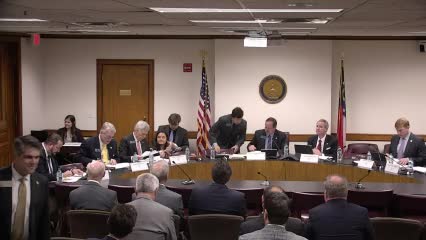
Finance committee advances Safe Storage Act; $300 training credit retained, sales-tax holiday shortened
Summary
The Finance committee advanced a substitute to House Bill 79, the Safe Storage Act, retaining a $300 tax credit for firearms-safety instruction while removing a storage-related $300 credit and shortening an ammunition-and-accessory sales-tax holiday to four days.
The Finance committee on an unspecified date advanced a substitute to House Bill 79, known in the meeting as the Safe Storage Act, keeping a $300 tax credit for firearms-safe-handling instruction while removing a separate $300 tax credit tied to storage purchases and shortening an ammunition-and-safety-accessory sales-tax holiday from 11 days to four days.
The bill’s sponsor and supporters said the substitute is a compromise that promotes firearm safety and provides limited tax relief to purchasers. Representative Newton, who presented the bill, thanked committee members and sponsors for negotiations that removed the storage-credit portion and retained the $300 credit for instruction courses.
The substitute retains a sunset provision carried from earlier committee action. Committee members also debated whether to create a separate, 30-day sales-tax exemption just for gun safes; supporters said that option would eliminate a purchaser record for that item, but the committee did not adopt a separate 30-day exemption.
A floor amendment offered by a committee member struck lines identified in the draft as 47–50 and 55–56, removing language that had limited the credit to a single lifetime use and that had created administrative-record concerns. The amendment’s proponent argued striking those lines would eliminate the need for the Department of Revenue (DOR) to keep a list of prior claimants; Austin Gibbons, chief of staff at the Department of Revenue, told the committee that preapproval and tax-administration records would still be required to enforce the bill’s overall $10,000,000 cap and to administer preapproval, but that removing the lifetime restriction would reduce the need for a persistent, public registry.
“...you would still have to apply for preapproval for the credit,” Austin Gibbons said, explaining DOR’s view of how preapproval and receipts would be used for tax administration. Gibbons added that applicants receive a preapproval letter and that DOR must track issuance to remain under the statutory cap.
Senator Estevez registered formal opposition to adding a sales-tax holiday for firearms purchases, saying it undercut the bill’s intent to promote responsible ownership. “It’s unfortunate that we are taking a what was a perfectly fine bill that promoted responsible gun ownership ... and ... added a tax holiday for the purchase of guns,” Estevez said.
The committee voted on the amendment first and then on the substitute as amended. Votes were taken by show of hands; the amendment carried with several opposed and the final passage of the substitute carried with opposition noted by the chair. The committee chair stated the bill would be reported out as amended.
Clarifying details discussed in the committee record included the removal of a separate storage tax credit, retention of a $300 tax credit for firearms safety instruction, the reduction of an ammunition-and-accessories sales-tax holiday to four days from 11, an option discussed (but not adopted) for a 30-day exemption specific to gun safes, a statutory cap on credits discussed as $10,000,000, and DOR’s requirement for preapproval and receipts for tax-administration purposes.
The committee proceeded to other agenda items after handling HB 79.