Get Full Government Meeting Transcripts, Videos, & Alerts Forever!
Get email alerts on the Education Cte Robotics topic
No spam. Unsubscribe anytime.
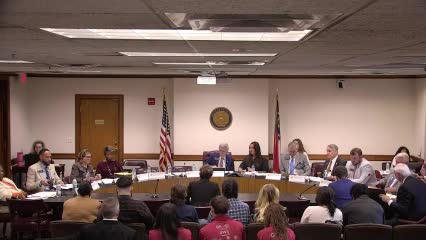
Committee hears bill to pilot robotics programs in low‑performing schools; cost and matching funds discussed
Summary
Senator introduced SB 253 to create a three‑year robotics pilot in up to 10 schools in the bottom 25% of academic performance. Supporters said robotics builds STEM pathways and workforce readiness; members questioned the proposed per‑school cost and suggested matching funds and caps.
A committee member presented Senate Bill 253, a proposal to establish a robotics pilot program in up to 10 Georgia schools that rank in the bottom 25% of academic performance. The sponsor described the initiative as a workforce and opportunity program to expand hands‑on STEM learning, align with career, technical and agricultural education (CTAE) pathways and address workforce needs in engineering, manufacturing and advanced technology.
The presenter said robotics programs such as the FIRST competition provide hands‑on projects, mentorship and real‑world engineering challenges and argued that students involved in robotics are more likely to pursue STEM careers. The bill would fund a pilot to assess impact and scalability and to identify best practices for statewide expansion.
During brief questioning committee members queried the bill’s budget assumptions. One senator noted the sponsor’s stated figure of roughly $200,000 per year per school in start‑up and running costs and recommended adding a per‑school cap and considering matching funds from local districts to stretch state dollars. The presenter said costs typically decline in later years, recommended mentor‑school support and suggested stipends for teacher/coach mentors to reflect the time commitment.
Committee members suggested the pilot could be structured as seed money and asked the sponsor to consider phased or graduated funding. The bill was presented and discussed; the committee completed the hearing and did not take a final vote on SB 253 during the meeting.