Get Full Government Meeting Transcripts, Videos, & Alerts Forever!
Get email alerts on the House Bill 14 Film And Music topic
No spam. Unsubscribe anytime.
Committee advances House Bill 14 after striking post-production tax credit; music office and foreign-adversary language retained
Summary
The Senate Economic Development and Tourism Committee moved LC590163S (House Bill 14) as amended, removing a proposed post-production tax credit but keeping provisions to move a music office to the Department of Community Affairs and to close a foreign-adversary vendor loophole. Two floor amendments were adopted.
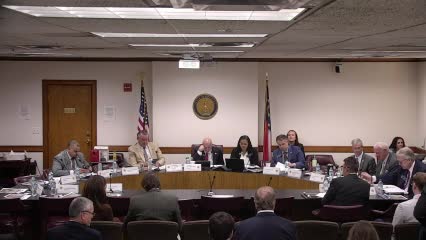
The Senate Economic Development and Tourism Committee advanced LC590163S (House Bill 14) after adopting amendments that removed the bill's proposed post-production tax credit but retained language creating a music office within the Department of Community Affairs and language closing a foreign-adversary vendor loophole.
Representative Carpenter, the bill sponsor, said the measure combines music, film and procurement provisions and that a set of strikes and renumbering would be offered during the committee's consideration. "It's such a pleasure to be here at 08:00 again. I love this committee," Carpenter said before turning the discussion to industry presenters.
Film-industry proponents told the committee the state risks losing post-production work unless it modernizes incentives. Matt Campbell, representing the film sector, described post production as a growth opportunity outside Metro Atlanta: "Post production is the visual effects and things that happen at the end of a production... This measure would allow other groups if Georgia doesn't miss out on a production to send the work to Georgia for post production, creating sustainable work and creating jobs for Georgians."
Hany Korngold of South Georgia Studios said post production typically represents a substantial portion of a film's budget and argued a targeted incentive would recruit work to rural studios: "Post production represents 30% of the budget of a film... that would bring new business to Georgia." Korngold said some tax language had expired at the end of 2022 and that reinstating and modernizing the credit would help retain work and jobs.
Committee discussion focused on specifics of the proposed credit and on statutory drafting. Senators asked whether user-generated or social-media content would qualify; proponents said the intent was to target traditional post-production and visual-effects work rather than small creator content. Questions were also raised about a provision that would provide an additional 5% credit for productions tied to designated counties; legal counsel advised that a population-based limitation in the draft should be struck because it could raise constitutional concerns, and the committee accepted that change.
The committee considered and adopted two critical amendments. An amendment to strike the post-production tax-credit language (lines 1—6 and 22—22—1 in the circulated draft) was moved and seconded; the committee voted 6-4 to adopt the amendment, removing the post-production tax credit from the bill. The committee then adopted a second amendment striking language on page 1 (from the 2-revised notation on line 7 through the word "construction" on line 13) and removing Part 2 (lines 284—418); that amendment passed unanimously.
After the amendments the committee voted to advance the remaining sections of LC590163S, including the music-office relocation to the Department of Community Affairs and the foreign-adversary vendor restriction. Brian Hudson of the Hudson Group described the foreign-adversary language as closing a loophole that currently allows third-party vendors with significant foreign-adversary investment to do business with the state.
The substitute retained a $60,000,000 annual cap in the draft language for the incentive components that remain in the bill; proponents told the committee the cap reflected an estimate of recruitable work. Committee members also discussed the existing film tax-credit structure (a base 20% credit plus a 10% uplift for qualifying productions) and how the removed language would have layered an additional 5% in specified circumstances.
Ending: With the adopted strikes, the committee advanced the bill as amended. Committee members directed staff and counsel to finalize redline language and to review constitutionality and county-designation language where needed; no committee vote on final engrossment was recorded in the transcript excerpt provided.