Get Full Government Meeting Transcripts, Videos, & Alerts Forever!
Get email alerts on the Public Safety Radio Systems topic
No spam. Unsubscribe anytime.
Dodge County committee kicks off countywide radio study to fix coverage and interoperability gaps
Summary
Dodge County’s Public Safety Radio Communications Committee on Tuesday launched a 90‑day study by TUSA Consulting to map coverage shortfalls, inventory radios and propose tower and system options to improve public‑safety communications, with a draft report and stakeholder meetings planned for mid‑July.
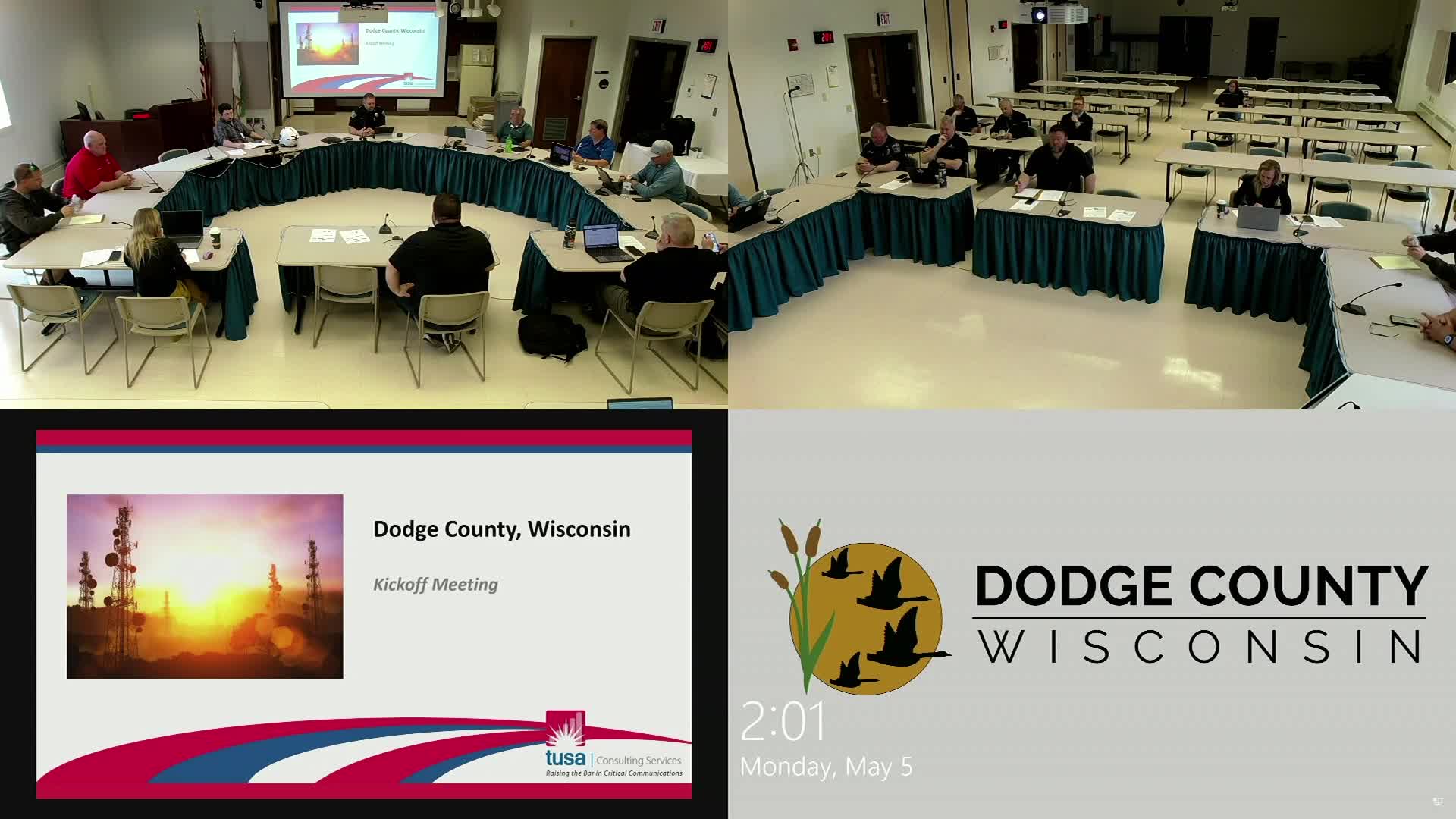
Members of the Dodge County Public Safety Radio Communications Committee on Tuesday opened a formal study of the county’s public‑safety radio system, commissioning TUSA Consulting to produce coverage maps, an inventory of radios and equipment, and conceptual budgets for potential system upgrades.
The study, which TUSA said would take about 90 days, aims to identify coverage “shortfalls” in areas including Waupun, Columbus and Watertown, catalog subscriber radios and consoles, and recommend tower or system changes to improve interoperability among local, county and state agencies.
Dean, a consultant with TUSA Consulting, told the committee the firm will gather data with online surveys, face‑to‑face interviews and site inspections of tower locations and dispatch centers. “Coverage is what you’re buying. It’s what’s king,” Dean said, describing the firm’s approach of pairing drive‑test measurements with user input.
The county’s sheriff, speaking about day‑to‑day operations, described persistent interoperability problems between agencies using disparate bands and systems. “We have significant interoperability challenges around the county,” the Sheriff said, noting that Watertown Police operate on 700/800 MHz while many local agencies remain on VHF and other neighboring counties use trunked 700/800 MHz networks.
Committee members and agency representatives described specific problems TUSA will study: limited portable radio coverage inside prisons (Waupun was cited as a weak spot), poor in‑building penetration at hospitals, routine trouble at the county fairgrounds, and gaps along certain highways. Participants also raised concerns about the cost and logistics of migrating agencies from VHF to 700/800 MHz, including the fiscal burden on smaller municipalities and volunteer fire departments to replace radios.
Technical topics the study will examine include encrypted channels and key management (several encrypted channels exist but are limited in range), paging options for volunteers, GPS/location tracking on portables, the mix of voice and data (LMR vs. FirstNet/cellular), redundant power and generator health at tower sites, and the possibility of cross‑jurisdictional tower locations to maximize coverage.
TUSA outlined near‑term tasks: circulate a draft online survey for stakeholder review, allow two to three weeks for survey responses, conduct targeted face‑to‑face interviews, collect subscriber and site inventories, and produce draft coverage maps and a conceptual report. Committee members were asked to identify critical buildings and high‑call locations (jail, courthouse, hospitals, schools, fairgrounds, distribution centers, data centers) and to turn in marked tower maps highlighting problem areas.
The committee approved the minutes from the March 19 and April 4 meetings at the start of the session. Joe Clapper moved the motion to approve the minutes; Evan (committee member) seconded and the motion carried.
Budget and governance were recurring themes. County staff and consultants warned that any plan will need clear, simple justifications for the county board — a 33‑member body described as fiscally conservative — and that the study should present several options with 15‑ to 20‑year cost‑of‑ownership figures so supervisors can weigh borrowing or financing proposals. Members noted examples of user costs: a Motorola APX 6000 portable was cited in the meeting as currently costing about $4,500–$5,000, while newer models could approach roughly $9,000 per unit, figures the study will consider in its budgeting.
TUSA and county staff proposed returning to the stakeholders with a draft report in mid‑July and scheduled a longer follow‑up meeting for July 23 to review coverage maps, conceptual designs and estimated budgets. The study team said the biggest cause of delay is gathering complete subscriber inventories and critical‑building lists; they asked committee members to expedite those submissions.
The meeting closed with instructions for agencies to identify the locations and events that need improved coverage and for the consultant to proceed with the 90‑day workplan. The committee will reconvene after the face‑to‑face interviews and once the draft report is available for stakeholder review.