Get Full Government Meeting Transcripts, Videos, & Alerts Forever!
Get email alerts on the Education Dei topic
No spam. Unsubscribe anytime.
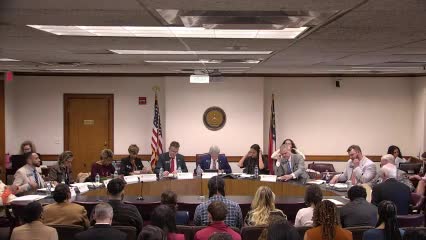
Senate committee approves substitute to House Bill 127 that limits DEI programs in Georgia schools
Summary
Senate members on the Education and Youth Committee approved a committee substitute to House Bill 127 that would bar public K–12 and postsecondary institutions from promoting or maintaining programs described in the bill as “diversity, equity, and inclusion” initiatives and would authorize withholding state or state‑administered federal funds for violations.
Senate members on the Education and Youth Committee approved a committee substitute to House Bill 127 that would bar public K–12 and postsecondary institutions from promoting or maintaining programs described in the bill as “diversity, equity, and inclusion” initiatives and would authorize withholding state or state‑administered federal funds for violations.
The substitute’s sponsor told the committee the measure is intended to keep operational decisions based on “merit, performance, and ability” rather than race, gender identity or sexual orientation and to prevent what he described as discriminatory practices in admissions, hiring and trainings. The provision includes definitions for local education agency and postsecondary institution and a carve‑out for interscholastic and intercollegiate athletics. The bill also contains a penalty clause that allows proportionate withholding of state funds and a statement that nothing in the section prohibits compliance with applicable state or federal anti‑discrimination law.
Sponsor Senator Burns, presenting the substitute (LC 492351S), said, “Education in Georgia must now address a concept which perhaps well intended, is fundamentally discriminatory.” He described provisions that would bar official promotion of certain concepts and would prohibit special benefits or different treatment based on protected characteristics. The substitute refers to code section 21 2 1 67 for the definition of local education agency and names the University System of Georgia and the Technical College System of Georgia for postsecondary institutions.
Committee members and public commentators sharply disagreed on what the bill would permit. Supporters argued the substitute prevents ideological litmus tests in hiring or admissions; opponents said the language could chill academic freedom and block ordinary campus activities, student groups and coursework. A public commenter summarized skepticism about DEI by saying, “Very few blacks embrace DEI. Okay? And let me tell you why,” and described concerns that DEI had become prescriptive rather than opportunity‑focused. Senator Dolezal addressed a specific phrase in the substitute, arguing that the term “anti racism” in the bill refers to a particular set of ideas and authors and describing that body of writing as ideological: “There are volumes of books written around the concept of anti racism ... And it is anti capitalism. And in many cases, it is is anti American.”
Members debated several technical points raised during questioning: whether student organizations are funded from student fees versus state allocations, whether academic instruction on concepts such as disparate impact would be restricted (the sponsor said historical or jurisprudential coverage would remain academic), and whether the bill preempts local waivers for secondary schools (the substitute states secondary institutions are not subject to waiver). Committee members also discussed a carve‑out inserted at lines 49–52 to protect gender‑based identification or policies for interscholastic and intercollegiate athletics.
The author acknowledged the measure is controversial and pointed committee members to a January 20, 2025, White House executive order cited in his remarks as closely related to the substitute’s approach. Law‑related references in committee discussion included code section 21 2 1 67 and the legislative reference LC 492351S.
After debate the committee considered two procedural moves: a motion to table the substitute failed, and an amendment was adopted that altered how the bill references “anti‑racism” (committee members appended a capitalization/change to mark a term of art as the amendment described). The committee then approved the vice committee substitute as amended; recorded opposition included five raised hands during the roll call noted in the transcript. The sponsor said the measure would proceed through the legislative process and that he would continue to work with Representative Cox, the author of the underlying House bill.
The measure would affect both local school systems and units of the technical and university systems; it prescribes definitions, prohibits specified institutional activities and authorizes state funding sanctions. Implementation specifics, including how the State Board of Education would apply funding withholdings and how the provision would interact with federal law, were discussed but not resolved during the hearing.
Committee leaders did not set a follow‑up schedule during the meeting; the sponsor said he would continue discussions with the bill’s original author.