Get Full Government Meeting Transcripts, Videos, & Alerts Forever!
Get email alerts on the Comprehensive Plan Update topic
No spam. Unsubscribe anytime.
Planning Commission members describe community screening session as neighborhood-focused, low public turnout
Summary
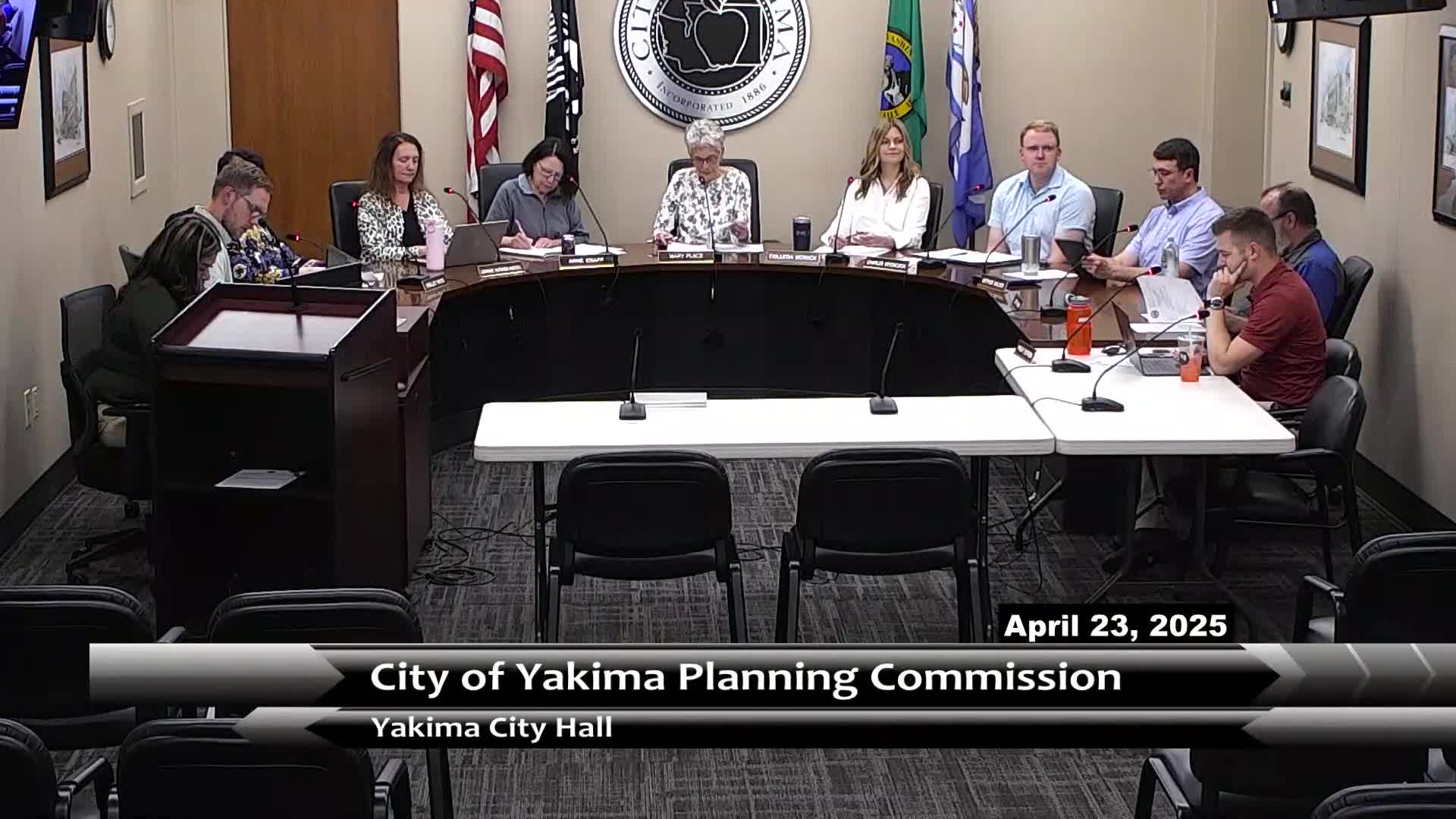
The City of Yakima Planning Commission on April 23 reviewed a community screening session held April 16 at the Henry Bockab Center, where consultant Ben Hahn presented draft deliverables for the city—s comprehensive-plan update.
The City of Yakima Planning Commission on April 23 reviewed a community screening session held April 16 at the Henry Bockab (Botchab) Center, where consultant Ben Hahn presented draft deliverables for the city—s periodic comprehensive-plan update and development regulation review.
Commissioners said the session emphasized identifying specific neighborhoods for new housing rather than applying uniform middle-housing rules citywide, and several commissioners described low public turnout and useful technical input from county planners.
Why it matters: The screening session is part of the consultant contract that will inform the comprehensive-plan update and the city—s development regulations. The shape of those deliverables will guide where and how additional housing types may be allowed in Yakima and inform what staff and the commission present to City Council on May 6.
Commissioners who attended said the workshop grouped participants at tables and used maps to focus conversations. "It was kind of obvious to me that . . . the gist of where we were sitting was to kind of direct the new laws toward specific neighborhoods," Shelley said, summarizing her table—s discussion. Several commissioners reported their tables identified older parts of the East Side (around 16th Avenue and the Yakima Valley College area) as candidates for more multifamily development because water and sewer already exist there.
Participants raised design and quality-of-life priorities, including walkability, bike and pedestrian networks, and housing that supports aging in place. One commissioner summarized the table comments: "They had a lot to say about walkable neighborhoods, pedestrian and biking friendly streets, more walkable streets . . . aging in place facilities."
Commissioners also discussed practical constraints cited at the screening: the cost of construction and public facilities improvements varies across the region and will shape where development is feasible. Several commissioners noted county planning staff attended and contributed technical perspective.
Staff said the consultant contract—s deliverables include land-use text amendments and downtown items; staff will forward materials to commissioners and to the Historic Preservation Commission and the Business Improvement/PED (BIPED) group as appropriate. The commission was told those code and text amendments will go to City Council on May 6.
Commissioners asked staff for access to larger printed maps used at the screening and for a link to the city—s GIS layers. Planning staff agreed to send the GIS link and to look into producing printed land-use and zoning maps for commissioners.
Several commissioners urged that commissioners review prior work the commission has done on the Housing Action Plan and the comprehensive-plan elements so future discussions do not repeat already-completed analysis. Staff said an assessment of existing capital facilities and utility planning documents is underway and a presentation may be available when the consultant returns to present in July.
The commission also discussed scheduling: two additional community workshops are planned for August and November, with consultant presentations to the commission expected in July and December.
The screening session recap consumed a substantial portion of the meeting and participants recommended broader distribution of session materials and maps to help future public engagement.