Get Full Government Meeting Transcripts, Videos, & Alerts Forever!
Get email alerts on the City Budget Finance topic
No spam. Unsubscribe anytime.
Yakima budget committee reports progress; survey shows public safety top priority and split on new taxes
Summary
A citizen budget advisory committee reported ongoing work to close an estimated $9 million shortfall, presenting community survey results that prioritize police and show majority support for a tax increase if it would fully fund public safety.
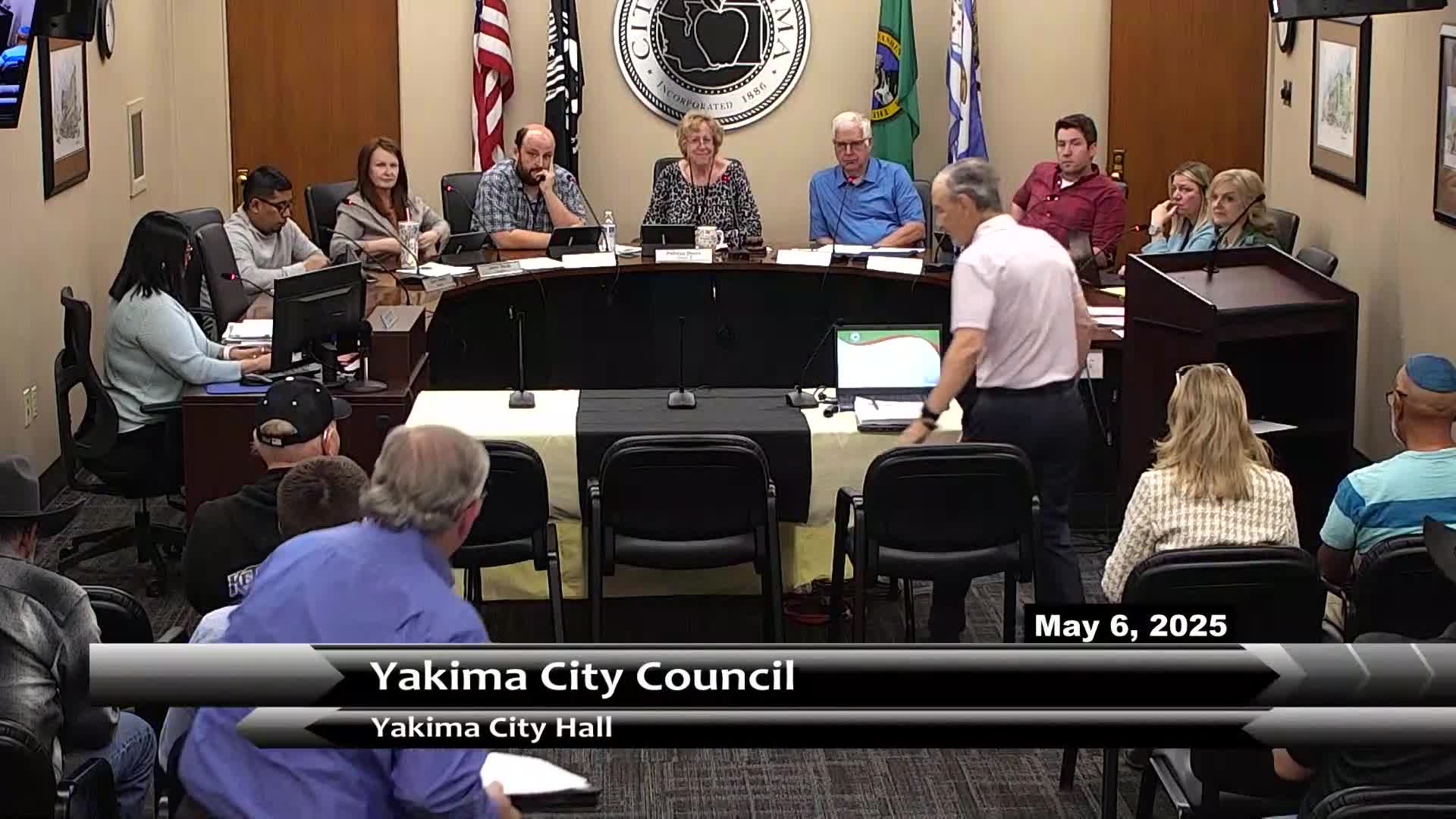
The Yakima City Council on May 6 received a progress report from the Citizens Budget Advisory Committee as members continued work to address an estimated $9,000,000 budget shortfall.
The committee, which met 12 times in 12 weeks, has been using the city’s priority-based budgeting framework and plans to return to the council with more concrete recommendations in about a month. “The committee was created by a resolution last December,” Mike Bailey, who served as the committee’s director and interim finance director, told the council as he summarized the group’s work and next steps.
The city also released results from an extensive public outreach effort and an online budget survey. Of 2,065 completed survey responses, respondents ranked police as the top budget priority (40%), followed by street maintenance (26%) and parks/pools/community centers (25%). When asked whether they would back a property-tax increase specifically for police, fire and court services, 40% said yes, 33% said no and 27% said they needed more information. A separate survey prompt framed a $20-per-month increase for the average homeowner as sufficient to fully fund public safety; 57% said they would support that level of tax increase.
Committee chair Gina Hernandez told the council the members are pursuing a “hybrid” approach of revenue and cuts and want more time to develop full recommendations. “We are committed to continue to work on this matter but expecting to be back in front of you with a direction in about a month,” Hernandez said.
Staff and committee members discussed specific revenue options. On sales tax, the committee’s back-of-the-envelope estimate for a one-tenth of one percent (0.1 percentage point) local sales-tax increase was roughly $2.7 million a year. City staff noted a legal and administrative timetable: state law requires a Department of Revenue notice period and changes must align with calendar quarters, meaning a sales-tax change could not start immediately; the earliest effective start date discussed would be Oct. 1 with the first allotment to the city arriving after the following remittance cycle.
Committee members and staff emphasized that state law constrains many revenue options and noted recent legislative action expanding an option to dedicate up to an additional 1 percentage point in sales tax for public safety as a newly available tool. The committee also discussed non-tax options such as increasing user fees, seeking sponsorships or philanthropy, targeting interlocal contract rates for services provided to neighboring jurisdictions, and operational efficiencies across the city’s program portfolio.
Outreach to the public included in-person “pop-up” events, three town halls and dozens of community meetings; roughly 3,400 people engaged with at least one survey question. Town halls surfaced consistent concerns about preserving the Harmon Senior Center and youth programs and showed different emphases by neighborhood: one meeting focused strongly on keeping the Harmon Center open, another emphasized youth programs and crime prevention, and a third emphasized economic development.
Council members and staff said they will return with additional analysis and that the committee will continue meeting. City Manager Vicki Baker said staff would work with the new finance director, Craig Warner, and the committee to refine options for council consideration.
Next steps: the committee will continue deliberations and aims to present specific revenue and cut recommendations to the council in about a month. Council members signaled they expect a mix of measures rather than a single solution.
Ending: The council did not take a formal vote on budget policy at the meeting; members received the progress report and directed staff and the committee to continue work toward a recommended package for future council consideration.