Get Full Government Meeting Transcripts, Videos, & Alerts Forever!
Get email alerts on the Transportation Infrastructure topic
No spam. Unsubscribe anytime.
Yakima council reviews Sixth Avenue rebuild options as trolley supporters press to preserve tracks
Summary
At a May 13 Yakima City Council study session, staff presented three design-and-cost options for the Sixth Avenue rebuild — including alternatives that would restore trolley track — after months of public outreach. Council scheduled a June 17 public hearing; staff were directed to continue design and funding work but no formal action was taken.
Yakima City Council members on May 13 heard a months‑long public outreach summary and draft designs for the Sixth Avenue rebuild, a Transportation Benefit District (TBD) project that stretches from Walnut Street to River Road and that could include restoring trolley track through the corridor.
The project matters because Sixth Avenue combines commercial, residential and industrial uses, carries truck traffic, hosts the William O. Douglas Trail and runs along the city‑owned Yakima Valley Trolley; rebuilding the street will require balancing competing demands while the city confronts a TBD funding shortfall.
Acting city engineer Bill Preston said the presentation was “a transportation project, not a presentation on the trolleys,” but acknowledged the trolley’s central role in public interest and in several design options. Preston told the council the corridor must be fully rebuilt because pavement and subgrade failures make mere resurfacing insufficient.
HLA and HBB, the city’s consultants, presented three high‑level concepts and preliminary cost estimates: a full rebuild with the trolley included (rough order $12.8 million, not including catenary/pole electrification estimated separately at about $2.1 million); a “couplet” concept that uses Fifth and Sixth Avenues together and allows reclassification of Sixth to an arterial (higher cost); and a no‑trolley design (about $7.5 million). Consultants estimated the trolley track portion alone at about $5.3 million. The presentation noted right‑of‑way constraints — roughly 60 feet through the industrial and residential segments and about 100 feet through the commercial segment — that limit what fits in the corridor without additional land acquisition.
Trolley supporters, including speakers from Yakima Valley Trolleys, urged preservation and restoration of the line. Ken Johnson, identified in public comments as president of Yakima Valley Trolleys, urged a phased approach that would prioritize urgent needs such as rebuilding a Central Washington Railroad crossing (he cited a replacement estimate of about $290,000) and bridge repairs while preserving the line for future expansion and potential historic designation. Greg Johnson, an online commenter, brought prepared figures asserting recent grant inflows of roughly $1.7 million to trolley‑related activities and said past operations drew a large share of out‑of‑town visitors.
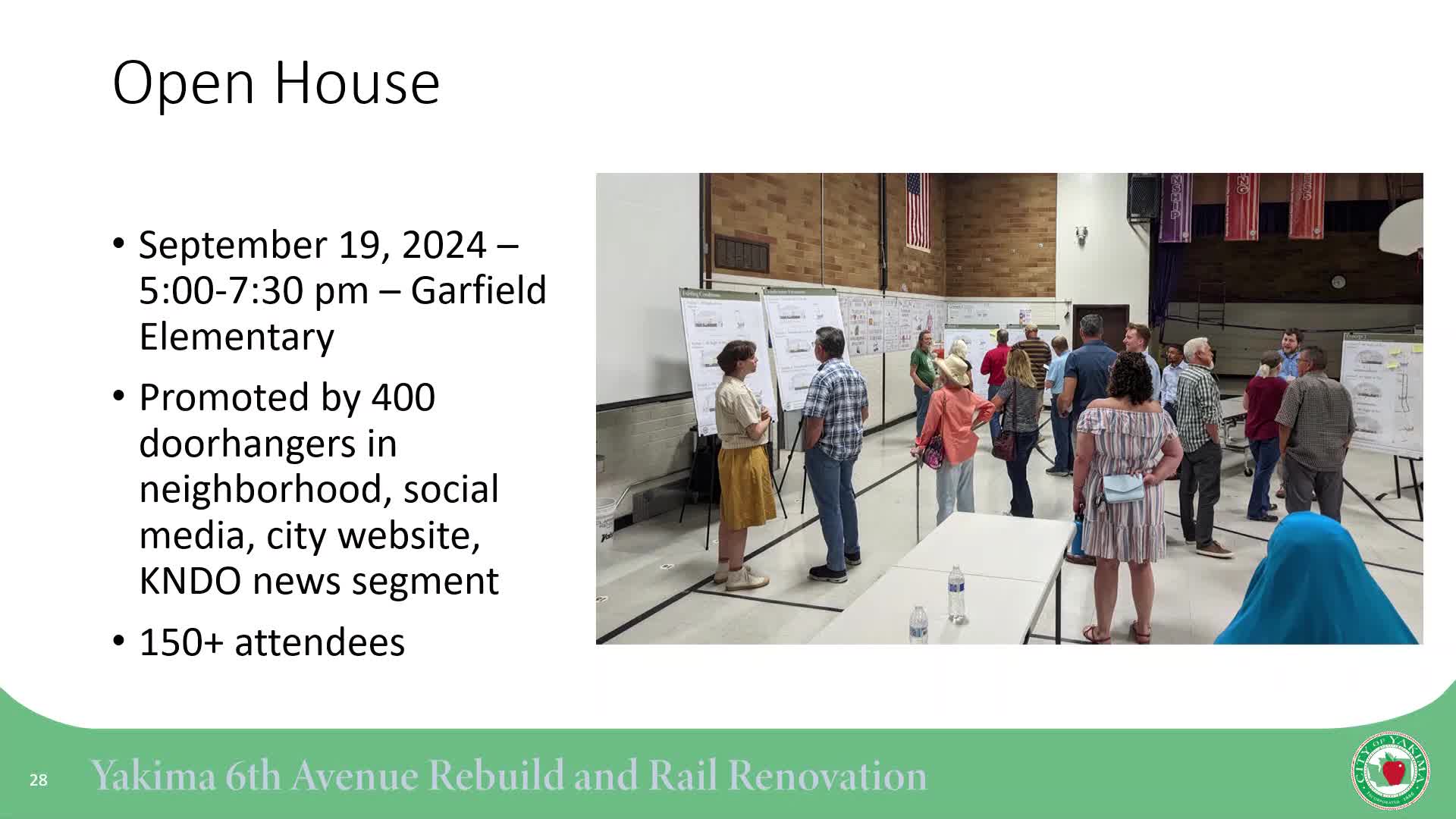
Consultants said public outreach included a site walk, an open house at Garfield Elementary, lunch meetings with industrial and south‑end businesses, door‑hanger and in‑person surveys, and an online survey that collected 706 responses in the first phase and a total of 818 surveys after additional outreach. The combined in‑person and online responses ranked sidewalks as the highest priority for City residents, followed by travel lanes and parking; support for a concept that retained the trolley was strong in the online results, with roughly 79% of online respondents backing the trolley‑included concept.
Preston reviewed project constraints and next steps. He asked the council for policy direction on which elements to include (sidewalk widths, bike facilities, parking, whether to pursue the couplet approach, and whether to include trolley track and catenary) and reminded members that including additional right‑of‑way would substantially raise cost and complexity. He said the city currently has TBD revenue (a $20 annual vehicle fee) of roughly $1.6–$1.7 million per year and entered 2025 with about $4.8 million in the TBD fund; even the lowest‑cost option showed a funding shortfall. The city also expects to continue seeking state and federal grants, and Preston said designation of the trolley as a national historic landmark could unlock additional funding opportunities.
Council members and staff discussed phasing, construction impacts on 33 industrial, 35 commercial and about 50 residential properties along the corridor, and the tradeoffs between minimizing construction disruption and the total project schedule. Preston estimated a trolley‑inclusive construction schedule in the roughly two‑to‑two‑and‑a‑half‑year range and a no‑trolley rebuild closer to about 18 months to two years, depending on phasing and contractor schedule.
City staff and the consultant team emphasized that the trolley’s overhead electrification (catenary) could be added later as a separate project but that restoring rails and designing the corridor with room for future electrification would be more efficient if planned during the rebuild. Stone Consulting (rail consultants) supplied the trolley track and catenary cost estimates used in the presentation.
No formal council vote was taken on the rebuild or trolley inclusion. The council and staff agreed to a public hearing on June 17 to consider the project scope and any material changes to the TBD project list; Preston asked council to instruct staff on which elements to carry forward into final design. Preston said he would continue design work and pursue funding consistent with council direction.
The TBD director and legal staff reminded the council that changes to the TBD project list or material changes to cost, scope or schedule require a public hearing under the city’s material‑change policy and state law governing transportation benefit districts.