Get Full Government Meeting Transcripts, Videos, & Alerts Forever!
Get email alerts on the Districting And Ballot Timing topic
No spam. Unsubscribe anytime.
Council debates districting options after survey results; subcommittee to refine ballot language and meet with legal
Summary
Councilors discussed public survey results on districting and whether to put a specific district structure on the November ballot or to ask a simpler advisory question; staff said a July council vote is needed to meet the elections office deadline for November placement.
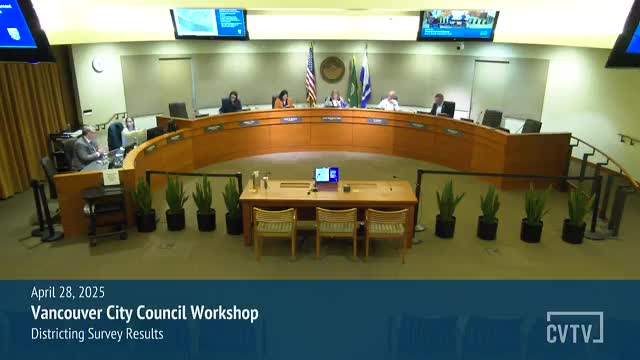
Vancouver City Councilors on Monday spent an extended workshop session reviewing recent survey results and options for citywide districting, including whether to present a specific districting structure to voters this November or to ask a narrower advisory question and convene a post-election committee to develop details.
The question is consequential because placing a charter change on the November ballot requires council action this summer to meet elections deadlines; staff told council that a vote in July would be necessary to submit language for the November ballot and that preparatory committee work would need to occur in May and June if council wanted community engagement before the vote.
City Manager (unnamed) and staff briefed the council that the topic has recurred through multiple charter review efforts and a districting subcommittee has been convened to develop proposals. Staff said earlier outreach showed mixed public sentiment: some respondents changed views after receiving explanation from consultants, and council members would need to choose whether to send a narrowly defined proposal (for example, a fixed number of districts and number of at‑large seats) to voters as a one-time charter change or to present a simpler yes/no question followed by a post-election process if voters approve.
Councilors split on approach. Council Member Hansen said he preferred leaving the system as it is or, if forced to pick, placing a simple advisory yes/no question before voters. Councilor Hartless, Councilor Fox and others said they want a definitive option on the ballot this November that would avoid a second voter return; Hartless and Fox said they would like the subcommittee to craft a specific, legally sufficient measure (for example, specifying number of districts and number of at‑large seats) so the city would not have to seek voter approval again for the structural choice. Councilor Harless expressed concern that single-member districts, as commonly configured, would not by themselves ensure the kinds of representational diversity she seeks and said she would not support certain districting proposals unless they advanced that goal (she favored multi-member districts or proportional approaches to increase representation diversity).
Legal and logistical constraints were discussed: staff and consultant Aaron (joined remotely) said a one-time ballot question would need enough specificity—at minimum the number of districts and the count of at‑large seats—so that the charter amendment could be implemented without an additional voter step. Staff also said the draft measure would need legal review to ensure the post-adoption steps (for example, how incumbents map to new seats and how district lines are drawn and reviewed) are clear.
Councilors weighed community engagement approaches. Some asked that staff and the subcommittee present multiple scenarios and cost estimates, with outreach to neighborhood associations and stakeholder groups before a final council vote on ballot language. Others argued that because community views have been repeatedly split across past forums and charter review commissions, an up-or-down question to the voters this November would provide a decisive answer and allow the city to form a post-election committee to finalize details if approved.
Next procedural steps agreed in the workshop: the districting subcommittee will meet with legal staff to refine options and the necessary level of specificity for ballot language; staff indicated the subcommittee will aim to return with draft ballot language or a recommended question before the council must make a scheduling decision in July in order to reach the elections office for a November measure. Councilors also agreed to place further discussion on the agenda for the next Monday workshop to continue the conversation and to allow the subcommittee time to meet with legal.