Get Full Government Meeting Transcripts, Videos, & Alerts Forever!
Get email alerts on the Land Use Section 30 topic
No spam. Unsubscribe anytime.
Council approves revisions to Section 30 land-use code after public hearing
Summary
The Vancouver City Council voted unanimously to adopt targeted changes to the land use code for Section 30, creating an alternative development path aimed at limiting industrial and low-density uses while enabling higher-density housing in a one-square-mile annexed area.
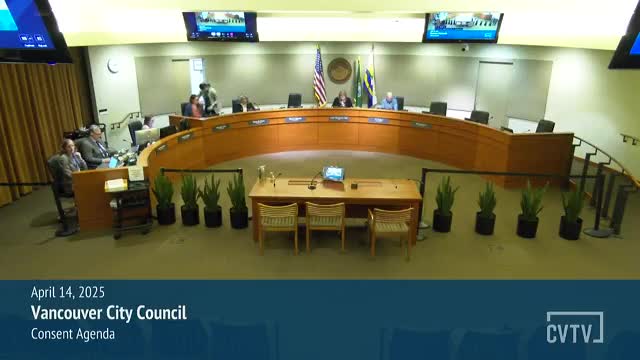
The Vancouver City Council on April 14 adopted targeted amendments to the city's land use code that apply to Section 30, a roughly one-square-mile area annexed in 2008, after a public hearing and staff presentation.
City planning staff told the council the amendments offer an "alternative path" for holders of pre-annexation development agreements (PETA holders) that would trade certain development rights for a streamlined approval process, modest flexibility in standards and an extension of development timelines. Chad, city planning staff, summarized the proposal as a negotiated trade-off: "In return for the ability to build greater residential density, for modest flexibility and development standards, for a more streamlined review process, and adding 2 and a half years, more to their development agreement, timeline, the 2 largest PETA holders would agree to abandon their rights to develop their properties for a number of uses, which are deemed to be inconsistent with the vision for section 30."
The staff report said the proposal responds to a concern that, without action, more than 40% of Section 30 could be developed for land uses inconsistent with the city's vision (examples cited by staff included large warehouses, mini-storage and low-density single-family subdivisions). Staff said negotiations over the past year were focused on the two largest PETA property owners (identified in staff materials as RACI and TAPNI) and that those owners are present and have signaled willingness to pursue the alternative path.
The draft ordinance incorporates a Planning Commission recommendation requiring PETA holders to file required development agreement amendments within 120 days of the ordinance's effective date to be eligible for the alternative path. Staff told council the amendments include findings to demonstrate consistency with the Vancouver strategic plan and the comprehensive plan and that the changes are necessary to further the public interest given present needs and conditions.
Council discussion was limited; Councilor Fox expressed support for the negotiated approach and said staff's outreach and negotiation with property owners was substantive. Councilor Fox moved adoption; Councilor Perez seconded. The council voted by roll call; Mayor Anne McInerney Ogel and all council members present voted aye. The ordinance passed unanimously.
The ordinance amends Vancouver Municipal Code chapter 20.69 and will become effective on the date specified in the ordinance. Staff said the changes are intended to encourage higher-density housing consistent with city goals and to reduce the risk that large parcels in the area would vest to lower-density or industrial uses that the city views as incompatible with the area's long-term vision.
The record notes staff will return to the council with additional ordinance details and any proposed development agreement amendments from affected property owners.