Get Full Government Meeting Transcripts, Videos, & Alerts Forever!
Get email alerts on the Economic Development topic
No spam. Unsubscribe anytime.
Council adopts economic development strategy; directs staff to return with detailed $2.5 million budget
Summary
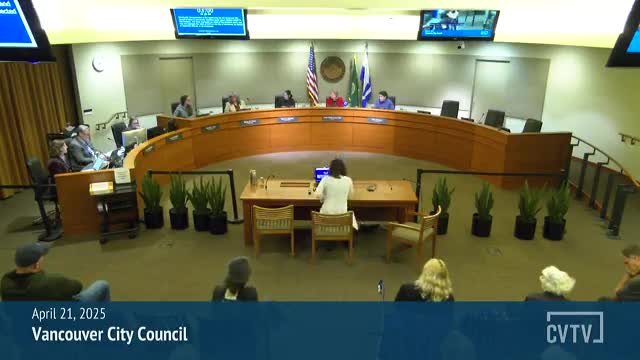
The Vancouver City Council on April 21 adopted a five-year economic development strategy and directed staff to return with a detailed budget for an estimated $2.5 million in early-stage program funding.
The Vancouver City Council on April 21 adopted a five-year economic development strategy and directed staff to return at the next available meeting with a detailed budget showing how an estimated $2.5 million in early-stage program funding would be invested.
The plan, intended to catalyze neighborhood-level business investments, passed after Council member Fox moved to approve the strategy and asked staff to provide specifics on the proposed five-year $2.5 million resource allocation. Council discussion focused on what those funds would pay for and how much would be city-funded versus leveraged from partners or external grants.
Council member Fox said she supported the plan’s goals but wanted clarity on the financing. A staff member responding to questions described the $2.5 million as an early estimate for “programmatic dollars” to launch actions in the plan rather than to create permanent city staffing. “It’s an early estimate when you look at the programs and what some of the early resources may need,” the staff member said. The staff member added the city intends to leverage partner organizations and outside funding where possible and that specific appropriations would return to council through the normal budget or supplemental processes.
Public testimony preceding the vote repeatedly urged the council to prioritize street safety and people-first design in neighborhood business districts. Alyssa Wheeler, a resident of the Esther Short neighborhood, told the council that “people enjoy spending time in places where cars aren’t,” citing the farmers market as an example of a car-free space that draws customers. Jason, another speaker, recounted a recent crash on Main Street in which a vehicle was traveling “70 plus miles per hour” and said, “if we don't do something, it's not a matter of if another car will crash into 10 or 15 people. It's a question of when.” Julia Treybert, who identified herself as a homeowner, urged small, low-cost interventions — concrete barriers, pedestrian-only side streets, or temporary closures — to improve patio and storefront safety and attract new businesses.
Council members and staff said the implementation phase will prioritize sequencing of the plan’s 12 actions, identification of potential partner organizations, and design of early pilot programs. The motion to approve the plan included direction for staff to return with a detailed budget for the proposed investment at the next available council meeting; the motion passed unanimously.
The council did not commit city funds in this vote; any appropriation would require a later budget or supplemental action. Staff said some of the early funding could come from state or federal sources and that the city’s role is intended primarily to convene, catalyze, and provide early capital where needed.
What’s next: staff will produce an implementation and financing plan and present budgetary details to council at the next available meeting, per the motion approved April 21.