Get Full Government Meeting Transcripts, Videos, & Alerts Forever!
Get email alerts on the Equity Inclusion Accessibility topic
No spam. Unsubscribe anytime.
Vancouver updates ADA transition planning, launches reporting portal and safe‑zone rollout
Summary
City staff reported progress on an Americans with Disabilities Act self‑evaluation and transition plan, announced a new Access Barrier Reporting Portal, said digital accessibility work must meet a new federal requirement by April 2026, and outlined an expanding Safe Zone program and youth civic initiatives.
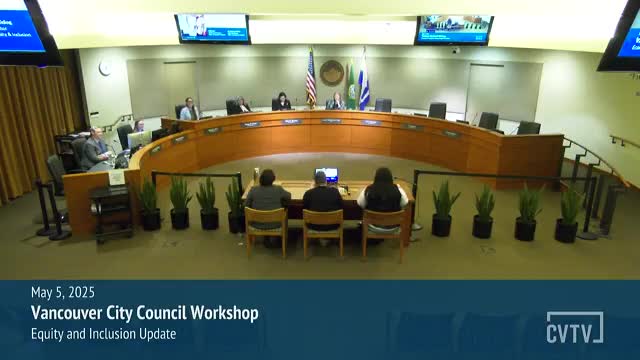
Lisa Bridal, deputy city manager, and staff from the Office of Equity and Inclusion briefed the Vancouver City Council on May 5 about accessibility work, staffing and community engagement plans, including a new public portal for reporting access barriers and an announced timeline for the ADA transition plan.
Jen Duggar Spalding, who has been carrying the office’s work during a recruitment for a permanent director, told council the office is conducting self‑evaluations required by the Americans with Disabilities Act and section 504 of the Rehabilitation Act and will begin physical evaluations of city buildings, parks and the pedestrian right‑of‑way. “The transition plan is then where we basically report what we found and what we’re going to do to improve the accessibility in the city,” Duggar Spalding said.
Nut graf: Staff described a multi‑year process that will identify barriers, assign departmental responsibility for remediation, estimate costs and publish a transition plan. The city also announced a new online Access Barrier Reporting Portal and a schedule for making city buildings and community partner sites Safe Zones to improve reporting and support for bias and hate incidents.
Duggar Spalding said the office will use data collected by Public Works and the transportation department and will prioritize the most severe barriers in the transition plan, which staff expect to publish in late 2026. She said removal and repair work will begin after that and the transition plan will be a living document with ongoing updates.
On digital access, Duggar Spalding told council a federal rule clarifying ADA obligations for digital information requires compliance by April 20, 2026, and that city staff are working across departments to meet that deadline. The office also launched an Access Barrier Reporting Portal that is live now on the city website (cityofvancouver.us/accessibility) and described it as a single place both community members and employees can report accessibility barriers.
Nikki Chen, who presented community outreach and programs, described outreach with the Chuukese community (referred to in the meeting as “Chiquis”/“Chukese” in course of remarks) and announced a planned county‑level proclamation and a May 24 community celebration at Esther Short Park. Chen said the office has hosted restorative justice “fishbowl” conversations with the Vancouver Police Department, will expand youth‑focused fishbowl events, and plans new young‑adult civic programs including Civic Minds and a Black Civic Leaders program aimed at high‑school students.
Chen also described the Safe Zone program, developed with the Vancouver Police Department, in which trained community organizations and city buildings will be designated as places where people experiencing bias or hate incidents can find immediate help and be supported in documenting incidents for police. “All city buildings will be safe zones by June 2025, and safe zone will be launching for community collaborations in June as well,” Chen said. She said police officers have already received training and city staff and partners will be trained this summer at community events.
Councilors asked about how digital complaints and hateful posts on city social media would be handled and about whether the reporting portal is live; staff said the portal is live and that they will coordinate on social media response and documentation procedures. Councilor Perez thanked staff for keeping the office running during a vacancy and asked about sustainability for youth programming; staff said the incoming director will help design longer‑term recruitment and retention strategies and that several partner organizations have offered support at no cost to the city for pilot efforts.
Ending: Staff said they are conducting the ADA self‑evaluation now, will publish a transition plan focused on the most severe barriers in late 2026, and will continue launching Safe Zone training and youth programs through 2026. The office is still recruiting a permanent director and expects interviews to conclude in the coming weeks.