Get Full Government Meeting Transcripts, Videos, & Alerts Forever!
Get email alerts on the Economic Development topic
No spam. Unsubscribe anytime.
Vancouver details early cost estimates for five-year economic development strategy
Summary
City staff told council the city has about $3 million a year from a business license surcharge increment to support redevelopment and implementation of a new five‑year economic development strategy and outlined early program cost estimates and supplemental budget asks.
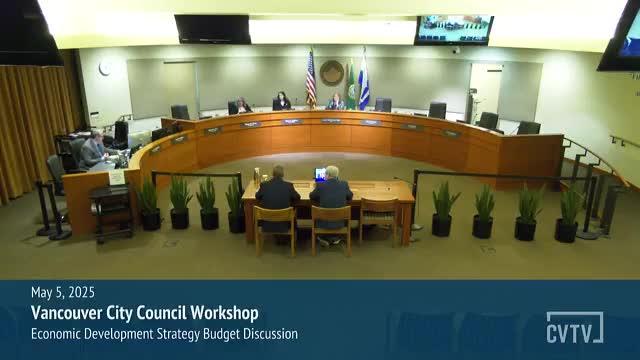
Patrick Quintin, director of economic prosperity and housing, told the Vancouver City Council on May 5 that the city expects roughly $3,000,000 a year from the business license surcharge increment to fund redevelopment and economic development work and offered early estimates for implementing the council’s newly adopted five‑year economic development strategy.
Quintin said the five‑year strategy is now moving from adoption into an implementation planning phase and that the initial cost estimates staff presented are preliminary. “We are at the front end of this,” Quintin said. “We would hope to have a better idea over the next, you know, six months of what it’s really going to end up costing to do the initial work.”
The city manager and department staff emphasized the estimates assume most work will be done with partners and that city funds will often serve as matching or start‑up dollars rather than long‑term full funding. Chris Harder, deputy director, walked council through line items and four broad program goals in the strategy, from workforce and small business support to startup investment and neighborhood commercial district work.
Nut graf: The council received a program‑level budget picture showing how the strategy might be funded without tapping the city general fund. Staff said the bulk of city contributions would come from the incremental revenue of a business license surcharge adjustment and that staff plan to leverage state, federal and private funds where possible.
Harder described a mixed funding approach and listed several early cost estimates: about $60,000 to sponsor outreach and job‑fair promotion for trades careers; roughly $250,000 to launch an incubator for emerging construction and trade firms; $600,000 as an early contribution toward a local early‑stage startup investment fund; $70,000 to seed a neighborhood business‑district improvement program; and a tentative city contribution to a product‑to‑market technical assistance effort and to a small business revolving loan fund tied to the city’s earlier “Fourth Plan for All” allocation. Harder said the city’s planning documents show about $1,000,000 from the Fourth Plan for All is already earmarked toward a revolving loan fund and staff are considering how to expand that citywide.
Quintin said the business license surcharge increment is projected at about $3,000,000 a year, and that much of that increment is already planned for redevelopment priorities including site acquisitions and The Heights redevelopment. He said staff have modeled carving out about $250,000 over the first two years to fund strategy actions, but cautioned the figures are early estimates and could change as programs are scoped and partnerships formed.
Council discussion focused on design details and accountability. Councilor Fox praised the spreadsheet and the nine‑cell presentation of partners and asked how items listed at $0 would be implemented; Harder said those items are expected to be accomplished largely by refocusing existing staff and programs but could require modest future resources if detailed scoping shows a need. Councilor Paulson pressed for clearer success measures and suggested adding a “how we will know this worked” column to program documents so council and the public can track outcomes.
Quintin also told council staff have $125,000 approved in the FY 2025–26 biennial budget and are requesting a spring supplemental appropriation of $125,000 for this year and another $125,000 for the following year; staff said both supplemental requests would be funded from the business license surcharge increment. Those requests were presented to the workshop but no formal council vote occurred during the session.
Harder and Quintin listed partners staff expect to engage in several initiatives, naming the National Association of Minority Contractors, Washington Chapter; Washington Apex Accelerator; the Washington state Office of Minority and Women’s Business Enterprises; and local technical assistance providers, among others, as possible collaborators for the trades incubator and procurement readiness work.
Ending: Staff said they will return with more detailed scopes and cost estimates as initiatives are designed and will seek the council’s direction during the regular budget process and future briefings. Council members asked staff to add clearer success metrics to future materials and to continue identifying grant and private leverage opportunities.