Get Full Government Meeting Transcripts, Videos, & Alerts Forever!
Get email alerts on the Curriculum Math topic
No spam. Unsubscribe anytime.
Mukilteo board hears recommendation to adopt Math Expressions as elementary math curriculum
Summary
District staff presented a multi-month pilot and recommended the adoption of Math Expressions (2026 edition) for K–6 elementary math, citing stronger rigor, a new digital platform and positive teacher feedback; the board did not vote and staff said contracting and implementation planning would follow if the board approves at a future meeting.
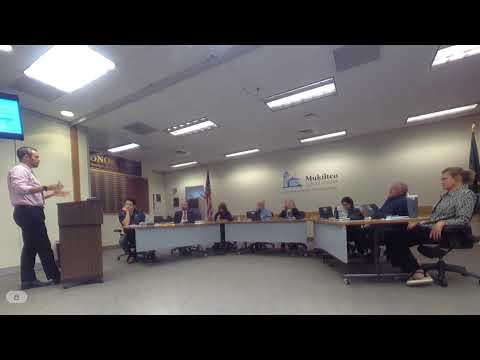
Mukilteo School District staff recommended on May 13 that the board adopt Math Expressions (the 2026 edition) as the district’s core elementary math curriculum after an 18-month review, a district-wide pilot and committee evaluations.
The recommendation came during a presentation by Matt Grama, the district’s director of curriculum and instruction, who asked the board to consider and ultimately approve the adoption. “We are here tonight … and ultimately, we hope that you agree with our recommendation and approve the adoption of Math Expressions to be our core curriculum for our elementary math,” Grama said.
The recommendation followed a formal adoption process that district staff described as a needs assessment, committee review, pilot and evaluation. Staff said the district found that the current adopted materials had expired and lacked the rigor of more recent editions. Teachers who piloted newer versions reported improved student mathematical discourse and instructional practice, staff said. The pilot included 56 teachers across the district and paired classroom materials with a digital platform called Flight and an adaptive practice tool called Matific.
Staff and publisher representatives emphasized three reasons for recommending Math Expressions: alignment with state standards, a research basis tied to the author (noted in the presentation as research supported by the National Science Foundation), and an integrated digital environment that teachers can use to differentiate instruction and run reports. Gretchen Hotaling, identified in the presentation as the district TOSA for elementary math and science, said teachers who used the teacher guide reported improvements in their practice: "When I dug into that teacher's guide, I learned so much. My practice improved," she said.
Piloting teachers and staff described classroom features that drove the recommendation: embedded math discourse prompts, manipulatives and visual models consistent across general and special education settings, bilingual family letters and unit-level guidance, and a collection of culturally varied short readers for math. Staff said Matific is accessible through the district’s Clever portal and can be used at home and in school for both remediation and challenge work.
Board members asked detailed implementation questions about bias review, progressions between grade levels, special‑education access and digital access for families. Staff said the district performed a bias and representation review focused on word problems and student-facing readers and found diverse representation in the pilot materials. Staff also described a three-year implementation plan of job‑embedded professional learning, grade‑level rollout sessions and ongoing feedback cycles should the board approve adoption.
No formal vote on the adoption occurred at the May 13 meeting. Staff said they will return with a formal recommendation for approval and, if the board votes to adopt, finance and procurement staff will negotiate contract terms and finalize multi‑year implementation supports.
Implementation and next steps: staff outlined a multi‑year rollout including June/August training, job‑embedded coaching, math leaders and pacing guides; they said the district will negotiate price and identify which manipulatives and print resources must be purchased. Staff estimated that prior upgrades and the district’s budget planning already account for adoption costs and that final contract terms will be presented to the board after approval to proceed.
The presentation ran longer than planned and generated questions from multiple directors about vendor comparisons, parental outreach and digital access. Board members and staff said they expect further public materials and school‑level demonstrations for parents and teachers before any vote.