Get Full Government Meeting Transcripts, Videos, & Alerts Forever!
Get email alerts on the Municipal Court topic
No spam. Unsubscribe anytime.
Casper municipal judges outline court procedures, 12-hour hold policy and probation options
Summary
Municipal court judges briefed the Casper City Council on how cases move through municipal court, explaining arraignments, pleas, bond conditions, the reinstated 12-hour hold-and-release practice and probation supervision.
Municipal Court Judge Hand told the Casper City Council that municipal court in Casper handles violations of city ordinances and state statutes adopted into the city code and stressed the court’s limited jurisdiction compared with district courts.
“The only cases that we have in the municipal court are violations of the city ordinances and state statutes that have been adopted by the city code,” Municipal Court Judge Hand said, explaining how cases typically start with citations or arrests and how arraignments work.
The judges explained common case entry points: citations issued by law enforcement (some allowing payment in lieu of appearance), arrests or warrants, and affidavits filed by officers. If a new arrest occurs, Wyoming rules require a probable-cause determination within 72 hours unless the person was arrested on a warrant.
Judge Hand described the court’s reinstated 12-hour hold-and-release practice: “we now have we've kind of reinstated the 12 hour hold and release rule that allows most people that are arrested to be released essentially on their own recognizance without posting a bond after they've served 12 hours or until they have sobered up.” He said that in-custody hearings are typically held Monday, Wednesday and Friday mornings at about 8:15 a.m.
On pleas and sentencing, the judges said guilty and no-contest pleas usually result in conviction and immediate sentencing (fine, probation or jail), while not-guilty pleas lead to bench or jury trial scheduling. They noted the court can offer supervised probation and has a court-appointed attorney process for indigent defendants when the offense is jailable.
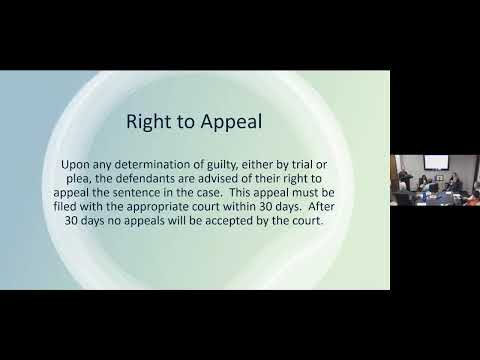
City Attorney Eric clarified the city attorney’s role: his office represents the city as prosecutor and is ethically restricted in advising judges or discussing specific pending cases. The judges and mayor emphasized that appeals are to the district court and must be filed within 30 days; appeals are limited to the trial record, not new evidence.
Council members asked for clarifications on bonds and conditions. The judges and city attorney explained the purposes of bonds (assure appearance, protect public safety), typical conditions (no contact orders, sobriety monitoring for DUI cases, random testing), and the distinctions among OR (own recognizance), cash and surety bonds.
The presentation was informational; councilors asked procedural questions and received clarifications about scheduling, bond conditions, probation supervision and appeal processes. No formal action was taken at the meeting.