CSU Pueblo outlines mixed‑use master plan, seeks local tax‑increment support for infrastructure
Loading...
Summary
CSU Pueblo officials presented a master development plan for more than 100 acres adjacent to campus and asked for local support for a financing package that would use tax increment financing and multiple metropolitan districts to pay roughly $7.8–9 million in horizontal infrastructure costs over a 25‑year period.
CSU Pueblo on May 15 asked Pueblo County officials to support a public‑private master development that would add retail, housing, a hotel, student apartments and new roads next to campus, and to consider sharing certain incremental tax revenues to finance horizontal infrastructure.
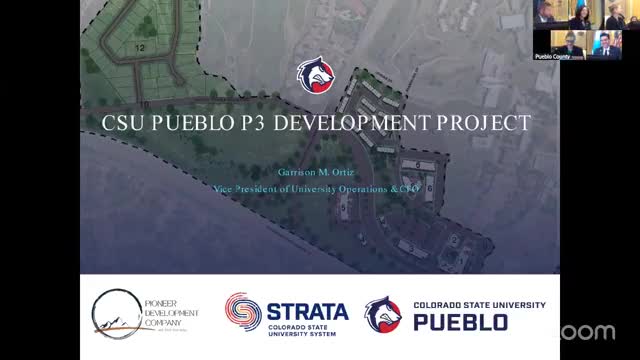
Garrison Ortiz, vice president of university operations and chief financial officer at CSU Pueblo, and Andy Arnold, principal of Pioneer Development Company, described a concept for development on more than 100 acres of university‑owned land that would be built in phases and financed through a combination of metropolitan districts, tax‑increment financing (TIF) from an urban renewal area and other public‑private tools. "This would be the first P3 project on a university campus that has its own metropolitan districts and its own URA overlapping," Ortiz said.
Ortiz said the university would contribute land and $3.8 million toward an extension of Desert Flower Boulevard and planned to use roughly $4.0 million in TIF financing to level and extend utilities to make the property developable. The presentation included an estimate of about $8.6 million in 25‑year net present value from tax increment revenue used to support bonding for public infrastructure; staff characterized the public‑eligible horizontal infrastructure cost as about $7.8 million. Andy Arnold said the metropolitan districts would likely issue debt to fund public improvements and that bonds could also be privately placed or purchased by a master developer.
Commissioners and presenters emphasized that the financing stack requires multiple approvals from the city, the county and other taxing entities. Ortiz said the CSU Board of Governors had approved a resolution in February to begin engagement on district formation, and that the city is handling the metro‑district formation process with an expected special election and timeline that could conclude by November. The presenters said they would not issue bonds until a master developer was selected; Ortiz said the university planned to issue a request for qualifications and hoped to select a developer by August or September.
Commissioners pressed for detailed written materials and modeling; several asked the university to provide the feasibility analysis, metro‑district documents and the draft urban renewal impact report so county staff could evaluate impacts to local taxing entities. Ortiz and Arnold said they would share working documents, impact reports and bond runs and expected additional materials to be provided as the URA and metro‑district work advanced.
No formal county action was taken at the work session. Commissioners expressed broad support for the project concept but framed the request as contingent on further analysis and formal intergovernmental agreements before any local tax revenue commitments are made.