Get Full Government Meeting Transcripts, Videos, & Alerts Forever!
Get email alerts on the State Legislation topic
No spam. Unsubscribe anytime.
Capital Success Group briefs Pueblo County on 2025 Colorado legislative wins and risks
Summary
Consultants from Capital Success Group summarized 2025 legislation they say will affect Pueblo County, highlighting a health‑care provider stabilization proposal, K‑12 funding preservation, changes to juvenile detention bed caps, and several county‑funding shifts tied to the state budget shortfall.
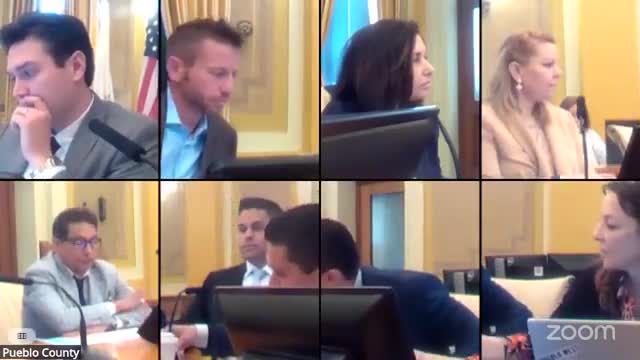
At a Pueblo County work session on May 13, representatives from Capital Success Group briefed county commissioners on major 2025 Colorado legislative actions likely to affect Pueblo County, including health‑care stabilization proposals, school funding choices and budget cuts that change county funding formulas.
The update mattered because several bills adopted or proposed this session directly affect county operations and local providers: hospitals and clinics, behavioral‑health centers, child‑welfare and public‑assistance programs, and juvenile services. County staff and commissioners were urged to prepare public‑facing summaries and meet with the local legislative delegation in June to plan next steps.
Alec Romero of Capital Success Group told commissioners that “Senate bill 25 3 10 this bill implement prop 1 30,” describing the bill as the implementing legislation for the voter‑approved Prop 130 fund. Romero said the Prop 130 implementation creates a multi‑year funding stream to support law‑enforcement hiring, training and retention; the fund is projected to start at $15,000,000 in fiscal 2026–27 and could grow to $35,000,000 over about 10 years, with disbursements beginning in December after the fund opens on July 1, 2026.
Romero and Ryan Romero of Capital Success Group highlighted other enacted and pending measures. Ryan Romero said House Bill 25‑1146 increases the statewide emergency juvenile detention bed cap from 22 to 39, allows more flexible assignment of those beds across Department of Youth Services facilities and requires monthly reporting on youth in detention and service delays. “It'll increase the emergency juvenile detention beds from 22 to 39 statewide,” Ryan Romero said.
The consultants emphasized health‑care pressures in the state. They briefed the board on Senate Bill 290, a bipartisan measure to create a provider stabilization fund backed by a minimum $100,000,000 investment from a mix of state and federal sources and contributions from hospitals. Capital Success Group described the bill as a response to the loss of Medicaid coverage for roughly 575,000 Coloradans over the past two years and said the fund aims to prevent clinic and behavioral‑health closures. The group also warned that the bill’s unusual funding mechanism—using interest on the State Treasurer’s Unclaimed Property Fund—could face legal challenge. The Unclaimed Property Fund was described in the presentation as holding about $1.5 billion in principal, with the stabilization proposal tapping interest earnings rather than principal.
On education funding, presenters said the legislature preserved full K‑12 funding and maintained hold‑harmless provisions that would have reduced aid for districts with declining enrollment. The update credited legislative choices during the session with preventing immediate cuts to K‑12 funding in Pueblo County.
Presenters summarized county‑relevant budget changes: a $25,000,000 increase for the Colorado Child Care Assistance Program (CCAP) spread across fiscal years (presented as $15,000,000 for 2024–25 and $10,000,000 for 2025–26), a $4,200,000 boost for SNAP administration (county responsibility), and a failed $3,000,000 proposed cut to child‑welfare funding. They also noted a reduction in the state share of retail‑marijuana sales tax distributed to counties—from 10% to 3.5%—which will reduce existing county revenue flows.
The consultants urged the county to shift from a defensive posture to a proactive one: preparing possible county‑led legislative proposals, coordinating with the county’s delegation, and scheduling a planning session in June. County Manager Ms. Genesio and commissioners encouraged a mid‑June meeting and requested that Capital Success Group provide concise, public‑facing bill summaries for town halls and constituent outreach.
The presentation included additional highlights: Senate Bill 3 (semi‑automatic firearms and rapid‑fire device restrictions with new training and eligibility requirements, effective Aug. 1, 2026) and House Bill 251040, which added nuclear energy to Colorado’s statutory definition of a clean energy resource and preserves local property tax revenue from nuclear facilities (effective Aug. 5, 2025). Staff said detailed reports and bill trackers will be provided to commissioners following the session.
County officials expressed concern about ongoing erosion of local control in some legislative proposals and about how the state addressed a reported $1.2 billion shortfall by sweeping state cash accounts. The consultants said Pueblo County should expect continued budget pressure next year and recommended early planning with the county’s legislative delegation.
The board did not take formal action on any bills during the meeting; the presentation was an informational briefing and the commissioners directed staff to schedule follow‑up planning and to request written summaries for public outreach.
Capital Success Group said it will send comprehensive reports and bill‑by‑bill trackers to the commissioners and offered to prepare short “cliff‑notes” summaries for town halls and public materials.