Get Full Government Meeting Transcripts, Videos, & Alerts Forever!
Get email alerts on the Public Transit topic
No spam. Unsubscribe anytime.
Regional transit planners give Norman update on 20–30-year Central Oklahoma plan
Summary
ACOG and Embark presenters updated the Norman City Council on the federally funded Central Oklahoma long-range transit plan, describing a 20–30 year vision that includes commuter rail, bus rapid transit, local network changes and potential Norman facilities. Planners stressed public input, funding timelines and federal environmental (NEPA) steps.
City officials and regional planners presented an update to the City of Norman Council on May 13, 2025, on the Central Oklahoma long-range transit plan, a federally funded study meant to guide transit investments across the region over the next 20 to 30 years.
The Association of Central Oklahoma Governments (ACOG) and Embark told the council the study—funded by the Federal Transit Administration and MAPS 4—has a budget of approximately $2,000,000 and is more than halfway through the planning process. "This plan is being funded by the Federal Transit Administration and MAPS 4 in Oklahoma City. It's approximately $2,000,000," said John Sharp, deputy director of ACOG.
The plan aims to define a regional vision tying high‑capacity corridors such as commuter rail and bus rapid transit (BRT) to local bus networks, microtransit, park‑and‑ride facilities and other mobility services so transfers and connections better serve riders. "We will develop an intentional plan for a cohesive network of transit services that supports growth, promotes equity, enhances quality of life, and facilitates opportunity across Central Oklahoma," said Chip Nolan, planning manager at Embark.
Planners said the study covers the ACOG planning area from Guthrie to Purcell and El Reno, and coordinates with local operators including Embark (Oklahoma City), Embark Norman, CityLink Edmond and First Capital Trolley. The RTA is participating in technical meetings and could provide regional funding and operations for future high‑capacity service. ODOT was identified as a partner for rural transit funding and the public transit revolving fund.
As part of the draft implementation assumptions presented, planners listed system‑level targets for the 20–30 year horizon: 15 high‑capacity, high‑frequency corridors (15‑minute service), 15 on‑demand microtransit zones, 23 new routes, 25 routes with enhanced frequency or span, and 16 capital facilities. For Norman specifically, the presentation identified two high‑frequency routes, four routes with enhanced service, three on‑demand zones, five new local routes and two capital facilities as possibilities.
Council members asked about potential Norman impacts including a proposed downtown station (the depot), north and south park‑and‑ride sites, an event stop near campus on Lindsay Street and the possibility of an RTA maintenance facility in Norman. Planners said those are being considered at a high level now and would require separate, more detailed studies and site evaluations before selection.
Staff cautioned about timing and federal requirements for property acquisition. A city staff member told council members that if federal funding will be sought, the environmental review under the National Environmental Policy Act (NEPA) must be completed before acquiring real property for transit facilities; acquiring property beforehand could jeopardize federal dollars for the project.
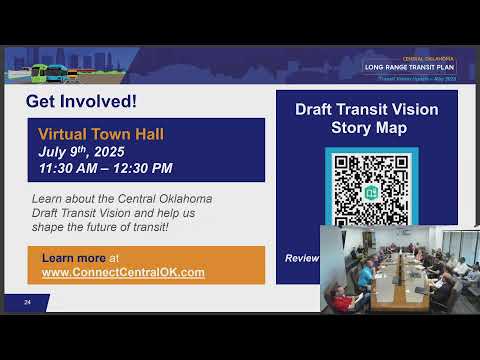
Planners outlined next steps and public engagement: another regional town hall in July, more workshops with agency staff to develop implementation details (dollars, staffing, facilities) and ongoing board and committee briefings through the summer. They said a final plan is aimed for public consideration this fall and subsequent review by the ACOG board in September or October.
The presenters encouraged public input via the project website, connectcentralokay.com, and noted a story map and recorded town hall are available there. City council members and staff indicated interest in continuing local planning work so Norman is prepared for future site‑level decisions and funding discussions.