Get Full Government Meeting Transcripts, Videos, & Alerts Forever!
Get email alerts on the Receivership Exemptions topic
No spam. Unsubscribe anytime.
Committee hears competing views on receivership bill that would change protections for wages
Summary
Senate Bill 3009, presented with a committee substitute, would require receivers after six months of unpaid judgments and expand receivers’ authority; proponents say it restores enforcement tools, opponents say it would strip long-standing protections for wages and other exempt assets.
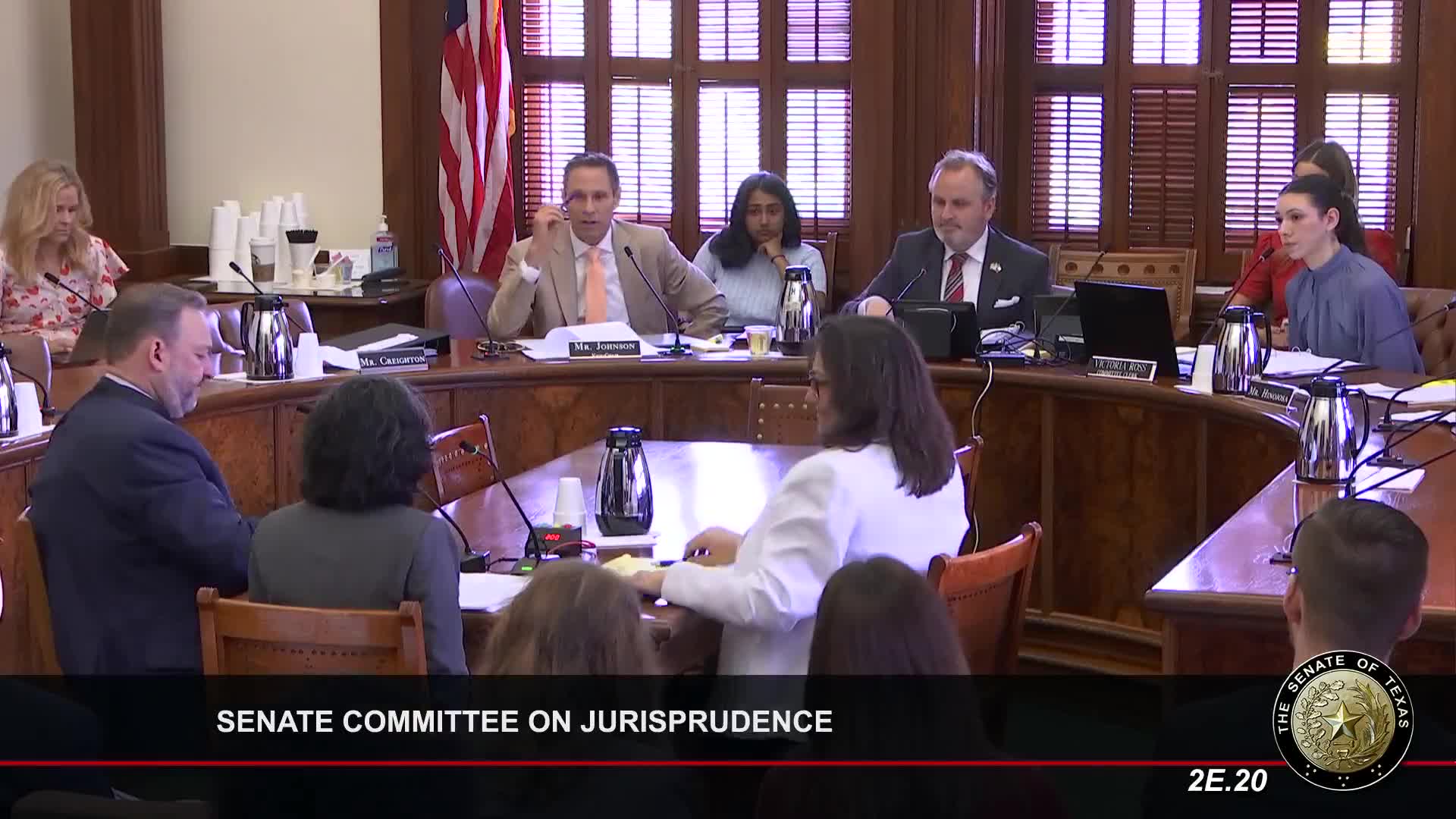
Senator Parker laid out Senate Bill 3009 and a committee substitute before the Committee on Jurisprudence, saying the measure "restores fairness and uniformity by requiring receivers after 6 months of unpaid judgments and also allowing receivers to seize non exempt property." The committee heard extended public testimony both for and against the substitute before closing public testimony and leaving the bill pending.
The bill’s supporters including Craig Nowak, speaking for the Texas Creditors Bar Association, said the change "is designed to stop the kinds of arguments that are being made, to disrupt what is already enshrined in the law." Nowak described turnover receivers as a necessary tool to enforce valid judgments and said receivers can resolve frozen accounts more quickly than garnishment proceedings.
Opponents — including Anne Vadore and Amy Clark, who testified in opposition — said the committee substitute removes long-standing protections for exempt assets and would expose low-income Texans to hardship. "The proceeds and disbursements of Texans' current wages are also protected from turnover receivers and this change in the law would remove that protection," Vadore said, adding that the protection was adopted in 1989. Clark said the bill "globs" two different legal schemes together and warned that receivership procedures are more powerful than garnishment and could be used against consumer accounts.
The central legal dispute presented to the committee concerned the scope of the protection in subsection f, 31.002 (as discussed in testimony): whether current wages and other exempt proceeds remain protected from turnover receivers or whether the committee substitute’s insertion of the word "sales" and additional language would permit turnover receivers to seize funds in bank accounts that contain commingled exempt assets. Clark and Vadore argued the change would collapse separate statutory regimes for garnishment and receivership, reducing consumer protections. Proponents said the change would harmonize enforcement approaches and prevent debtors from avoiding valid judgments.
Witnesses cited case law and administrative guidance during questioning. Opponents pointed to Cain v. Cain and the 1989 legislative change that, they said, was intended to protect paychecks and retirement benefits. Proponents described an increase in turnover use for small consumer debts since 2017 and urged the committee to restore what they described as the statute’s intended effect. The Texas Justice Court Training Center and the Texas Justice of the Peace and Constables Association were referenced as institutions involved in training and practice guidance.
Committee members pressed witnesses on practical consequences and on whether the bill’s language matched the sponsor’s intent. Judge Johnson asked opponents to identify concrete harms from the exact language added to subsection f; witnesses described consumer stories of frozen accounts, withheld financial aid and cascading hardships when exempt funds were taken. Both sides said they were open to compromise; one witness referenced the Texas Judicial Council’s 2020 recommendation for a basic cost-of-living exemption as an example of a middle-ground approach.
No vote was recorded in the transcript. The chair sent up a committee substitute and opened and closed public testimony; the bill remained pending at the end of the transcript.
The committee’s discussion underscored the procedural distinction witnesses emphasized: whether receivership rules should remain distinct from garnishment rules and whether statutory edits in the substitute would expand receivers’ power over funds long considered exempt.
If the committee or sponsor pursues further changes, committee members urged interested parties to work together to draft clarifying language that addresses enforcement efficiency without removing baseline protections for low-income Texans.