Get Full Government Meeting Transcripts, Videos, & Alerts Forever!
Get email alerts on the Capital Improvement Program topic
No spam. Unsubscribe anytime.
Planning commission finds two new CIP projects consistent with Fortuna City general plan
Summary
The Fortuna City Planning Commission voted to find two projects — a wastewater digester evaluation and a water-meter radio upgrade — consistent with the city general plan and will forward the recommendation to city council for inclusion in the fiscal 2025–26 Capital Improvement Program.
The Fortuna City Planning Commission voted to find two projects added this year to the draft 2025–26 Capital Improvement Program (CIP) consistent with the Fortuna City General Plan and forwarded the recommendation to the City Council for adoption as part of the budget process.
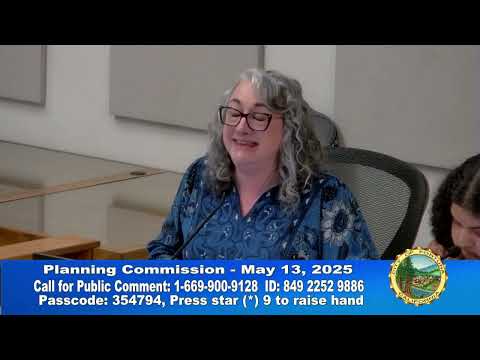
Sherry Meads, Fortuna City community development director, presented the item and described the two additions: an evaluation and repair project for the wastewater treatment plant digester and a radio replacement for the city’s aging water meters. “I am going to be presenting the 2025 Capital Improvement Program General Plan Consistency item,” Meads said at the start of her presentation.
The digester project responds to damage sustained during a December 5, 2024, earthquake. Meads showed photos of cracking on the digester’s floating dome and said the issue could force the city to take the digester offline. “A stuck dome could be a problem because air can get under the dome and mix with the methane, leading to potentially an explosion or most likely the dome would get stuck, which would force staff to take the digester offline, and cause interruptions in service, and potential fines,” Meads said. The CIP entry would fund an evaluation and any needed repair planning, including scheduling an offline inspection by a specialist to check for internal damage.
The second project will replace the current 520R radio-read meter system with a two-way SmartPoint 520M radio network. Meads said the existing 1-watt devices require meter readers to get very close to the units and are at the end of their life. The two-way system would allow near-real-time detection of leaks and usage anomalies so staff or customers can be alerted sooner. Meads said the upgrade would support city goals to reduce water waste and help maintain existing levels of service.
On environmental review, Meads said the commission’s consistency finding is an administrative determination and is exempt from environmental review; each project will undergo its own environmental review later if required by state law. “This project is simply evaluating the two new projects for their consistency with the general plan. The environmental review is exempt because it's an administrative activity that will not result in direct or indirect physical environmental changes,” Meads said. She added that individual projects will receive their own environmental review as they move forward.
Commissioners asked technical and policy questions during the discussion, including whether wastewater and water-system evaluations relate to housing-element requirements and whether extension of sewer service (for example, the Hilltop Road wastewater extension mentioned in the CIP materials) would trigger annexation or simply be provided as a service. Meads said she did not have the annexation detail available at the meeting and offered to follow up by email after consulting the deputy city engineer.
After public comment was closed, the commission approved the consistency finding by roll call and will transmit the CIP recommendation to the City Council, which is scheduled to consider adoption of the CIP as part of the fiscal 2025–26 budget process on June 2, according to Meads.
The commission’s action does not itself fund construction; it is a finding of general plan consistency that allows the projects to proceed through budget and project-specific environmental and design steps.