Get Full Government Meeting Transcripts, Videos, & Alerts Forever!
Get email alerts on the Special Needs Registry topic
No spam. Unsubscribe anytime.
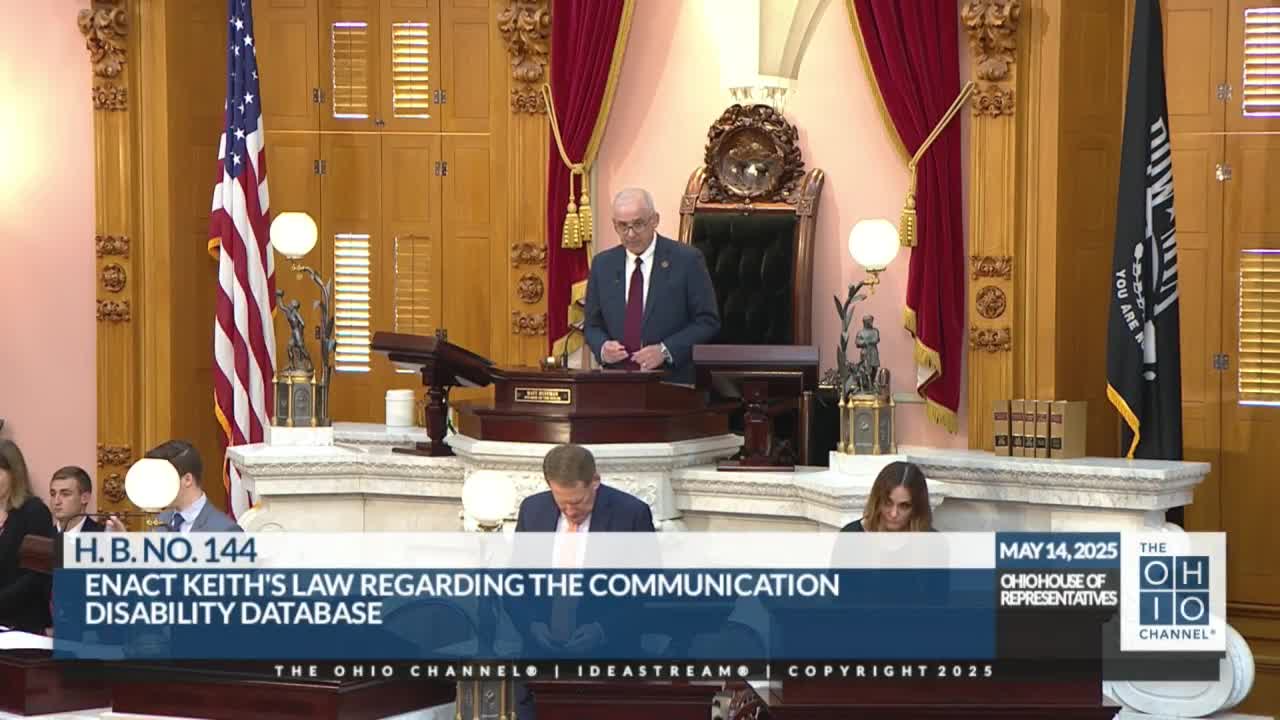
Ohio House passes ‘Keith’s Law’ to create voluntary special‑needs registry for first responders
Summary
The Ohio House on Tuesday passed House Bill 144, known as Keith’s Law, creating a voluntary statewide special‑needs indicator intended to let law enforcement and 9‑1‑1 centers know if a motorist or resident has autism, intellectual or developmental disabilities, or communication challenges.
The Ohio House on Tuesday passed House Bill 144, known as Keith’s Law, creating a voluntary statewide special‑needs indicator intended to let law enforcement and 9‑1‑1 centers know if a motorist or resident has autism, intellectual or developmental disabilities, or communication challenges.
Supporters said the registry could give first responders important context during traffic stops and other encounters. Representative Click, the bill’s sponsor, said the database would be run through the Department of Public Safety and “directs them to share that information with the local 9‑1‑1 centers across our state and requires them to implement a program locally.”
The bill’s backers told the House the registry is voluntary and intended to reduce the chance that officers will misread a person’s behavior during stressful encounters. Representative Lorenz, a joint sponsor, said, “This bill is simple. It's voluntary, and more importantly, it has the power to save lives.” Lorenz recounted a personal example involving his son and described the measure as giving families “control” and “peace of mind.”
Representative Click described the bill’s origin as a constituent request and gave examples of encounters in which anxiety or communication challenges were misinterpreted as intoxication or noncompliance. Click cited a national case in which an autistic man was shot during a confrontation and argued that better information could prevent similar outcomes. Click said the database will be voluntary and that many counties already maintain similar local lists.
Representative Brewer urged colleagues to support the bill while noting outstanding concerns about privacy and training; she said sponsors had assured her those issues would be addressed going forward. The House then voted; the clerk reported 89 affirmative votes and 2 negative votes, and the chamber declared the bill passed.
Implementation details discussed on the floor include: the indicator would be voluntary; it would be accessible to law enforcement during traffic stops; the Department of Public Safety was named as the statewide hub that would provide referrals to county 9‑1‑1 systems; and sponsors said the cost and operational burden would be minimal. The bill received unanimous committee support before floor consideration.
The measure now advances to the next step in the legislative process. No additional implementation timetable was provided on the floor.