Get Full Government Meeting Transcripts, Videos, & Alerts Forever!
Get email alerts on the Economy Revenue Forecast topic
No spam. Unsubscribe anytime.
Oregon economists warn trade uncertainty trims near‑term growth; June forecast reduces available resources by about $756 million
Summary
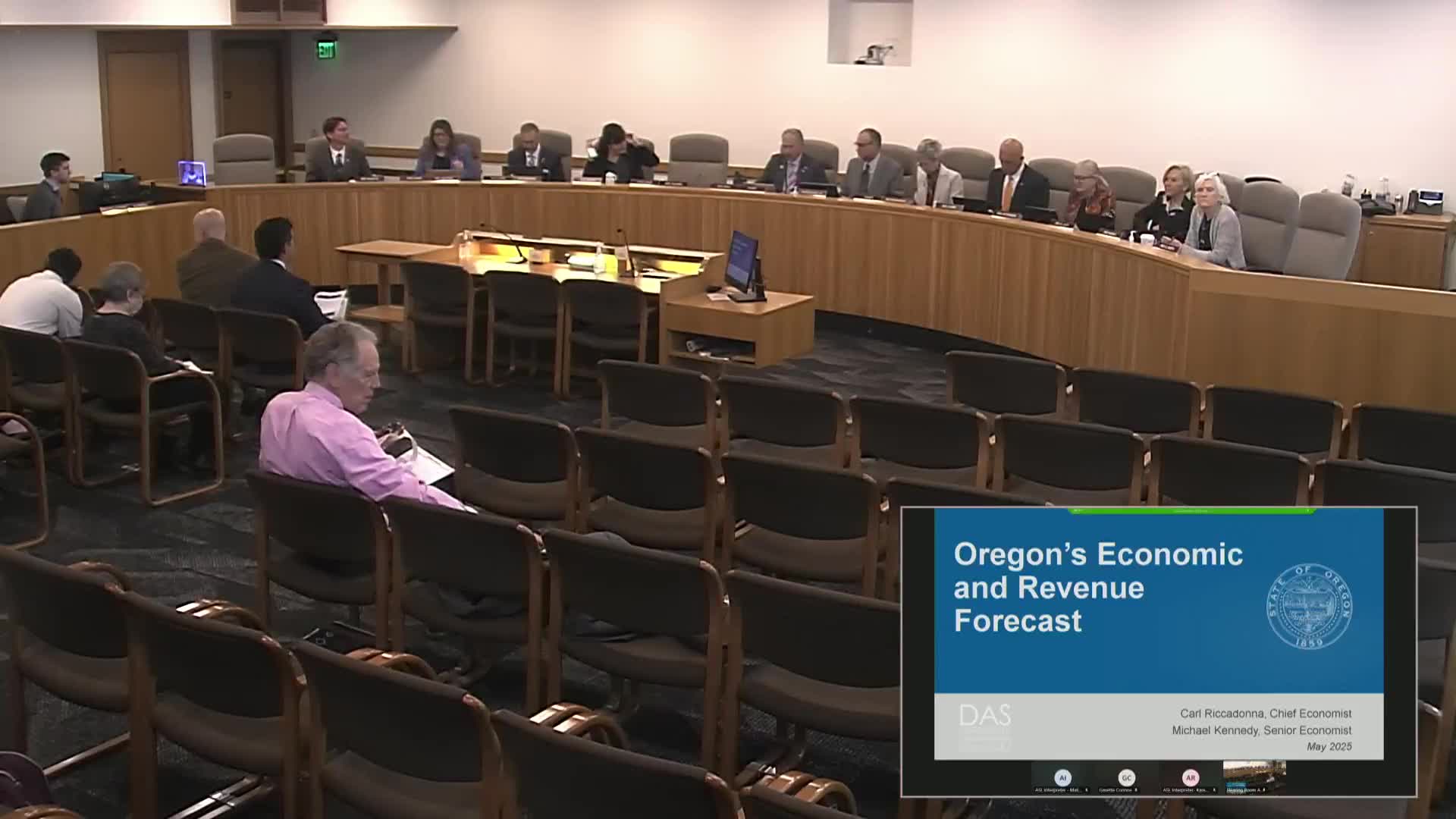
Office of Economic Analysis officials told the Senate Committee on Finance and Revenue on May 14 that easing trade headlines have lowered recession odds but a slower 2025 economy and weaker wage growth cut projected revenues, reducing net available resources for the 2025–27 biennium by about $755.7 million.
SALEM, Ore. — Officials from the State of Oregon’s Office of Economic Analysis told the Senate Committee on Finance and Revenue on May 14 that recent trade developments have reduced near‑term recession risk but that a slower national and state economy has cut the revenue outlook and will shrink resources available for the 2025–27 biennium.
“Oregon was impacted more than the average state by the 2018 tariff episode,” said Carl Riccadonna, chief economist for the State of Oregon. “Our view is that the risk of recession is more like a 25 percent probability.”
The committee heard that recent diplomatic and trade headlines — including reported progress in talks with the United Kingdom and contacts involving senior U.S. Treasury officials and Chinese counterparts — reduced the Office’s estimate of an “effective” tariff rate applied to U.S. imports from about 28 percent to roughly 18 percent. Riccadonna said that change corresponds to a multi‑hundred‑billion‑dollar swing in the implicit tariff levy and materially affects the short‑run outlook for GDP and prices.
Why it matters: economists said the tariff news cut some downside risk but that the state still faces a period of sluggish growth in 2025 and into early 2026. That slower growth, combined with weaker wage and salary trajectories, is the primary driver of the diminished revenue outlook.
Michael Kennedy of the Office of Economic Analysis presented the revenue figures tied to the economic outlook. “There’s basically a revenue decrease between the current biennium ... and next biennium. The total revenue decrease is about half a billion dollars,” Kennedy said. He later detailed that the forecast now shows the ending balance down by about $414 million and that net resources available for appropriation for the 2025–27 biennium are down roughly $755.7 million.
Most of the revenue reduction stems from lower personal income tax collections. The office reduced its expectation for wage and salary growth in the current year from 5.5 percent to 4.5 percent; Kennedy said the compounded effect of that and earlier revisions is the chief reason personal income tax receipts are lower in the forecast. He also noted compositional changes in 2024 tax filings, including a higher observed capital‑gains share during tax season that then partly retracted.
Committee members pressed economists about sectoral and regional exposure. Riccadonna said Oregon is more exposed than the nation to international trade because of its manufacturing and export footprint and that manufacturing and construction job losses have weighed on recent state performance. He also highlighted demographic pressures: Oregon’s population growth has slowed and the state is aging, which “has negative implications for tax revenues” as per his testimony.
On reserves and other funds, Kennedy reported the state’s combined reserves (education stability fund and rainy day fund) remaining near 10.6 percent of general fund revenues under current assumptions; he warned that extreme historical shortfalls (for example, the 2001 episode that produced a roughly 15.6 percent shortfall relative to forecast) remain low‑probability but illustrate downside exposure.
The forecast incorporates scenario analysis. Staff characterized a baseline that assumes softer growth in 2025 with re‑acceleration in later 2026 and 2027 if tariffs ease further, federal tax proposals provide stimulus and the Federal Reserve eases policy; alternative scenarios model larger downside and upside outcomes. Economists emphasized uncertainty: Riccadonna noted the office’s central scenario carries somewhat less than normal confidence and that forecasters are presenting fatter tails around the baseline.
The presentation was informational; the committee did not take formal action. Senators and representatives asked follow‑up questions about the implications for state policy, the size and use of the projected “kicker” refund, and whether Oregon could capture reshoring of manufacturing. Economists said Oregon is not heavily exposed to automobile manufacturing reshoring but that state policy could affect future competitiveness.
The Office of Economic Analysis said it will continue to monitor incoming data — including revised state employment data due later the morning of May 14 — and update projections as warranted. No committee votes or budget decisions were taken at the hearing.