Get Full Government Meeting Transcripts, Videos, & Alerts Forever!
Get email alerts on the Sustainability topic
No spam. Unsubscribe anytime.
DAS outlines statewide sustainability push, cites HB 3409 and new design guidelines
Summary
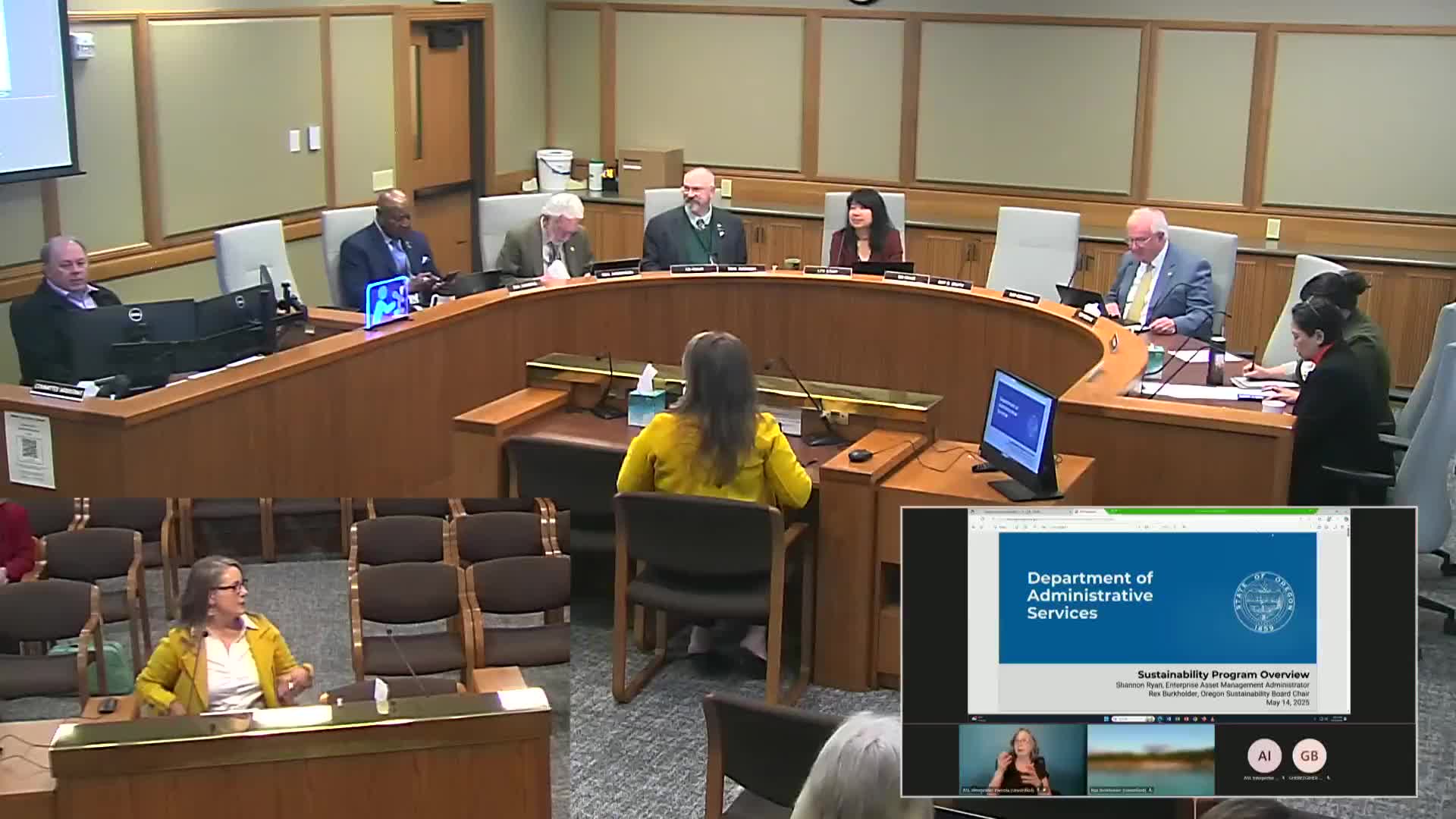
Department of Administrative Services officials told the General Government Subcommittee on May 14 that the agency is scaling up sustainability work across state buildings, vehicle fleets and procurement to meet new legislative and executive directives.
Department of Administrative Services officials told the General Government Subcommittee on May 14 that the agency is scaling up sustainability work across state buildings, vehicle fleets and procurement to meet new legislative and executive directives.
The briefing focused on House Bill 3409 and executive orders directing greenhouse-gas reductions, expanded electric-vehicle charging and ‘‘net‑zero ready’’ building aims; DAS officials described new enterprise tools, guidance and a public dashboard to track agency energy and vehicle emissions.
Shannon Ryan, administrator for DAS’ Enterprise Asset Management division, told the committee: "We have 2.3 megawatts of installed solar" and said DAS is developing next‑generation sustainable design and landscape guidelines to shape future construction and major renovations across state agencies. Ryan said the office of sustainability is situated inside Enterprise Asset Management to reflect that most enterprise emissions come from buildings and vehicles and that the office serves as both a technical resource for DAS and a statewide policy support unit for agencies.
Rex Burkholder, chair of the Oregon Sustainability Board, described the board’s membership and role in advising on procurement, building design and equity: "The Oregon Sustainability Board is comprised of currently 9 members who represent communities from throughout the state," he said, and noted the board’s emphasis on measurable outcomes and community engagement during an annual out‑of‑Valley meeting.
DAS described four implementation areas that have been rolled out with board support: energy/resource conservation practices for building operations, fleet electrification, sustainable procurement policies now housed in the state procurement office, and guidance on chemicals and landscape management. Ryan said the enterprise dashboard currently aggregates energy, fuel and greenhouse‑gas data and that water and waste metrics will be added in the coming year.
DAS told the committee that HB 3409 requires agencies to assess their buildings’ greenhouse‑gas emissions and that DAS is building an enterprise database to track emissions for goal setting and life‑cycle analysis. Ryan said the department is also creating ‘‘sustainable design guidelines’’ that will affect new construction and major renovations and that landscape guidelines will be updated to reflect regional climate and water‑use conditions.
When asked about solar deployment, Ryan said installations on some state properties and projects such as a solar awning in Wilsonville are in place but cautioned that rooftop solar rarely powers an entire building: "It is by no means like the panacea," she said, noting that geography and solar resource matter. She and Burkholder both flagged opportunities to site larger solar arrays in state right‑of‑way and noted DAS has submitted a $15,000,000 general‑fund policy option package to coordinate statewide EV infrastructure and support solar in harder‑to‑electrify places.
Committee members asked about the enterprise dashboard and an interactive ‘‘storyboard’’ mapping emissions and commute impacts from hybrid work. Ryan said the tool uses Workday and GIS data to estimate vehicle‑miles avoided and greenhouse‑gas reductions tied to telework and hybrid schedules; she encouraged members to review the public storyboard and dashboard.
DAS said many implementation tasks will be substantial IT and program efforts — building the emissions database, updating procurement rules and standing up guidance for agencies less familiar with facility management. Ryan told the committee DAS will continue supporting the Oregon Sustainability Board and agencies as policies are translated into agency plans and projects.
The presentation closed with the department offering to provide follow‑up materials and links to the dashboard and storyboard for legislators and staff.
Less urgent items from DAS’ presentation included a description of the board’s quarterly meeting practice of visiting communities outside the Willamette Valley and the agency’s work on pesticide, chemical and stormwater guidance for landscapes in different regions.