Get Full Government Meeting Transcripts, Videos, & Alerts Forever!
Get email alerts on the School Finance topic
No spam. Unsubscribe anytime.
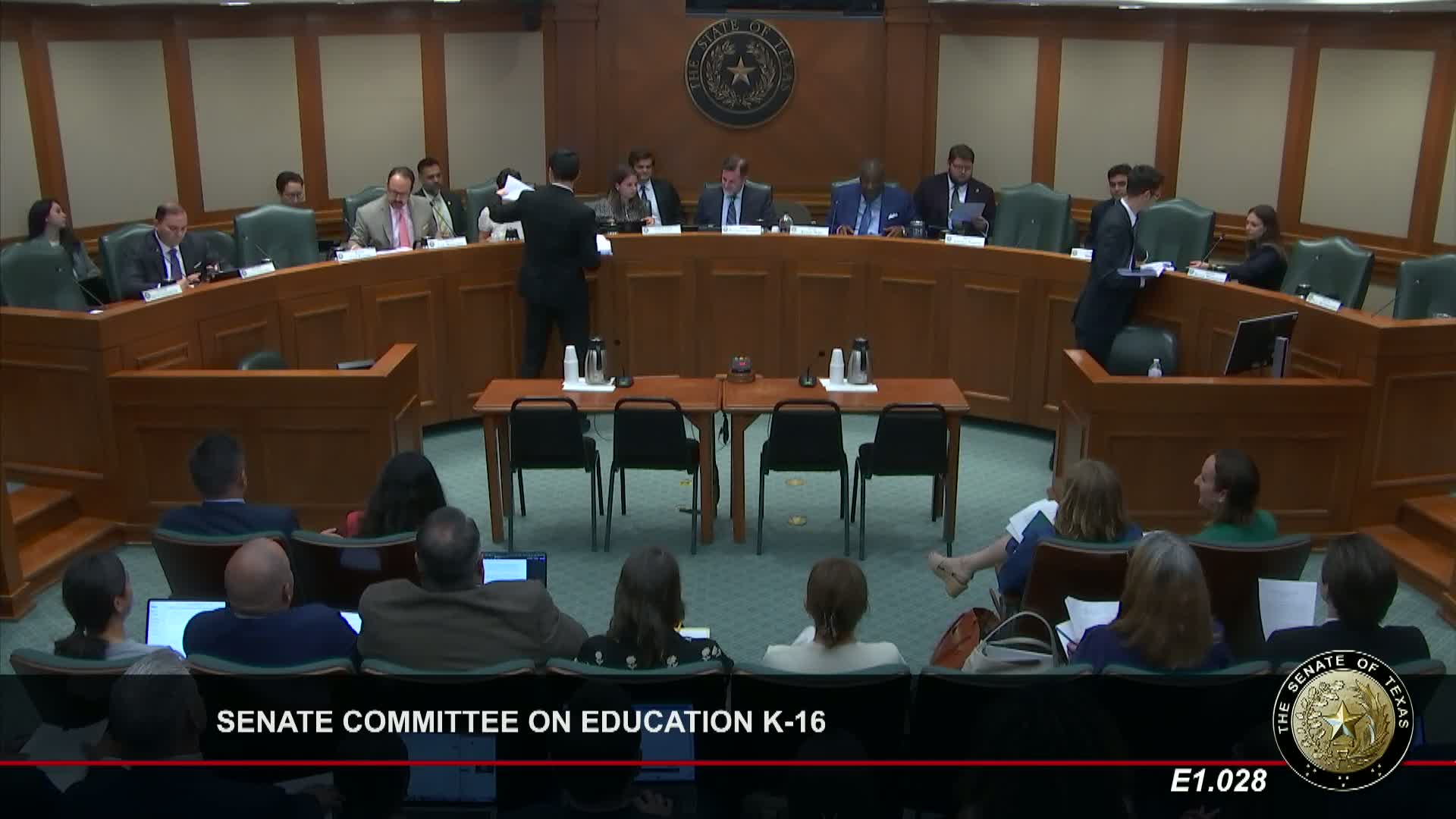
Senate Education Committee adopts HB 2 committee substitute that directs $8 billion for public schools, creates permanent teacher pay allotment
Summary
The Senate Education Committee on HB 2 adopted a committee substitute at a committee hearing that the chair said would deliver "$8,000,000,000 in new funding for Texas public education."
The Senate Education Committee on HB 2 adopted a committee substitute at a committee hearing that the chair said would deliver "$8,000,000,000 in new funding for Texas public education." Senator Creighton, chair of the Senate Education Committee, presented the substitute and described new, permanent funding for teacher compensation and targeted investments in literacy, career and technical education and school safety.
Why it matters: The substitute reshapes how Texas directs new dollars to school districts by creating a permanent teacher compensation allotment separate from the basic allotment, expanding special education funding and adding tranches for early literacy and school-safety investments. Committee members and invited witnesses said the changes could affect teacher recruitment and retention, district budgeting and charter school funding and oversight.
The committee substitute for House Bill 2, as laid out by Senator Creighton, would allocate $8 billion in new state funding across the biennium. Creighton said the bill adds an equivalent of $55 to the basic allotment — the session’s stated $55 increase equates to about $800 million — and that the remainder of the new dollars, about $7.2 billion, is devoted to other targeted investments. "House Bill 2 delivers $8,000,000,000 in new funding for Texas public education," Creighton said while summarizing the substitute.
Central to the substitute is a new, permanent teacher compensation allotment, Creighton told the committee. He said the allotment is intended to make teacher pay increases enduring rather than one-time stipends tied to the two-year budget cycle. Creighton also described a larger funding split for teacher compensation: he said roughly 80% of the new teacher-compensation dollars are intended for across-the-board raises beginning in the third year of teaching, while about 20% would go to the Teacher Incentive Allotment (TIA), the program that provides additional compensation for designated teachers.
Creighton said the substitute also expands investments in early literacy and numeracy, teacher preparation and mentoring programs, career and technical education, and school safety. He reported that special education funding in negotiations had been increased to $1.3 billion from an earlier figure when the bill left the Senate. "So you see that reference alone... the special education money separate from that couldn't be $1,300,000,000," he said.
Senators pressed the chair on several policy and distribution details. Senator Menendez and others asked whether parental-notification provisions for uncertified teachers applied to charter schools; Creighton replied that the current requirement in the substitute is for "public schools" and that, as drafted, charter schools are treated differently in some provisions. Menendez repeatedly raised concerns about parity between charter and traditional independent school districts (ISDs), questioning why certification and other requirements would apply differently to charters and traditional public schools. "If we're going to have people building these new buildings, what guarantees or assurances do we have to Texas taxpayers that these buildings are gonna be owned by taxpayers and not owned by out-of-state corporations," Menendez said while questioning charter facilities policy and oversight.
Senator West echoed concerns about charter alignment with public-school requirements and asked the chair to consider parity on teacher-certification rules and other obligations. Creighton acknowledged differences in statutory treatment of charters and traditional public schools, noting that charters have specific accountability mechanisms such as automatic closure after three consecutive failing ratings, a mechanism not applied to traditional public districts.
Committee action: The clerk called the roll. After members present were announced, the committee "adopted the committee substitute" for House Bill 2; Senator Hinojosa "sent up" the committee substitute and the chair asked if there were objections. Hearing none, the committee ordered the substitute adopted. The committee then proceeded to invited testimony and opened public testimony for registered witnesses.
Invited and public testimony focused on teacher pay, mentoring, residency programs and the Teacher Incentive Allotment. Dr. Imelda La Rosa, an eighth-grade science teacher with an exemplary TIA designation from a rural campus, told the committee that mentorship and expanded TIA access help rural districts recruit and retain teachers and that teacher-support investments are investments in student outcomes. "When we support teachers, we're investing directly in student achievement," Dr. La Rosa said. Val Acree, a rural high-school teacher with a TIA designation, asked the committee to expand eligibility and noted that TIA helped Yorktown ISD recruit teachers in subjects that had previously been taught remotely.
Other witnesses urged restoration or expansion of fine-arts and extracurricular funding and asked the committee to consider the distributional effects of the bill. Philip Morgan and Dash Koska highlighted the role of fine arts and extracurriculars in student engagement; several witnesses said those programs help keep students in school and improve outcomes. Superintendents and trustees described local circumstances: Greg Poole, superintendent at Barbers Hill ISD, asked the committee to consider flexibility for districts that already pay higher salaries and have consistently high outcomes.
Process and next steps: The chair reminded members that public registration for testimony on HB 2 remained open until 1 p.m. and that registered public witnesses would be limited to two minutes each. The committee recessed to attend Senate floor business and planned to reconvene after the floor session to continue public testimony and questions.
What the committee did not do: The substitute was adopted as a committee action; the committee did not take a roll-call recorded vote on final passage in this hearing. Several policy details discussed during questioning — including exact charter-school facility oversight, whether certain certification deadlines should be aligned for charters and ISDs, and how the "golden penny" yield interacts with recapture/Robin Hood — were left for further consideration during negotiations with the House and subsequent committee work.
The hearing record shows the committee advanced a sweeping funding framework for public education that lawmakers and witnesses said would reshape teacher pay structures and fund targeted programs, but many implementation and parity questions remain to be resolved in conference with the House and in later committee work.