Get Full Government Meeting Transcripts, Videos, & Alerts Forever!
Get email alerts on the Military Veteran Peer Network Expansion topic
No spam. Unsubscribe anytime.
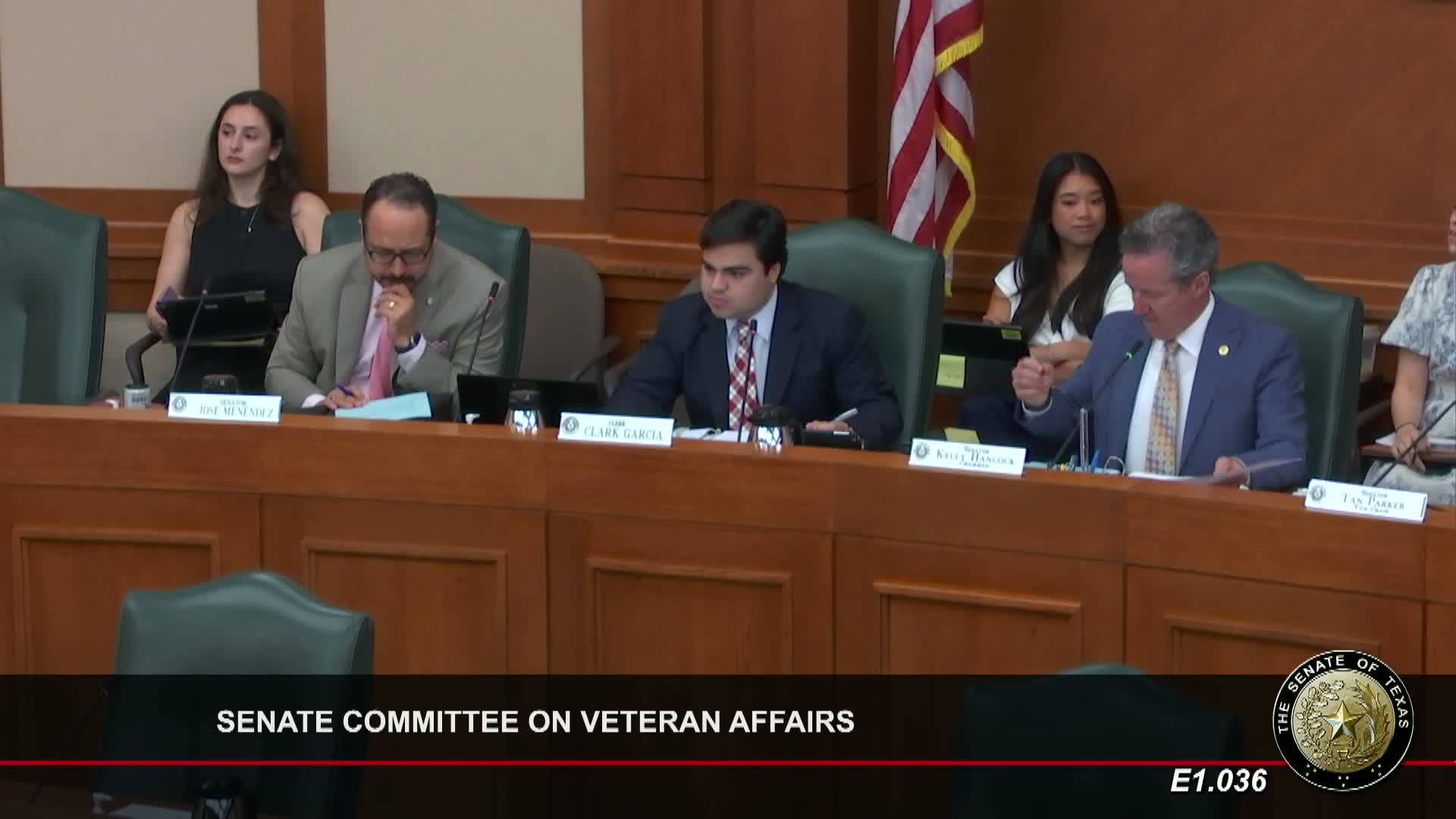
Panel hears bill to study expansion of military veteran peer network; VFW urges growth to address suicides
Summary
House Bill 1965 would require the Texas Veterans Commission to study ways to increase access to veteran peer‑support coordinators — with emphasis on rural areas — and recommend steps to grow the military veteran peer network; the committee left the bill pending after testimony from the VFW and a TVC resource witness.
House Bill 1965, sponsored in the House by Representative Garcia and presented to the Senate committee by Senator Menendez, would require the Texas Veterans Commission to study how to expand access to mental‑health services through the military veteran peer network and provide recommendations to increase the number of peer support coordinators, particularly in rural communities.
Senator Menendez said the military veteran peer network is tasked with providing peer‑to‑peer support, referrals to mental‑health services, suicide‑prevention training, and military‑cultural‑competence training for local communities. “Decades of research has shown that peer support services are highly effective and can promote a sense of community while improving mental health and substance use outcomes for veterans,” he said.
The committee record shows the network currently comprises 66 TVC‑certified peer service coordinators who work with local mental‑health authorities, veterans treatment courts and county jails; those coordinators oversee over 6,000 registered peer volunteers, and volunteers helped more than 60,000 veterans last year, the sponsor said. The bill emphasizes expanding coordinator capacity in rural areas, where coordinators must often travel long distances to meet veterans.
Mitch Fuller, legislative director for the Veterans of Foreign Wars (VFW) Department of Texas, testified in support. “Sometimes, most of the time, actually, the best person to help a veteran talk to a veteran is a fellow veteran,” Fuller said. He added that the VFW and the Grunt Style Foundation are pressing for accountability for federal programs and questioned how federal VA suicide‑prevention funds are used. “The VA spends $571,000,000 on its veteran suicide program. Where does that money go?” Fuller asked.
The committee opened and then closed public testimony with no further speakers and left House Bill 1965 pending for later action.