Get Full Government Meeting Transcripts, Videos, & Alerts Forever!
Get email alerts on the Tax Rate Injunctions topic
No spam. Unsubscribe anytime.
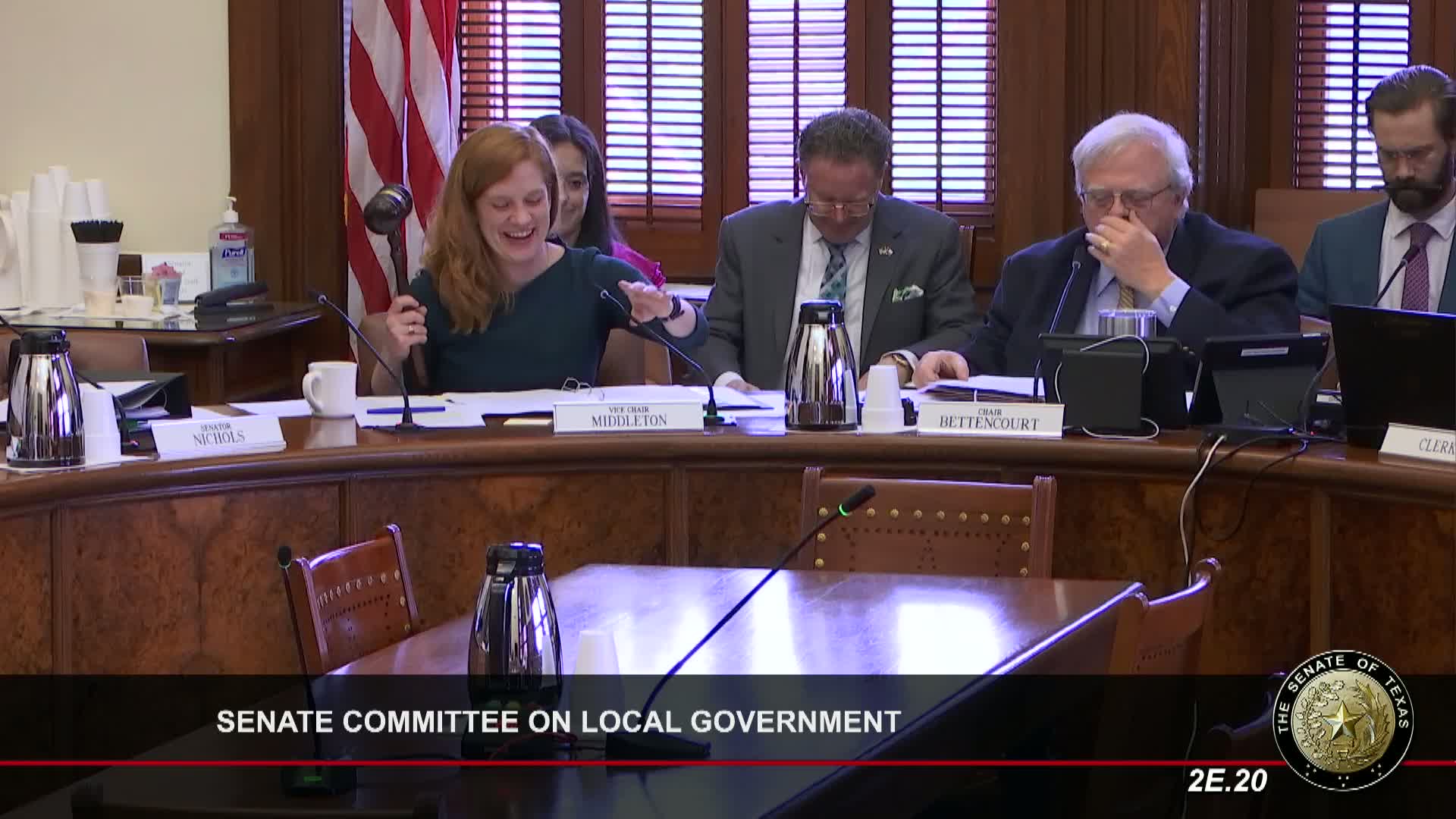
Committee hears wide-ranging debate on SB 3071, which would allow injunctions if voter-approved tax uses materially deviate
Summary
Senate Bill 3,071 would let property owners seek injunctions barring tax collection when a taxing unit materially deviates from the purpose described in a voter-approved tax-rate ballot; senators and witnesses debated standards, effects on voter-approved financing and Project Connect examples.
The Committee on Local Government heard extended testimony on Senate Bill 3,071, which would permit a property owner to obtain an injunction to halt collection of taxes when a taxing unit materially deviates from the purpose stated on the ballot for a voter-approved tax rate.
Senator Bettencourt, who laid out the bill, said the measure seeks to “codify limits on how much a local government can change the purpose for a tax rate election after the votes have been cast.” He told the committee the protection already exists for bond elections and should similarly apply to tax-rate elections.
The committee substitute, described in committee, would add legislative-counsel language specifying that the act applies only when the material deviation occurs after the act’s effective date; the sponsor said the act takes effect immediately if it receives two-thirds support for immediate effect, otherwise on Sept. 1.
Witnesses were divided. Rick Fine, an attorney who practices in property-tax law, supported the bill and said clearer statutory guardrails would reduce litigation over when a taxing unit has changed the use of voter-approved funds: “This statute would actually prevent a lot of litigation,” he said, adding that the bill provides “very, very lenient” guidelines for permissible deviation.
Opponents warned of unintended consequences. Jay Blaze Crossley, representing Farm & City (a transportation and planning nonprofit), opposed the bill and said it could effectively make tax-rate elections impractical by exposing taxing units to perpetual legal risk. “It creates a significant legal time and cost for cities,” Crossley said, arguing the result might be fewer local tax-rate elections.
Several witnesses used Austin’s Project Connect as an example of the kind of large infrastructure program supporters say triggered the bill. Susan Spataro, who testified earlier in the hearing, said that when project scope and alignments changed after voters approved financing measures, the deviations were material and required a remedy: “When you’re taking taxpayers’ dollars, you need to tell them the truth,” she said.
Transit Forward’s executive director, Ashika (Ashika) Ganguly, opposed the bill on similar grounds, telling the committee that large projects face inflation, supply-chain and engineering changes, and that a 33% cost increase is “not failure, it’s just a simple reality” in current construction conditions. Ganguly said the bill’s “vague definition of material deviation” risks encouraging lawsuits, draining public funds and undermining voter trust.
Proponents pointed to a 15-day filing window in the substitute and to existing mechanisms that limit frivolous suits, including court rules and bond requirements. Senator Bettencourt and other supporters argued the bill includes specific factors—such as a 33% increase in projected cost, significant reduction in scope, or a change in stated purpose—that courts could use to decide whether a deviation is material.
The committee took the testimony and left the committee substitute pending subject to the call of the chair. No committee vote was taken the day of the hearing.