Get Full Government Meeting Transcripts, Videos, & Alerts Forever!
Get email alerts on the Insurance Rate Regulation topic
No spam. Unsubscribe anytime.
Senate committee adopts substitute changing how insurersmay be reviewed for "excessive" rates; commissioner warns it wont fix root causes
Summary
The Senate Insurance Committee on May 14 adopted a substitute to Senate Bill 172 that removes the statutory "competitive"/"noncompetitive" market distinction and inserts NAIC-style language to let regulators review whether rates are "excessive" or "unreasonably high," a step the insurance commissioner warned would not fix the underlying causes of high premiums.
The Senate Insurance Committee on May 14 adopted a substitute to Senate Bill 172 that would change how the Department of Insurance reviews homeowners and property rate filings, removing a statutory distinction between "competitive" and "noncompetitive" markets and adding language drawn from NAIC guidance to address "excessive" or "unreasonably high" rates.
The substitute also would require insurers to furnish the department with additional detail about expense and profit components of filings and replace several existing statutory terms with new definitions drawn from model-law language. The committee adopted the substitute by unanimous voice and then reported the bill favorably.
The change drew support from senators sponsoring the measure as a tool to press insurers and their affiliates for clearer justification when premiums rise. "We are gonna take some of this language ... which mirrors some of Mississippi's language to give us the best chance at lowering rates," Senator Alon said when presenting the substitute to the committee.
But Tom Temple, Louisiana insurance commissioner, told the committee he opposed the amended approach and that adding a separate "excessive" standard would not address the underlying drivers of high premiums. "This seems to still be a solution looking for a problem," Temple said, adding that the Department of Insurance already "21 times" had denied company rate requests because they were "not actuarially justified."
David Caldwell, a Department of Insurance attorney who later addressed statute language, said existing law already gives regulators the tools to deny rates that are inadequate or unfairly discriminatory and that actuarial review covers profits, expenses and other components. "Rate shall not be inadequate or unfairly discriminatory in a competitive market," Caldwell recited, and he pointed to existing actuarial standards the department applies during review.
Supporters of the substitute said the NAIC-model wording clarifies how the department should evaluate profit and expense items that can make otherwise actuarially defensible rates nevertheless "unreasonably high." Opponents, including Commissioner Temple and several insurance industry witnesses, warned that inserting a definition such as "unreasonably high" could introduce subjective judgment into rate approvals and could deter carriers from writing business in the state.
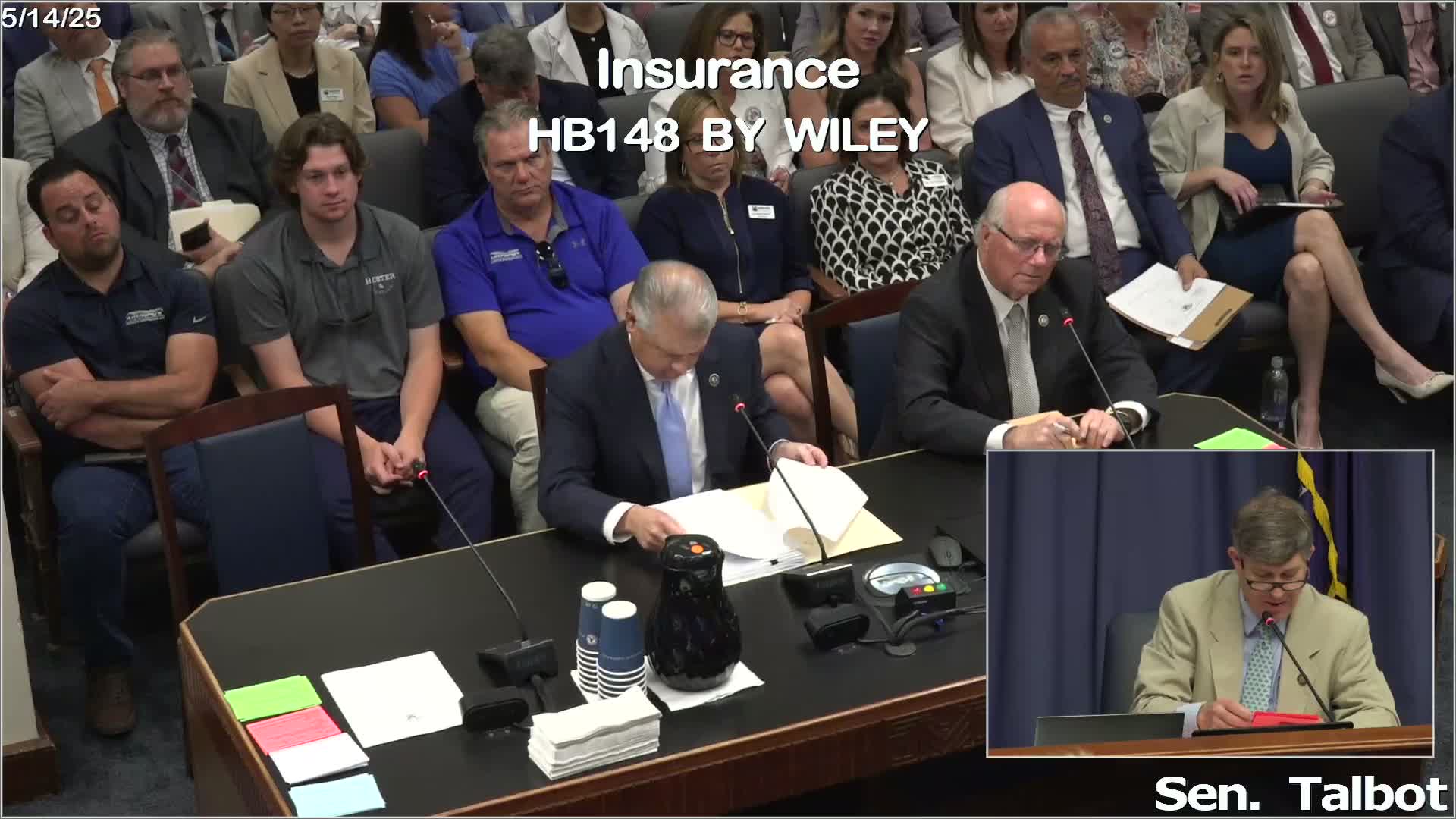
In related action, the committee moved House Bill 148 (Representative Wiley), which would require insurers to show prior-period premium amounts on renewal notices so customers can more easily tell how their premium has changed. That measure advanced after proponents argued it is a straightforward consumer-transparency step; Commissioner Temple backed the renewal-disclosure portion but again objected to the NAIC-model language that would broaden regulatory review.
What the committee adopted does not immediately change an existing insurerrate filing process statewide; it places a different standard in statute and sends the measure on to the next legislative steps. The commissioner said he would continue to press for reforms to reduce claims costs and that he preferred administrative or study approaches rather than a statutory overhaul he called potentially destabilizing.
Lawmakers and the department agreed to continue discussions as bill text proceeds to the next stage, and the committee recorded the substitute as adopted and reported SB172 to the full Senate.