Get Full Government Meeting Transcripts, Videos, & Alerts Forever!
Get email alerts on the Union Dues topic
No spam. Unsubscribe anytime.
Committee advances bill requiring annual reauthorization of public-sector union payroll deductions
Summary
House Bill 293, which would require annual written reauthorization for payroll deductions of union dues and shift administrative costs to unions, was reported favorably by the Senate committee after extensive testimony from educators and union leaders.
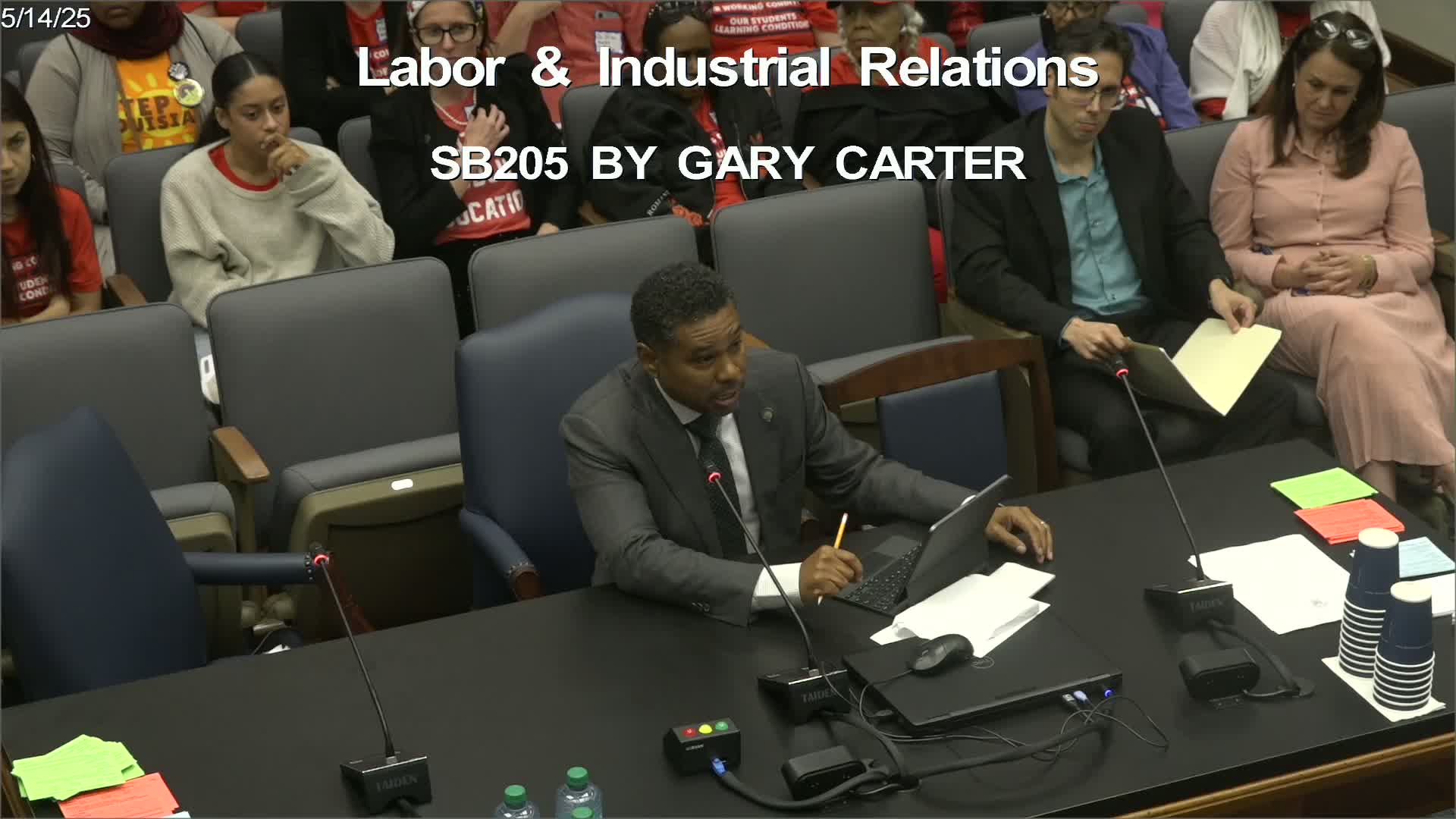
The Senate Labor and Industrial Relations Committee on May 14 voted to report House Bill 293 favorably, a bill that requires annual written reauthorization before public employers deduct union dues from paychecks and directs labor organizations to bear administrative costs for those deductions.
Representative Mallory, the bill’s author, said the measure standardizes and clarifies employees’ options to stop dues deductions: “This is an opt in. I don't want to clarify that part for everybody... it is an opt in,” Mallory said in closing remarks.
Supporters of the bill, including representatives of the Associated Professional Educators of Louisiana and the Pelican Institute, described it as a consumer-consent and transparency measure. Keith Corville of APEL said the bill “is not anti-union” but is intended to ensure affirmative consent and to protect employees from unnoticed deductions.
Organized labor and many educators opposed the measure. Multiple teachers, paraprofessionals and union leaders said the change would impose administrative burdens and risk lapses in protections for employees who rely on payroll deductions for membership, liability coverage and insurance. Rachel Chapman, president of the Vermilion Association of Educators, said, “When the state tries to interfere with the relationship between employees and their union, it undermines trust, morale, and the democratic process.”
Opponents also flagged the bill’s broader provisions: annual reauthorization of dues, possible retroactive invalidation of prior authorizations, and exemption language that excludes police and fire in some sections. Peter Robbins Brown of the Louisiana AFL-CIO warned the bill created “red tape” and could require repeated verification around collective-bargaining agreements.
An amendment adopted in the House directs that administrative costs for processing opt-outs be borne by the labor organization to avoid unfunded mandates on public employers.
The committee recorded a favorable report on HB 293 by roll call; the chair announced the result as reported favorably (committee announcement: House Bill 293 is reported favorably). The committee did not detail a floor amendment at that time.
What’s next: With the committee vote to report, HB 293 moves on in the legislative process to the next Senate stage.