Get Full Government Meeting Transcripts, Videos, & Alerts Forever!
Get email alerts on the Insurance Regulation topic
No spam. Unsubscribe anytime.
Senate committee votes to report bill making Louisiana insurance commissioner an appointed post
Summary
The Senate and Governmental Affairs Committee reported favorably, as amended, on Senate Bill 214, which would change the insurance commissioner from an elected office to a governor-appointed position, adding consumer representatives to the appointment list and delaying the transition date.
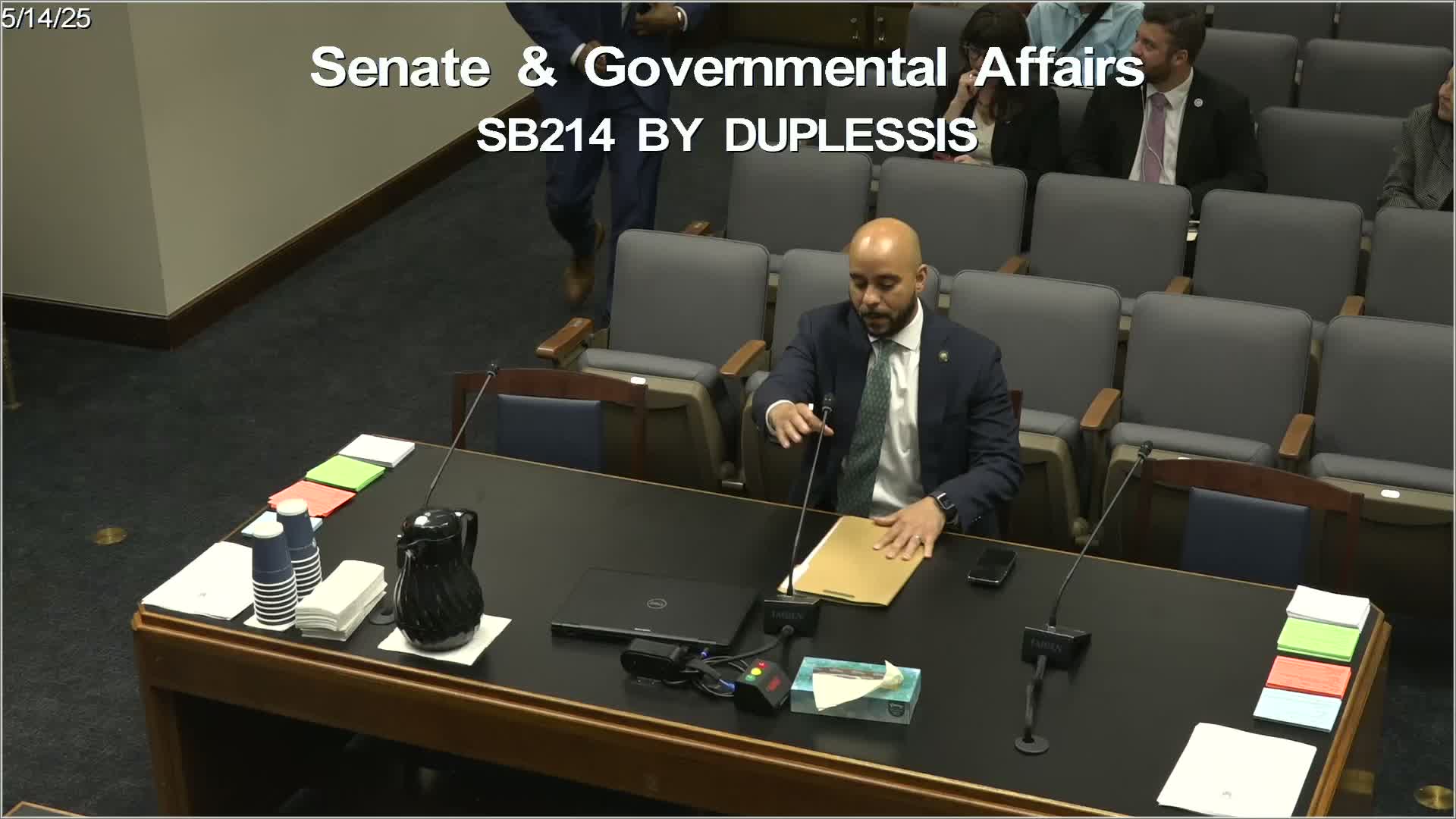
Senators on the Senate and Governmental Affairs Committee voted to report Senate Bill 214 as amended, a measure from Sen. Royce Duplessis that would change Louisiana's insurance commissioner from an elected to an appointed position.
Supporters said the change would depoliticize regulation and could help stabilize insurance markets; opponents said it would remove accountability by taking the choice away from voters.
Sen. Royce Duplessis opened the hearing by arguing that "when something isn't working ... we have to be honest enough to say it's time to do something different," citing Louisiana's high auto and homeowners premiums and the state's loss of carriers. Duplessis said the current structure "has created a system of political dependence on the very industry the commissioner is supposed to regulate," and cited analysis from the R Street Institute showing Louisiana as an outlier among states that elect commissioners.
Insurance Commissioner Tim Temple testified in opposition. Speaking to the committee, Temple said changing the selection method "takes the will of the people" out of the process and warned that appointment can inject different political pressures: he recounted a multijurisdictional enforcement example in which an appointed commissioner in another state was reluctant to pursue certain enforcement steps. Temple told senators, "Removing the vote from the people will not lower insurance cost claims, which is what we need to do if we want to have lower insurance rates."
Committee debate focused on tradeoffs between electoral accountability and regulatory independence. Members asked whether appointed commissioners in other states outperform elected ones on rates; Duplessis cited a statistic he attributed to US News and the R Street Institute that nine of the 10 states with the lowest average auto premiums in 2025 have appointed commissioners. Commissioner Temple and other senators said the causal link is not clear and pointed to broader cost drivers, including loss ratios and investment income.
The committee adopted two amendments offered in committee: one (Amendment 16-87) moves the effective date to Aug. 1, 2028; a second (16-89) expanded the list of groups that would submit nominees for the governor's consideration to add consumer-advocacy and housing groups. After the amendments were adopted, Sen. Carter moved the bill "to report as amended," and the chair recorded no objections; the bill was reported out of committee as amended for further consideration by the full Senate.
The measure now moves to the Senate calendar; no floor vote was taken in committee.
Duplessis framed the bill as a consumer-protection reform that would "take the politics out of regulation and start putting consumers, not contributors first." Temple and other critics urged lawmakers to target the underlying cost drivers and maintain voter control of the office. The committee's amendments added consumer representation to the appointment process and delayed the effective date to allow for the transition to an appointed regime.