Get Full Government Meeting Transcripts, Videos, & Alerts Forever!
Get email alerts on the Law Enforcement Retirement topic
No spam. Unsubscribe anytime.
Committee advances bill letting state police buy out-of-state law‑enforcement service after six months
Summary
The House Retirement Committee reported Senate Bill 1 favorably after testimony that the measure would let Louisiana State Police members buy actuarial credit for out‑of‑state or federal full‑time law‑enforcement service after six months of membership instead of a previous 10‑year requirement.
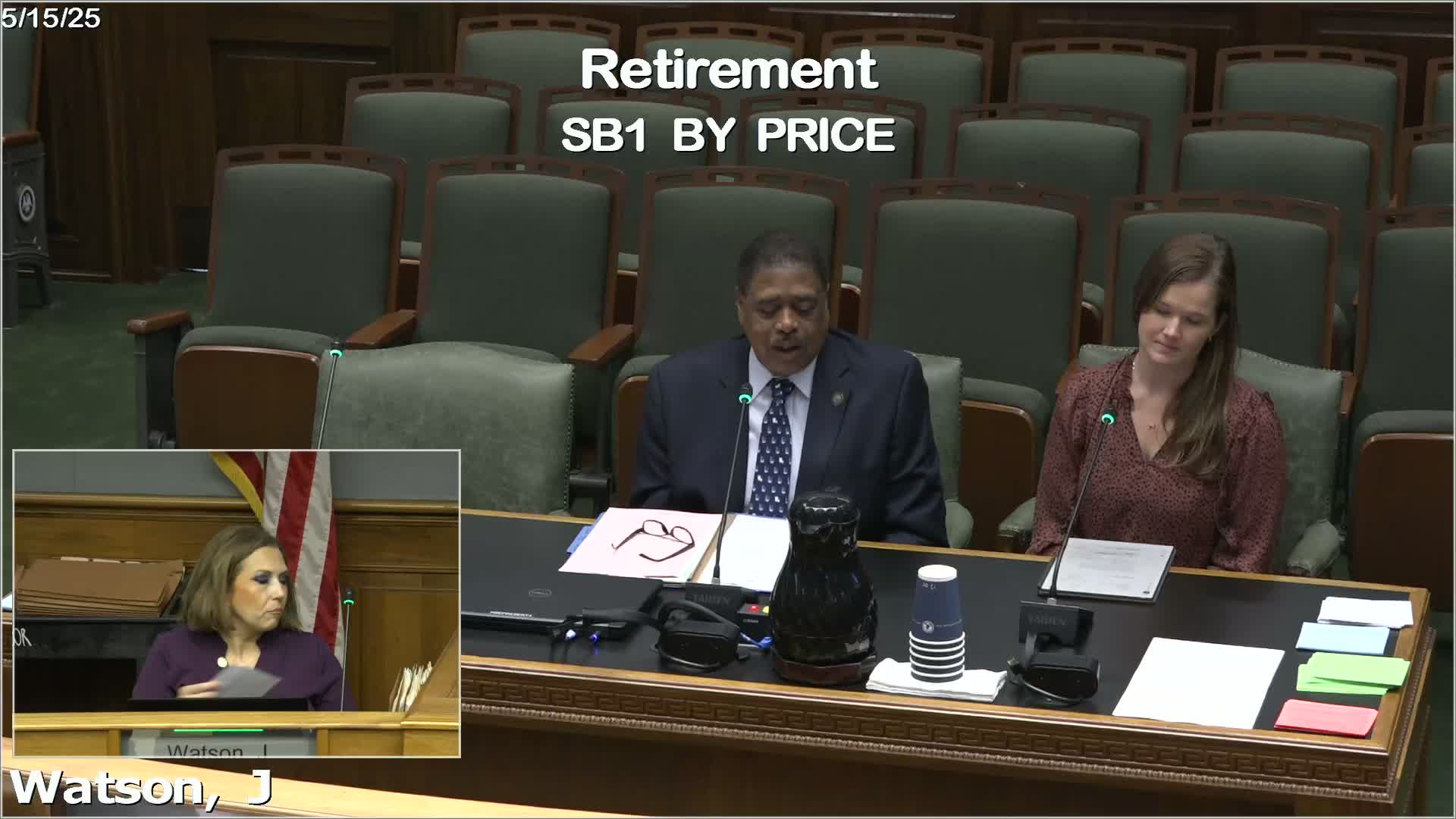
Senate Bill 1, presented to the House Retirement Committee on May 15, 2025, would permit Louisiana State Police Retirement System members to purchase actuarial service credit for prior full‑time law‑enforcement service outside Louisiana or with the federal government after six months of membership rather than the prior 10‑year requirement.
The change “mimics the transfer statutes,” said Margaret Michel, executive director of the Louisiana State Police Retirement System, adding the bill “actually removes a previous sunset” and is an actuarial purchase, not a transfer. Michel said the actuary will calculate each purchase “based on how far they are into their career, what is their current salary” and other individualized factors.
The committee heard that the state police have begun recruiting from outside Louisiana and have hired officers from other states; Michel said the system had two members from Mississippi in the last class and wanted to offer the purchase option to answer questions from recruits. Michel cautioned that the bill is not a transfer: whether an outside state will move employer contributions depends on that state’s laws — “it's gonna depend on Mississippi's laws, honestly,” she said.
Representative Thomas asked whether the purchase is on a sliding scale; Michel replied that each case is individualized and that members with different years of prior service would pay different actuarial amounts. At the appropriate time, Thomas moved to report the bill favorably, and with no objection the committee reported SB 1 favorably by voice consent.
The bill does not change how other states treat employer contributions when a member moves between systems; the committee recorded no roll‑call vote in committee, only the favorable report to the floor.