Get Full Government Meeting Transcripts, Videos, & Alerts Forever!
Get email alerts on the Rail Belt Governance topic
No spam. Unsubscribe anytime.
Senate committee hears history of Rail Belt reforms; gaps remain in transmission development
Summary
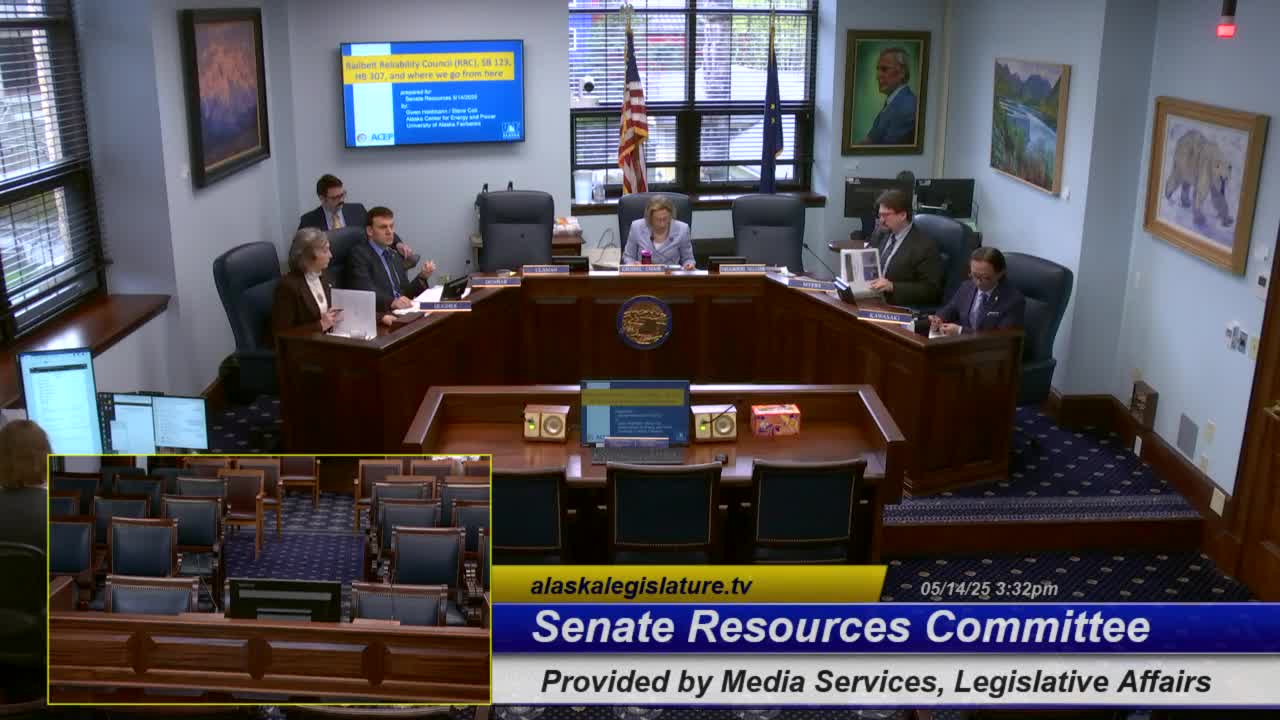
The Alaska Senate Resources Committee on May 14, 2025, heard a briefing on Rail Belt electric transmission governance from the Alaska Center for Energy and Power, which reviewed the creation and roles of the Rail Belt Reliability Council and the Rail Belt Transmission Organization and identified remaining gaps in systemwide transmission development.
The Alaska Senate Resources Committee on May 14, 2025, heard a briefing on Rail Belt electric transmission governance from the Alaska Center for Energy and Power, which reviewed the creation and roles of the Rail Belt Reliability Council and the Rail Belt Transmission Organization and identified remaining gaps in systemwide transmission development.
The presentation matters because the Rail Belt system’s governance determines how transmission costs are allocated, how reliability standards are set and whether low-cost generation can be dispatched across the region — issues that affect ratepayers, utilities and prospective independent power projects.
Presenters Gwen Holdman, chief scientist at the Alaska Center for Energy and Power, and Steve Colt, research professor at the same center, traced a sequence that began with heavy investment in generation between about 2010 and 2015 (a figure of roughly $1.5 billion was cited in a 2015 letter from RCA Chairman Pickett). That spending, Colt said, prompted the Regulatory Commission of Alaska (RCA) to recommend broader regional coordination including an independent transmission company, regional siting authority and regional planning. "This this was a big deal in the history of the rail belt," Colt told the committee.
The voluntary Rail Belt Reliability Council (RRC) formed by MOU in late 2019 to develop technical reliability standards and to coordinate integrated resource planning, Holdman said, but it does not operate the system, undertake economic dispatch or build transmission. "The RRC was established to fill essentially these two key functions: to develop and enforce the technical reliability standards for the rail belt grid and then to coordinate the integrated resource planning across the multiple utilities," Holdman said.
Colt and Holdman told the committee that the 2020 legislative package (SB123 and companion HB151) adopted three core elements the RCA had sought: authority to certify an electric reliability organization (ERO), statutory siting authority for the RCA, and RCA-regulated integrated resource planning for the Rail Belt. The presenters said those statutory changes formalized responsibilities but left other important functions unresolved.
House Bill 307 (enacted more recently) created the Rail Belt Transmission Organization (RTO) within the Alaska Energy Authority to administer an open access transmission tariff for the Rail Belt backbone. Holdman said the RTO’s current statutory role focuses on cost allocation and nondiscriminatory access; the RTO does not, in its present structure, make final decisions about development or construction of future transmission projects. The presenters noted that an RTO board working group has drafted a backbone definition and list of qualifying assets that the RTO board was scheduled to consider the week after the committee meeting.
Both presenters and committee members emphasized that the Rail Belt is primarily served by public power entities rather than investor-owned utilities, which affects governance choices. They also said a major merger — Chugach’s acquisition of the Anchorage municipal utility (discussed in the presentation as a factor in regional integration) — materially changed the ownership landscape and complicated voluntary pathways to economic dispatch.
The presenters identified a remaining gap in the Rail Belt governance structure: no single organization currently has clear responsibility for systemwide development and implementation of transmission projects. Holdman summarized that planning and reliability standards exist in law and practice, but "there’s really no organization that’s responsible for that particular function" of carrying plans into built projects. She and Colt said that additional legislation or implementation steps may be needed to close that gap.
The committee did not take formal action on policy at the hearing. Senators on the committee asked clarifying questions and were told the RTO is expected to assume operational control by July 2026 and that the RRC will continue developing reliability standards and IRP outputs. The committee chair, Senator Tara Giesel, said the committee would hear from the RRC board chair and CEO at its next meeting on May 16.
Background and next steps: the presenters urged the committee to monitor rulemaking and implementation of the statutes that created the RRC and RTO, including regulatory filings and RTO board decisions about the backbone asset list and revenue mechanism. They also noted that other jurisdictions (including Iceland’s LANDSNET, cited in the presentation) are sometimes referenced as comparative models for isolated systems.
(Reporting note: direct quotations are attributed to speakers who spoke on the record at the May 14 presentation.)