Get Full Government Meeting Transcripts, Videos, & Alerts Forever!
Get email alerts on the Oil Gas Tax Transparency topic
No spam. Unsubscribe anytime.
Committee hears bill to increase disclosure of oil-and-gas production tax data, proponents cite need for fiscal transparency
Summary
Representative Mears presented House Bill 206 to the House Resources Committee, proposing expanded disclosure of oil and gas production tax information. Proponents argued that Alaska’s net tax system creates volatility and that lawmakers need detailed, producer-level and monthly data to assess whether the tax regime meets policy goals.
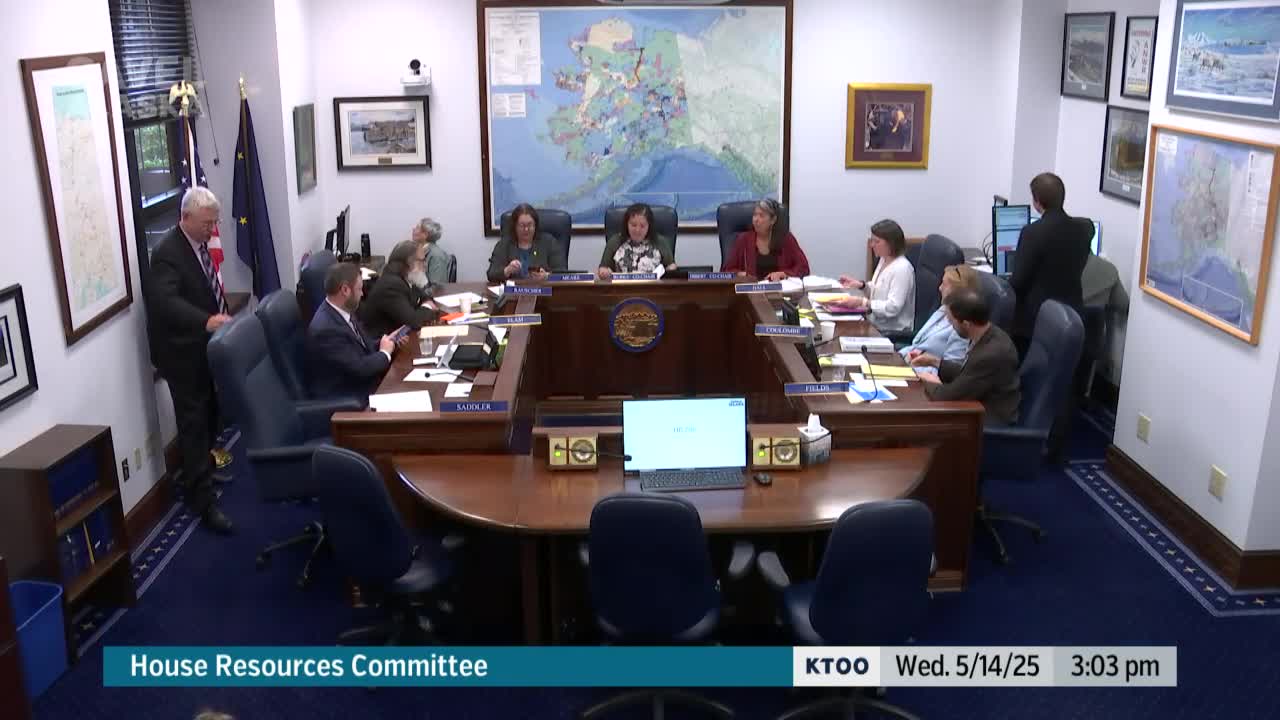
May 14, 2025 — House Bill 206, a measure to expand disclosure of oil-and-gas production tax information, received an initial presentation Wednesday before the House Resources Committee. Representative Mears and her staff said the bill aims to give legislators better access to data necessary to judge the effectiveness of Alaska’s tax policy.
Representative Mears told the committee the amount of oil flowing down the Trans Alaska Pipeline — not just the tax rate — is the single largest driver of state revenue from oil. "We need information to do our work, and we need greater fiscal transparency to do it," Mears said during the presentation.
Corey Alt, staff to Representative Mears, framed the bill against the state constitutional duty in Article VIII, Section 2 to manage natural resources "for the maximum benefit of its people," and described how Alaska’s net tax structure makes state revenue more sensitive to producers’ profitability than gross-severance systems used in other producing states. Alt showed comparative examples the committee could use to assess the effect of different price points and tax structures on state revenue: under a gross (severance) tax, a modest decline in oil price has a smaller effect on taxed value than under Alaska’s net system, where profit-driven deductions can produce sharper swings in taxable value.
Alt summarized the practical consequences: with Alaska's net system, a $5 decline in the per-barrel price in his hypothetical cut state revenue in half in that example, whereas an equivalent change under a gross tax produced a much smaller change in tax paid. He said the legislature lacks access to well-level, month-by-month production and value data by company that would permit lawmakers to evaluate whether the existing tax structure is meeting goals of promoting production, investment and competition.
Proponents said they have discussed information needs with industry and the Department of Revenue and are seeking a workable balance between transparency and protection of legitimate business confidentiality. Alt referenced past consultations with outside experts noting that tax systems should be designed around policy outcomes — such as promoting production and investment — and that revenue outcomes should be measured against those goals.
Committee action: The bill was presented for initial consideration and discussion; no committee vote or formal action on HB 206 was taken at the May 14 hearing. Sponsors said they will continue conversations with industry and the Department of Revenue and return to the committee for further action.
Discussion vs. decision: The hearing was presentation and discussion only. Committee members asked questions and asked staff to provide additional detail in follow-up sessions; no direction to draft amendments or votes were recorded during this meeting.
Ending: Representative Mears said she intends to continue stakeholder consultations and to bring additional detail to the committee in future meetings so the legislature can determine whether expanded disclosure is practical and whether statutory changes to title 43 or related law are needed.