Get Full Government Meeting Transcripts, Videos, & Alerts Forever!
Get email alerts on the Biomass Pellet Project topic
No spam. Unsubscribe anytime.
Residents raise health, carbon and forest-concern objections to proposed Golden State Natural Resources pellet plant
Summary
Multiple residents urged the Tuolumne County Board of Supervisors to reject or tightly condition a proposed Golden State Natural Resources wood-pellet project, citing the draft environmental impact report, cancer-risk estimates and concerns that the plant would rely on whole-tree harvests rather than clearing slash piles.
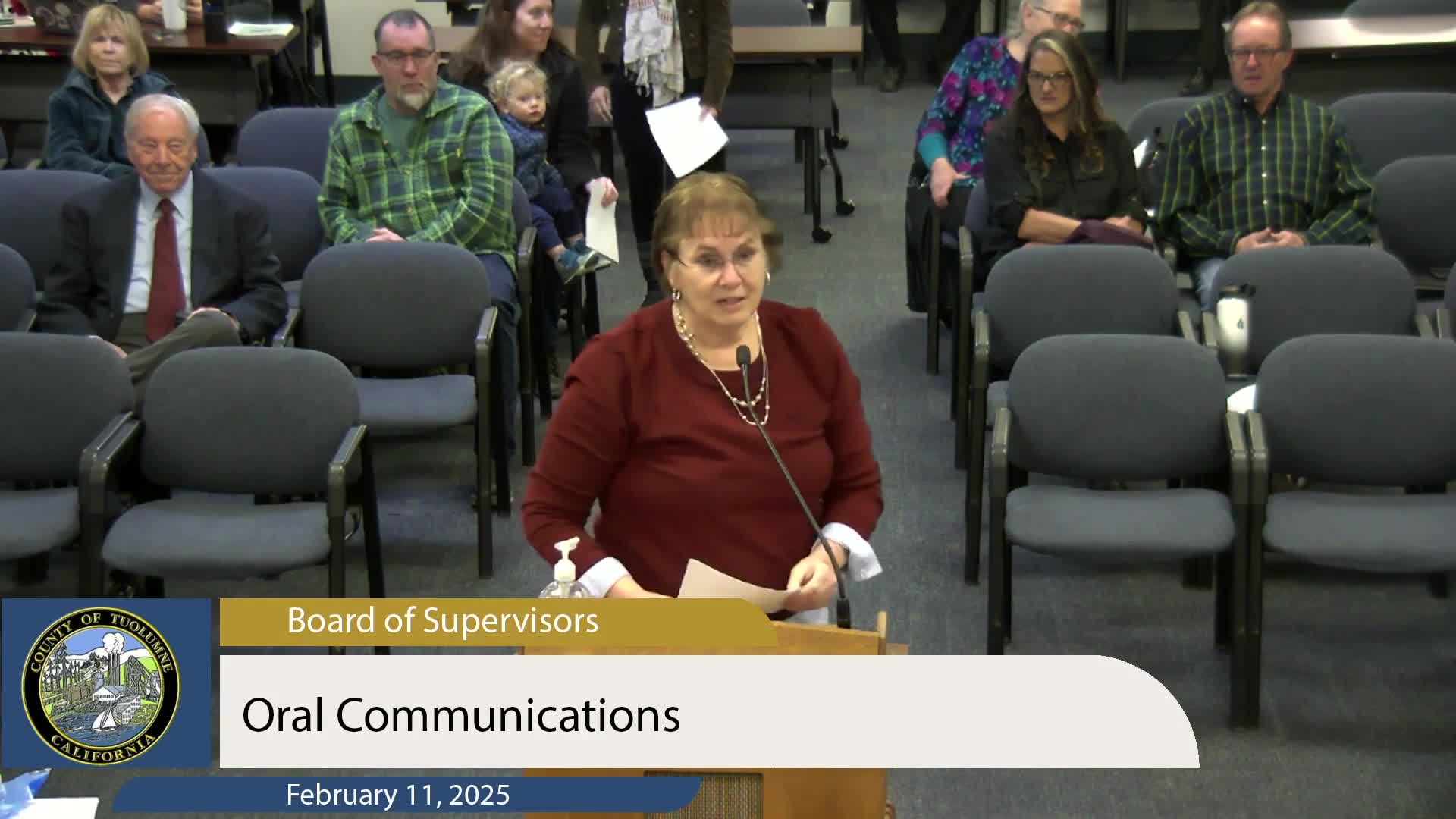
Dozens of residents told the Tuolumne County Board of Supervisors on Feb. 11 that a proposed Golden State Natural Resources (GSNR) wood-pellet project poses significant local health, climate and forest-management risks.
Speakers urged the board to reject the project or require enforceable, independently verified commitments from the developer. Elaine Hagan, a registered nurse who identified herself as a daughter of a logger, said she had read the project’s draft environmental impact report (DEIR) and concluded the project “is all risk and no reward.” She said the DEIR’s air-pollution analysis shows operations at two facilities would “exceed the [cancer] threshold by approximately 3 to 6 times.”
The speakers’ concerns mirrored three themes that recurred in public comment: (1) direct local health impacts from air emissions, (2) flawed claims that the project would reduce slash piles and (3) lifecycle carbon emissions from pellet production and export.
Residents described the DEIR as extensive but, in their view, inadequate. A commenter who identified herself as a resident and referenced international examples warned that industrial pellet standards exclude rotting material and most slash-pile debris, so the plant would likely rely on whole trees. She cited Smithers, British Columbia — where a pellet plant built with corporate partners later relied on whole-tree feedstock — as a cautionary example and said GSNR’s partner Drax has a history of regulatory violations. She urged “clear enforceable commitments and independent verification,” and said a plant should be shut down if commitments are broken.
Karen Johnson, who said she will become a parent in March, called the project “greenwashing” and highlighted a 20-year emissions figure disclosed in the DEIR: 1,900,000 metric tons of CO2-equivalent. “Any so-called fire mitigation plan that contributes to climate change ... isn’t a solution,” she said, and urged the board to reject the project.
Not every commenter opposed the concept. A speaker who identified himself as a timber faller and firefighter told the board that thinning and removing ladder fuels and some live trees are important for forest health and firefighter safety. He urged county support for biomass projects that “pay enough to get the fuels out of the forest and down the hill” and to retain local economic value.
County staff and board members clarified the current decision process. Quincy Yaley, community development director, said the Rural County Representatives of California (RCRC) entity and GSNR will initially administer environmental review and that future land-use entitlements and permits would come before the board. Acting County Administrator Roger Root confirmed the board serves in both executive and quasi-judicial roles for land-use matters and therefore must avoid prehearing statements about pending permits.
The board did not take formal action on the GSNR project during the meeting. Several residents requested strict contract terms, independent auditing of feedstock sourcing, and enforceable penalties if mitigation commitments are not met.
Members of the public who asked questions at the meeting were told that any eventual land-use entitlements would return to the board for hearings and that staff could provide additional procedural information in advance of those hearings.
Ending: The board heard extended public comment but made no decision; staff said any required land-use entitlements and permits would return to the board at a later date for formal consideration.