Get Full Government Meeting Transcripts, Videos, & Alerts Forever!
Get email alerts on the Governance Manual topic
No spam. Unsubscribe anytime.
Supervisors adopt revised governance manual after hour‑long line‑by‑line review
Summary
Following a line‑by‑line review, Tuolumne County supervisors approved edits to the board governance manual and set a five‑year formal review cadence for the next revision cycle.
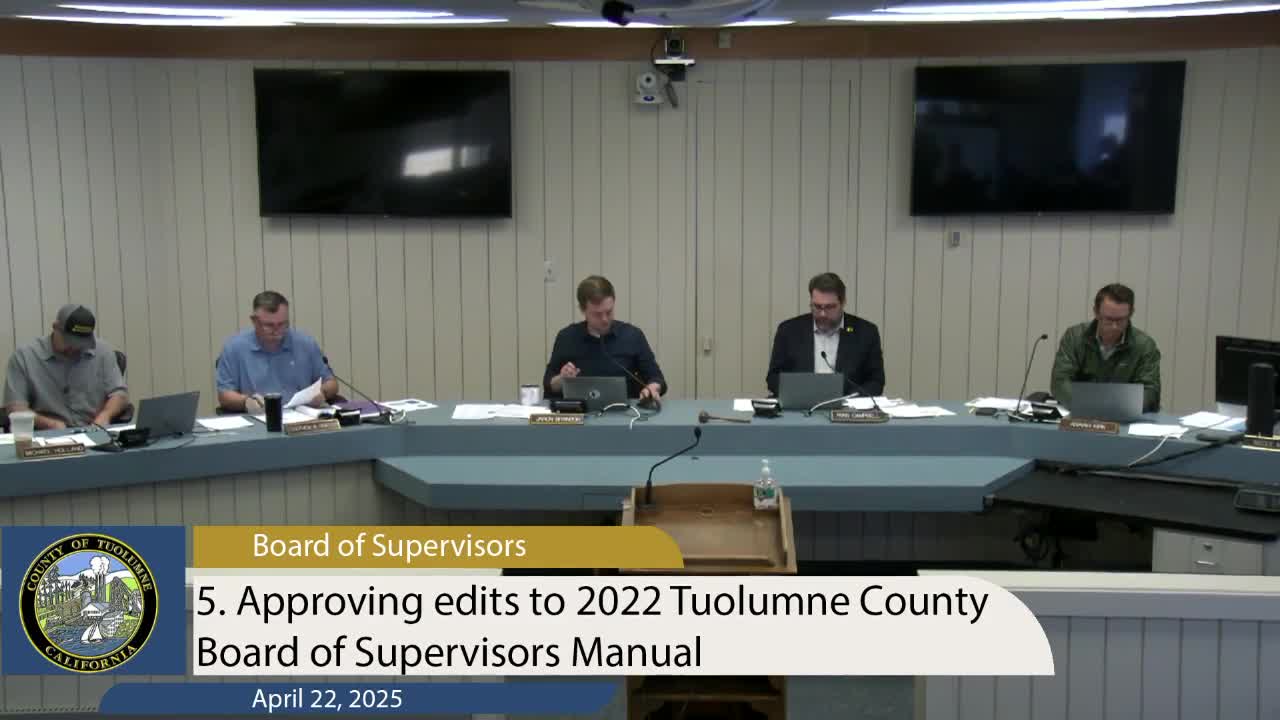
Tuolumne County supervisors reviewed and approved proposed edits to the county Board of Supervisors governance manual on April 22 after a lengthy, clause‑by‑clause discussion.
Heather (last name not given), a county staffer who led the session, presented a consolidated list of clerical edits and a set of policy‑level questions for the board. Supervisors debated several procedural points — how frequently to review the manual, whether to formalize onboarding and board‑request procedures, rules about staff and department reports, time limits for presentations and public comments, and how the chair may manage members who go off topic.
Key outcomes: the board agreed that the manual should be reviewed every five years; it declined to adopt a strict annual review requirement. The board kept current image/logo options unchanged. It asked staff to clarify that written correspondence to the board will not ordinarily be read aloud during meetings but that written comments received before or during public hearings will be included in the administrative record for those hearings. The board also directed staff to update governance language to reflect its recent practice of providing project and priority updates three times per year rather than annually.
On the board‑request protocol — a mechanism that allows a single supervisor to request that an item be added to a future agenda — supervisors debated keeping a trimmed procedure versus eliminating it entirely and replacing it with a clarified pathway to request items during reports. The board elected to remove the existing board‑request protocol from the manual and to clarify that supervisors may recommend future agenda items during the reports portion of a meeting, so long as follow‑up is coordinated through the CAO’s office.
At the end of the session the board voted unanimously to approve the staff‑compiled edits.
Why it matters: The governance manual codifies how the board operates in public meetings and clarifies expectations of staff, meeting cadence and public‑participation procedures. The board’s decision to formalize a five‑year review cadence aims to strike a balance between institutional stability and periodic updates to reflect practice.
Ending: Staff will publish the updated governance manual and implement the clarifications. The board asked staff to return with any items that require future legal or procedural clarification.