Get Full Government Meeting Transcripts, Videos, & Alerts Forever!
Get email alerts on the Upe 70112 Revocation Appeal topic
No spam. Unsubscribe anytime.
Board delays final decision on Copper Hill batch-plant permit after lengthy appeal and straw vote to reverse revocation
Summary
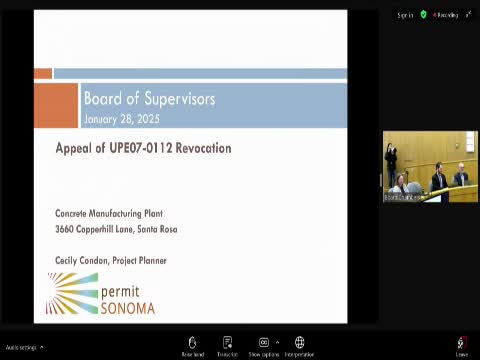
The Sonoma County Board of Supervisors paused a final decision on revocation of Use Permit UPE 70112 for a concrete batch plant at 3660 Copper Hill Lane, taking a nonbinding straw vote to reverse the Board of Zoning Adjustments revocation and continuing the matter to Feb. 11 so staff can draft a resolution.
The Sonoma County Board of Supervisors did not issue a final ruling on an appeal of a revocation of Use Permit UPE 70112 for a concrete batch plant at 3660 Copper Hill Lane. County staff recommended denying the operator’s appeal and upholding a March 28 Board of Zoning Adjustments (BZA) decision to revoke the permit for long‑running noncompliance; the board instead made a nonbinding straw motion to reverse the BZA revocation and continued the item to Feb. 11 so staff can prepare a resolution reflecting the board’s direction.
The dispute centers on a 1.24‑acre approved project area historically used for a concrete batch plant and associated mobile office and truck storage. Staff’s report summarized a decade of code‑enforcement history, including recorded notices of violation beginning in 2011; it stated that pre‑operational conditions of approval were never fully satisfied and that the BZA found ongoing violations and a public-nuisance condition warranting revocation. Staff recommended the board deny the operator’s appeal and characterized the revocation as an enforcement action exempt from CEQA.
The permit holder, Farrow Ready Mix, and its counsel argued the county repeatedly prevented the operator from coming into compliance — including a disputed period after the operator filed an appeal — and cited a court finding by Judge DeMaio that, in litigation between the operator and the property owner, the operator had exercised diligent efforts and spent substantial sums in reliance on the permit. Attorney Tina Wallace and the operator’s representatives told the board Farrow had spent about $2 million in hard costs plus additional soft costs pursuing compliance and that many permits and mitigation payments have since been submitted.
The property owner, CMS Properties, disagreed. Counsel for CMS said the operator knew of code violations when it leased the property, described seven years of noncompliance, and supported the BZA’s revocation decision. CMS asked the board to either uphold the revocation or require that operations cease until full compliance is achieved by a date certain.
The public record and testimony included technical submittals from civil and structural engineers, a demolition permit, a sewer permit, evidence of some mitigation‑fee payments, and a December 2023–2024 timeline of filings. Operator witnesses and employees said building permits and plan checks were submitted and — in the operator’s view — largely cleared, but county planning staff indicated two remaining building permits require site-plan adjustments to align with the original UPE site plan and environmental review before issuance.
Board members questioned both sides about the timeline and the impact of parallel litigation between the operator and the landlord. Supervisor Gore noted the unusual presence of a court decision endorsing some findings of diligence and asked whether that influenced the planning record at the BZA hearing. County staff confirmed parts of the work had been submitted after the BZA hearing and that, from a building‑permit plan‑check standpoint, many technical reviews are complete, but planning must verify that the permits conform to the use permit site plan before final clearance.
Supervisor Gore moved to reverse the BZA revocation and direct staff to prepare a resolution consistent with the board’s direction; Supervisor Hermosillo seconded. Staff said it did not have a ready resolution for immediate adoption and requested time to draft one; the board agreed to continue the matter to Feb. 11 on the consent calendar so the resolution can be circulated. Supervisors indicated, during the hearing, that county staff and the operator should continue to work in good faith on outstanding items during the continuance; staff told the board they can process outstanding permits once an updated site plan is submitted that conforms to the approved UPE.
The hearing included multiple public commenters: employees who said revocation would cost local jobs, the operator’s manager and attorney describing compliance work completed or in progress, and the property owner’s representatives urging the board to enforce conditions and to halt operations until full compliance. Several technical consultants testified they had submitted structural and engineering documentation.
Ending: The board left the revocation formally undecided. It took a straw vote in favor of reversing the BZA decision, but because staff did not have a resolution ready the matter was continued to Feb. 11 for formal action and for staff to prepare a resolution memorializing the board’s findings and conditions. The board directed staff to continue processing permits but noted any outstanding site‑plan discrepancies must be resolved before final building‑permit issuance.