Get Full Government Meeting Transcripts, Videos, & Alerts Forever!
Get email alerts on the Housing Homelessness topic
No spam. Unsubscribe anytime.
Tuolumne County staff outline progress, funding gaps on housing and homelessness projects
Summary
County Health and Human Services summarized operational and in‑development housing projects — including a navigation center, sanctioned camping pilot, transitional housing trailers and several county‑owned properties — and said funding reductions and grant deadlines create uncertainty for completion timelines.
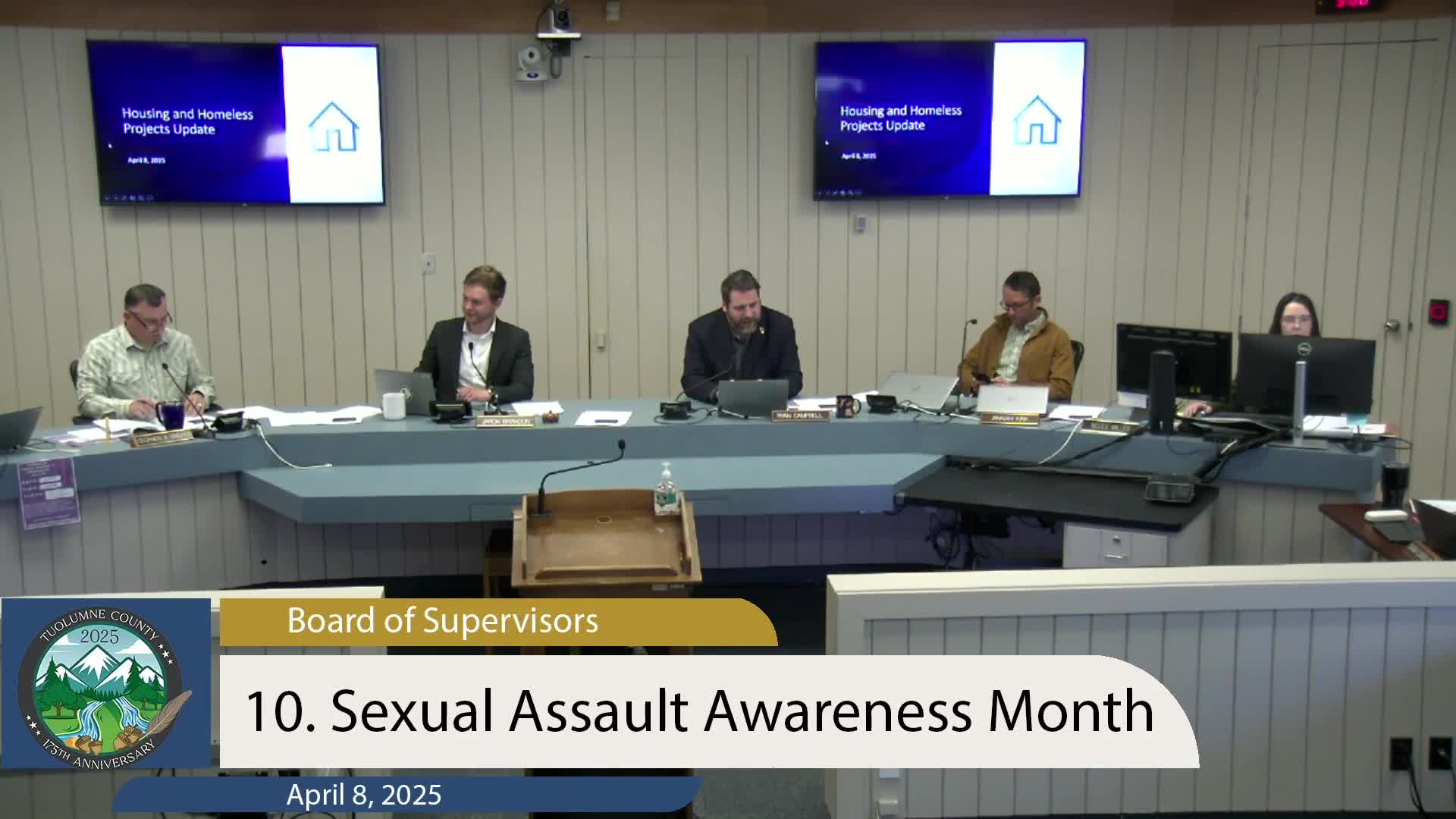
Tuolumne County staff told the Board of Supervisors they have made measurable progress on a set of housing and homelessness projects approved in late 2022, but warned state and federal funding cuts and near-term grant deadlines leave some planned sites at risk.
The presentation, delivered by Health and Human Services Agency Director Annie Hockett and Behavioral Health Director Tammy Mariscal, said operational programs include the county’s sanctioned camping pilot (Camp Justice), the navigation center (Rafferty Court), a small fleet of refurbished RVs for transitional housing and Parrott’s Ferry, a county‑owned supervised housing site purchased and opened in 2024. Other properties purchased with encampment‑resolution (ERF) dollars — Snell Street, Highway 108 and Columbia Way — remain in development. Hockett said Snell Street is close to construction completion and may be brought back to the board for formal approval to proceed; Highway 108 requires more work to bring it to permit readiness, and Columbia Way is being evaluated to confirm program design and funding options.
Why it matters: County leaders said the projects form a “continuum of care” intended to move people from street homelessness into stable housing, but cautioned that the state’s shifting funding priorities and the grant rules tied to ERF could force the county to return funds if projects don’t reach required milestones. Staff asked the board for clear direction about priorities and for time to work the remaining permitting, partnerships and financing questions.
What staff reported
- Camp Justice (sanctioned camping pilot): Approved as a one‑year pilot, the site has exceeded early utilization estimates. Staff reported roughly 122 unduplicated users since opening and a current population of just over 50. The sheriff’s office and county staff jointly manage on‑site safety and have trespassed 17 individuals for rule violations. Known ongoing monthly costs cited by staff included water and port‑a‑potty service; staff forecast roughly $2,500/month in basic operating costs and said the Homeless Services Committee will bring a set of recommendations for sustaining the pilot.
- Navigation center (Rafferty Court): The county opened family and non‑family buildings in Soulsbyville; Hockett reported a current census of 21 residents (10 children) and 11 exits, 10 of which were into permanent housing. Staff said funding is in place for several years of operations, and they are exploring additional fiscal supports.
- Transitional housing (trailers/RVs): Seven FEMA‑style trailers were refurbished and placed into use as an interim housing option shared between Behavioral Health and Social Services; staff stressed trailers are not a long‑term housing solution but have helped increase capacity.
- Parrott’s Ferry: Purchased with state Behavioral Health Bridge Housing funds and rapidly stood up, the Parrott’s Ferry site is open at full capacity. Mariscal reported 11 tenants had exited into permanent housing and that behavioral health has placed housing staff on site (a housing manager and two case managers) and added treatment supports.
- Snell Street and Highway 108: Both purchased with ERF dollars, Snell Street — two homes totaling six bedrooms — is nearly construction‑ready and could come to the board for contractor authorization. Highway 108, acquired as a motel/housing site, has an architect’s estimate near $1.9 million for work; county staff said additional funding sources (CDBG and other grants) were expected to help close gaps. Staff emphasized ERF rules and the timing of allowable expenditures require confirmations from the state.
Funding risks, state rules
Staff walked the board through how Behavioral Health Services Act funds (Prop 1) now include a housing category that can sustain housing operations but carry planning and community‑input requirements. They also identified ERF (Encampment Resolution Fund) and federal/state reductions as a risk: if a funded project is not completed within program deadlines, the county may be required to return some funding. Director Hockett said county staff, led by the CAO’s office, had a meeting set with the state to seek clarity on permissible flexibility and timeline extensions.
Public comment and community partners
Multiple nonprofit and service‑provider speakers urged the board to keep funded programs running and to expand services. Representatives from local service providers — including a residential recovery center and volunteer groups — told supervisors demand exceeds supply; several offered that repurposed motel rooms and rapid stand‑up approaches could provide immediate capacity if funding and permit obstacles can be resolved quickly.
What the board asked staff to do
Supervisors asked staff to return with a more discrete timeline and a recommendation for each county‑owned property: whether to proceed to construction, seek alternative uses, or pursue sale or lease options. Several supervisors requested a special workshop dedicated to these properties and the financial risks, with a focus on: 1) projected completion timelines for Highway 108 and Snell Street; 2) the state ERF deadlines and options to pare or swap project elements; and 3) operational cost estimates per site so supervisors can weigh tradeoffs. The board directed staff to schedule a focused session in May to walk through project budgets, grant timelines and contingency plans.
Ending note: County staff said they will continue the current work to keep programs running and pursue complementary funding (CDBG, opioid settlement funds, HHAP), but stressed that timetables and flexibility from state grant administrators will shape whether some sites can be completed on the current schedule.
Sections: {"lede":"Tuolumne County staff told the Board of Supervisors they have made measurable progress on a set of housing and homelessness projects approved in late 2022, but warned state and federal funding cuts and near‑term grant deadlines leave some planned sites at risk.","nut_graf":"County leaders said the projects form a 'continuum of care' intended to move people from street homelessness into stable housing, but cautioned that the state’s shifting funding priorities and the grant rules tied to ERF could force the county to return funds if projects don’t reach required milestones.","ending":"Supervisors asked staff to return with project‑level timelines and a recommendation on whether to proceed, pause or re‑scope county‑owned sites; staff were directed to schedule a focused follow‑up in May."},