Get Full Government Meeting Transcripts, Videos, & Alerts Forever!
Get email alerts on the Cdbg Funding topic
No spam. Unsubscribe anytime.
Tuolumne County hears CDBG strategy, warned food‑bank aid likely delayed until 2026
Summary
County staff outlined how Tuolumne can pursue federal Community Development Block Grant funds and said a missing financial audit will keep the county ineligible for the next (June) NOFA; local food‑bank leaders were told the earliest new CDBG awards the county could apply for would be January 2026, with contracts likely issued many months later.
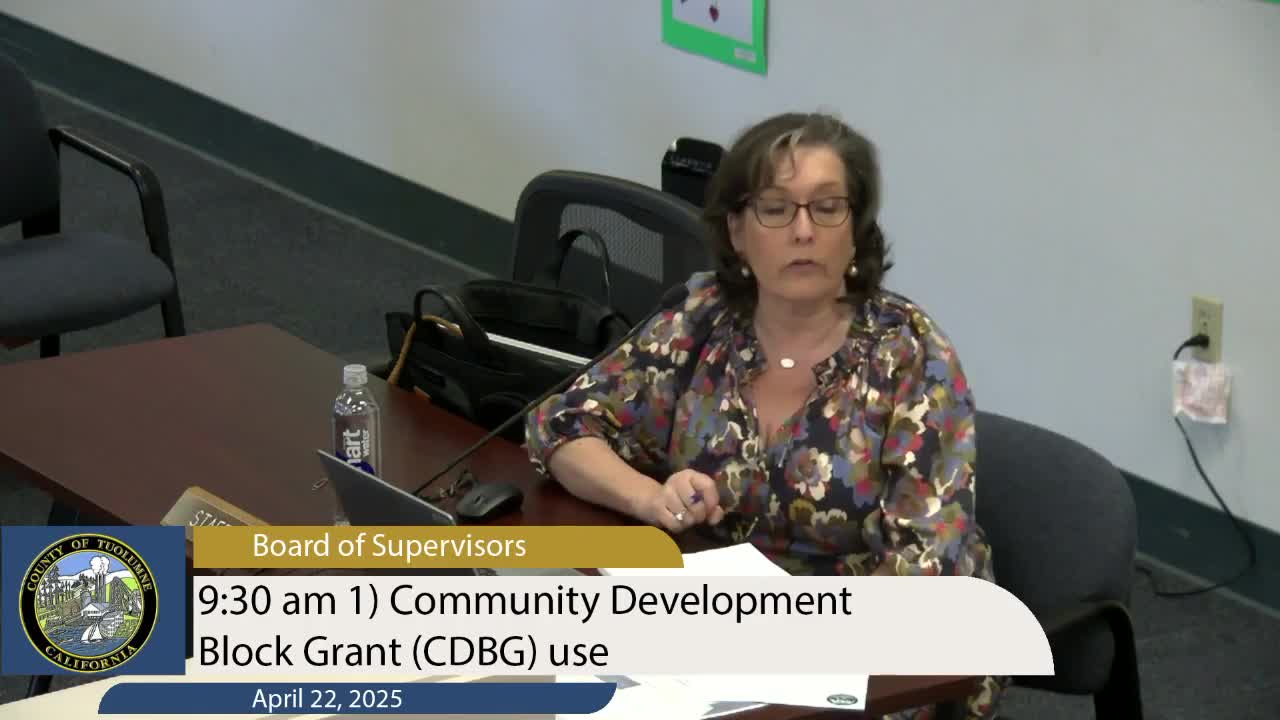
Tuolumne County officials spent the April 22 supervisors meeting reviewing how the federal Community Development Block Grant (CDBG) program works and what the county must do to remain competitive for funding.
The county’s CDBG consultant, Lori (last name not given), told supervisors the state has indicated Tuolumne could access about $3.6 million per year under the upcoming consolidated plan and that program income and competitive notices of funding will continue on an annual cycle. She said CDBG scoring favors applicants who have signed contracts with subrecipients and who demonstrate other leveraged funding, and she cautioned that the state’s timelines and rules frequently change from HUD’s federal regulations.
The presentation highlighted several immediate constraints for Tuolumne: the county’s financial audits are behind, and state program requirements mean the county is not eligible for the CDBG notice expected this June. Lori told the board the next CDBG NOFA the county could realistically apply for is currently expected in January 2026, with contract awards and execution likely several months after that.
That timeline has direct consequences for community services. APCA/ATCA — the nonprofit that runs the local food bank — told supervisors earlier in the meeting that it has been using reserves to operate and is likely to exhaust them by year‑end. County Auditor‑Controller Donnie McNair and staff later said audit completion is the gating item: the county must finish fiscal year audits (FY22 and then FY23–24) before it can be eligible for some state CDBG cycles. McNair told the board the FY22 audit was expected to be finished within days at the time of the meeting and that staff were preparing RFPs to bring in auditors for later years.
Consultant Lori also reminded the board of technical grant details that shape local project choices: CDBG requires beneficiaries to be households at or below 80% of area median income (AMI) or to be in defined low‑to‑moderate income (LMI) areas; program rules limit public services to 15% of a grantee’s award; and some types of projects (for example, street or maintenance work) can be ineligible unless framed as replacements or improvements rather than maintenance. She noted program income (loan repayments on prior CDBG loans) is available for local reuse, with a program‑income account that the county controls and can allocate for small local loan programs or other uses.
Supervisors used the session to press staff for clarity and timing. Supervisor Campbell and others asked county staff to communicate the funding timing clearly to ATCA and other nonprofits so they can plan: staff indicated the county could not apply in June because of the audit status and that an application window in January 2026 would yield awards and contracts later in 2026. Supervisor Campbell asked staff to contact affected providers promptly to explain the timetable; Auditor‑Controller McNair said he would ensure audit scheduling and communicate with impacted organizations.
Why it matters: CDBG awards fund streets, water and sewer, housing rehab, economic development programs, emergency home hardening and social services. With roughly $3.6 million per year available to the county in the forthcoming consolidated plan, the county’s ability to compete — and to deliver follow‑on services such as the local food bank and transit service — depends on meeting state audit and readiness criteria and on projects’ technical readiness.
Ending: Consultant Lori and county staff said they will return with more targeted proposals and timelines. Supervisors asked staff to prioritize finishing audits and to communicate the projected grants timetable to local nonprofits and partner agencies so projects and services can plan for gaps in outside funding.