Get Full Government Meeting Transcripts, Videos, & Alerts Forever!
Get email alerts on the County Budget Fees topic
No spam. Unsubscribe anytime.
Board approves FY 2025–26 consolidated fee schedule, orders July 1 effective date
Summary
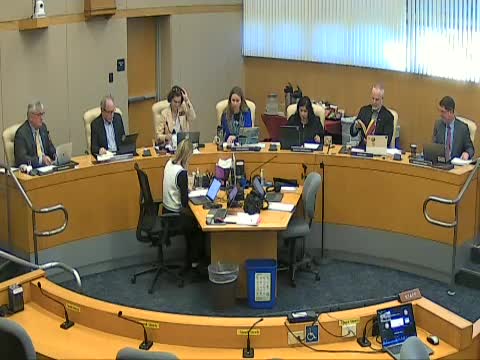
The Sonoma County Board of Supervisors on March 25 approved a consolidated fee schedule for fiscal year 2025–26, adopting hundreds of departmental fee changes that county staff said are intended mainly to better align user charges with the cost of providing specific services.
The Sonoma County Board of Supervisors on March 25 approved a consolidated fee schedule for fiscal year 2025–26, adopting hundreds of departmental fee changes that county staff said are intended mainly to better align user charges with the cost of providing specific services. The fee changes will take effect July 1 unless the board acts otherwise.
County budget staff presented the packet as a single consolidated hearing to increase transparency and allow departments to use fee approvals in the coming year’s budget. Peter Brueland of the CEO’s operations and budget team told the board the packet contains about 1,000 discrete fee lines because many fees are tiered by facility size or service level. He said more than 80% of fees rise by less than 4% and that the county’s average “cost-of-doing-business” number this year was roughly 3%.
Why it matters: Fees pay for services used by specific customers rather than general tax-supported services; increasing fees shifts some program costs to users and can reduce general-fund subsidies. Brueland said the packet’s estimated revenue if fee volumes match projections is about $2.6 million, with the largest shares coming from Permit Sonoma, the airport, and Regional Parks.
Key changes and department notes: Permit Sonoma — General fee increases around 3% with a few higher percentage changes noted as de minimis (small-dollar increments); new fees tied to state law TB38 (defensible-space inspections) and differentiated appeal deposits were included. Airport — public infrastructure staff said the airport operates as an enterprise fund and proposed increases for selected charges, with a median increase of roughly 6.5% across 28 adjusted fees; parking updates account for a significant share of projected airport revenue. Regional Parks — mix of new services, deleted obsolete fees and typical 3–6% increases on many items; marinas and Spring Lake (a Water Agency-managed facility) had separate line items. Veterans buildings — staff proposed short-term rental rate increases in the 10–50% range; staff said long-term leases would not be affected and existing bookings before an effective date would be honored. Sheriff’s Office — time-and-cost studies produced a mixed set of adjustments; the net estimated revenue change for Sheriff’s fee items in the packet was small.
Notable statutory and mandated fees: Brueland noted two state-mandated fees processed through the county for the Sheriff: the jail booking fee (allowed to increase by CPI plus 1% when the state fails to appropriate a jail management amount) and the jail access fee, which staff said is charged to arresting agencies when misdemeanor bookings exceed a three‑year average. The packet proposes a large increase to the jail access fee — an increase of roughly $730 over the existing amount — based on a multi‑year cost study and the fact the fee had not been updated substantially since 2019.
Sheriff Eddie Ingram explained the purpose of the jail access fee as a disincentive to unnecessary booking of nuisance misdemeanor cases that the law intends to be cited out rather than booked. The sheriff told the board that departments are notified monthly of their status relative to the three‑year average and that, as of the most recent month, no arresting agency had exceeded its three‑year average and triggered the fee. He also described the narcotics‑unit pilot’s recent seizures during a public report earlier in the meeting, saying, “That’s enough fentanyl to kill over 340,000 people,” to underline the drug‑enforcement rationale behind staffing priorities.
Board direction and follow-ups: Supervisors asked staff to return with more granular data and to keep working with an ad hoc on code enforcement to examine fee impacts on behavior, equity and access; Supervisor Raman and others stressed use of CPI as a common baseline for annual adjustments and suggested a fall update to allow deeper departmental reviews. Brueland told the board that the Department of Health Services had not completed its fee review in time for this packet and will come later. Staff also noted internal service rates (fleet, ISD, etc.) are still being finalized and that a second update this year is possible if needed.
Vote and next steps: The board approved the consolidated fee schedule (items 35–44) by roll call; the changes were adopted with an effective date of July 1, 2025. Staff will implement the adopted fee schedule, publish required notices, and return with any subsequent changes or late packets (for example, Health Services) if needed.